China’s economy slows to 4.3% as domestic demand weakens
China’s economy grew 4.3% in the second quarter, missing forecasts as weak household demand and an oil shock tied to the Iran war blunted stronger exports.
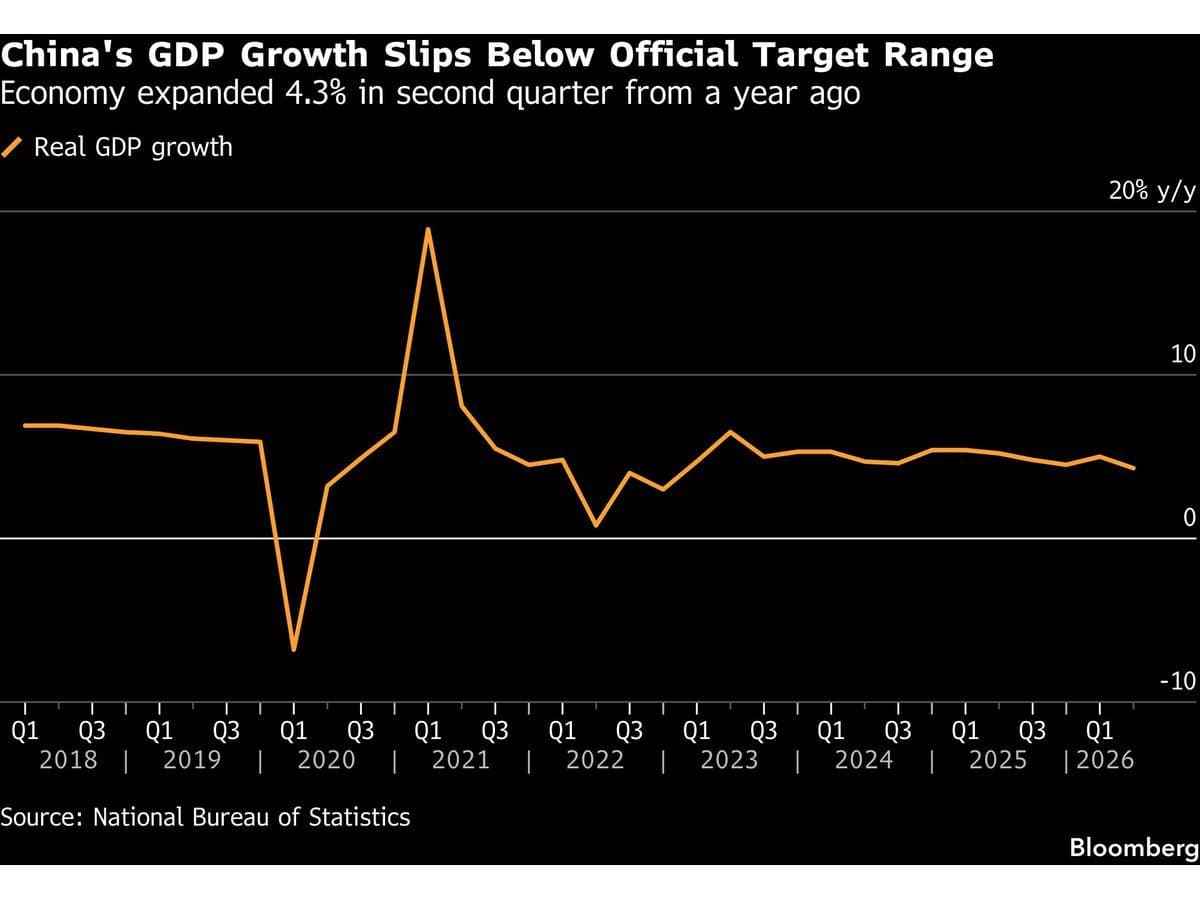
China’s economy grew 4.3% year on year in the second quarter, the slowest pace since the final quarter of 2022 and below economists’ expectation of 4.5%. The result showed how quickly domestic weakness is overtaking the country’s headline export strength, even as factories and overseas shipments continue to provide support.
The National Bureau of Statistics said output expanded 4.7% in the first half of 2026, reaching about 69.57 trillion yuan, or $10.25 trillion. But the quarterly breakdown pointed to a patchy recovery: June retail sales rose just 1.0% from a year earlier, industrial production increased 5.3%, and fixed-asset investment fell 5.7% in the first half, underscoring how cautious households and businesses remain.

The slowdown leaves China below its full-year target range of 4.5% to 5.0%, a goal Beijing trimmed in March to give policymakers more room as growth lost momentum. That range is already the least ambitious official growth target in decades, and the latest numbers show how hard it will be to stay inside it without more policy support.
The pressure is coming from several directions at once. A prolonged property slump has kept housing demand weak, consumers have remained hesitant to spend, and higher energy prices tied to the Iran war and broader Middle East disruptions have added to the strain. The World Bank said earlier this month that high-tech investment and exports were helping offset some of the domestic softness, but that the property sector was still adjusting and consumers remained cautious. It projected China’s growth at 4.4% in 2026 and 4.3% in 2027.
Economists are now watching Beijing for any response. Fresh stimulus is expected to be limited, with policymakers likely to lean more on fiscal measures than aggressive monetary easing. That leaves China’s near-term growth still dependent on exports and industrial output, even as the more fragile parts of the economy continue to lag.
This article was produced by Prism’s automated news system from verified source data, official records, and press releases, then run through automated quality and moderation checks before publishing. The system is built and supervised by the people who set the standards it runs under. Read our full AI policy.
Did this article answer your question?