China's Energy Strategy Positions It to Gain Most From Iran War Crisis
Beijing spent years quietly buying sanctioned oil, building pipelines, and electrifying its freight sector; now that Iran is at war, those moves are paying off in ways rivals cannot quickly replicate.
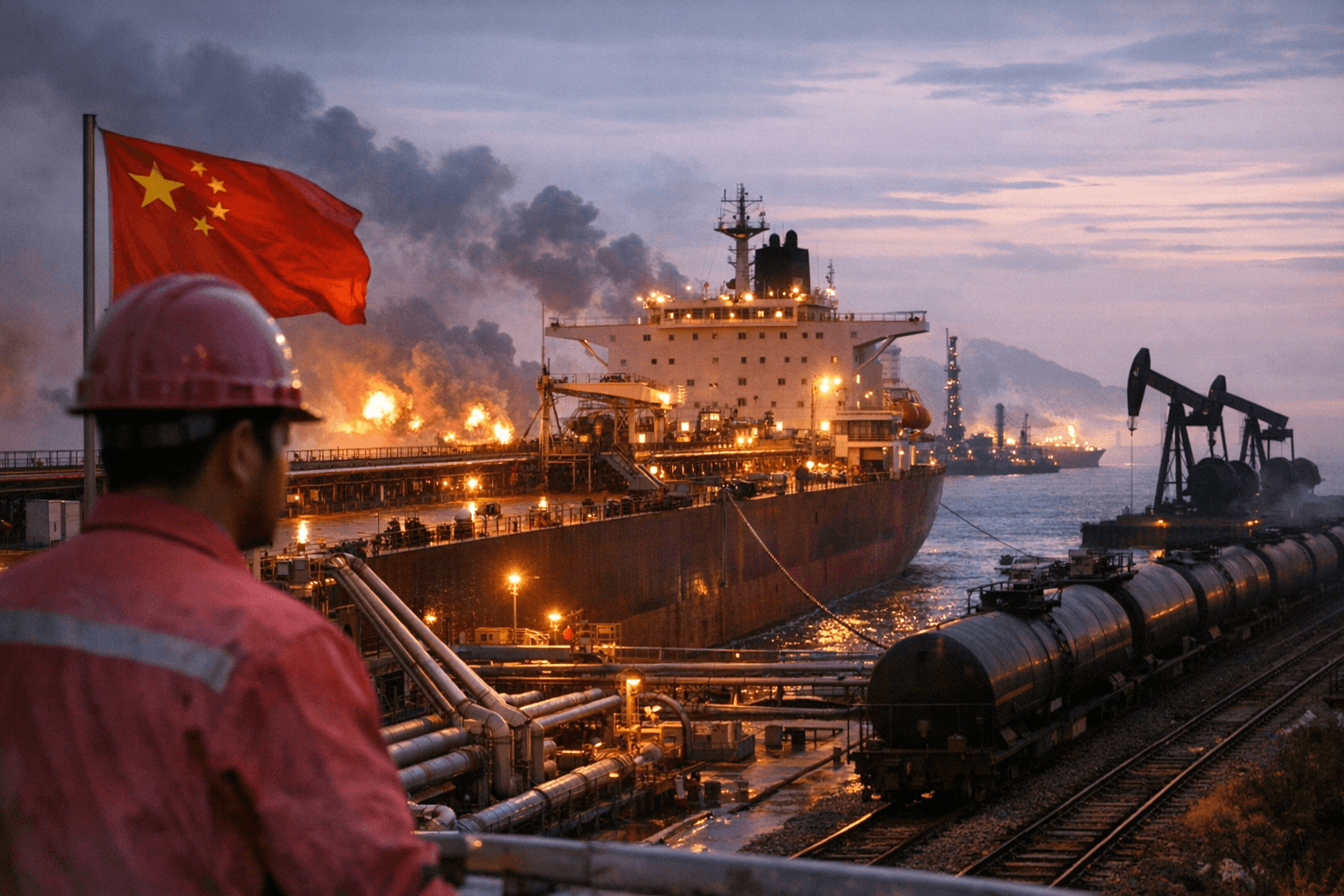
When U.S. and Israeli strikes hit Iran on February 28, global oil markets convulsed. Prices lurched past $100 a barrel, shipping insurers repriced Middle East risk overnight, and energy ministers from Tokyo to Berlin began emergency calls. Beijing's response was notably measured. That composure was not improvised diplomacy. It was the dividend of a decade-long strategic infrastructure campaign built specifically to absorb exactly this kind of shock.
A Relationship Built on Discounts and Dependency
The foundation of China's advantage sits in its bilateral energy relationship with Iran. By end of 2025, China was importing 1.4 million barrels of Iranian crude per day, representing 13% of its total 10.4 million barrel-per-day seaborne crude intake. The more striking figure runs in the other direction: China absorbs 80 to 90 percent of Iran's entire oil export volume, making Tehran's energy economy structurally dependent on Chinese demand. That dependency was formalized in the 2021 Iran-China 25-year cooperation agreement, which locked in roughly $400 billion worth of oil at below-market prices in exchange for Chinese investment in Iranian infrastructure and security cooperation, according to analysis from the Brussels-based think tank Bruegel.
Those below-market barrels were not simply consumed. According to a House Select Committee on China report, Beijing used a shadow fleet of tankers to purchase sanctioned crude from Iran, Russia, and Venezuela at a discount, with sanctioned oil accounting for approximately one-fifth of China's total crude imports. From those purchases, China assembled a strategic petroleum reserve estimated at roughly 1.2 to 1.4 billion barrels by early 2026, representing approximately 109 to 120 days of seaborne import cover, built at well below market cost. The United States Strategic Petroleum Reserve, by contrast, held only around 415 million barrels in mid-March 2026, roughly 60 percent of its capacity.
The Teapot Refinery Network
China's shadow-fleet purchases only work because of domestic infrastructure designed to process what mainstream Western markets refuse. The country's independent "teapot" refineries, small-scale operators concentrated largely in Shandong province, are less exposed to Western financial oversight and are engineered to handle non-standard, heavy, discounted crude that major state refiners avoid. As Al Jazeera reported, these teapot operators have become a critical cushion precisely because they can continue absorbing Iranian barrels even when sanctions pressure tightens around conventional channels. The financial mechanics of these arrangements are deliberately obscured: payments for sanctioned oil have been structured to avoid scrutiny, with cargo routed through ship-to-ship transfers in international waters and subsequently laundered through ports in Malaysia, the UAE, and Oman.
Russia Steps In as Iran Stumbles
With Iranian supply lines disrupted by the conflict, a structural pivot is already underway. Carnegie Endowment for International Peace analysis concluded that "the primary beneficiary is Russia, which is ready to increase oil exports to China." Russia was already among China's top crude suppliers in 2025, and the war in Iran removes one of the main competing discount-crude sources, potentially shifting more Chinese purchasing power toward Moscow.
What makes this relationship particularly revealing is the leverage China has already demonstrated. In early 2025, China purchased 11 percent less Russian crude by volume, while the value of those shipments fell by 24 percent, even as Russia's discount over international benchmarks was widening. China was extracting better terms from a supplier that has few alternative buyers. That dynamic is unlikely to reverse. Beyond Russia and Iran, China imported approximately 389,000 barrels per day of Venezuelan crude in 2025, another sanctioned-oil stream purchased at a discount through similar evasion infrastructure.
Routes Around the Chokepoint
About 40 to 50 percent of China's oil imports currently transit the Strait of Hormuz, a narrow waterway with Iran on one side and Oman and the UAE on the other. Iranian Foreign Minister Abbas Araghchi told NBC News that Tehran would not close the strait, but the waterway has nonetheless been disrupted by the conflict, forcing contingency planning across the region.
Beijing has spent years reducing its chokepoint exposure. The China-Pakistan Economic Corridor and the Myanmar-China pipeline were both designed partly as oil import alternatives bypassing the Strait of Hormuz entirely. Russia's Power of Siberia pipeline delivers Chinese energy demand from the north without any maritime exposure. On the Middle East side, three pipeline alternatives exist: Saudi Arabia's East-West Pipeline (the Petroline), the UAE's pipeline to Port of Fujairah, and an Iraqi pipeline. But these carry significant vulnerabilities of their own. In 2019, Houthi drones struck pumping stations on the Saudi East-West Pipeline, forcing a temporary shutdown and demonstrating that even land-based bypass routes are contestable. Iran's Jask Port and the UAE's Port of Fujairah can absorb some diverted volume, but analysts stress these alternatives would replace only a limited share of Hormuz throughput in a sustained crisis.
The Electric Truck Buffer No One Anticipated
Perhaps the most structurally significant factor in China's resilience is one that has nothing to do with crude oil supply chains at all. China's battery-electric heavy-duty truck market captured 22 percent of domestic heavy-duty truck sales in the first half of 2025, up from just 8.6 percent in the same period of 2024, according to the Institute for Energy Economics and Financial Analysis. The zero-emission medium- and heavy-duty vehicle market expanded 115 percent year-over-year in H1 2025, with sales of heavy trucks and tractor-trailers nearly tripling versus the same period a year earlier, per International Council on Clean Transportation data.
Nine Chinese manufacturers dominate this market, companies including Sany Group, China National Heavy Duty Truck Group, and Xuzhou Construction Machinery Group, while Western competitors remain marginal. Volvo sold just 5,700 electric trucks globally across six years, from 2019 through late 2025. Fleet operators in China are switching for straightforward economic reasons: electric trucks offer a 10 to 26 percent cost advantage over diesel and LNG alternatives. Bill Russo, founder and CEO of Shanghai-based advisory firm Automobility Limited, has noted that Chinese manufacturers "bring cost competitiveness, manufacturing know-how, and proven technology stacks" and "act as enablers for global fleet operators who want to decarbonize but lack local suppliers at scale."
The geopolitical significance is direct. As Chinese freight increasingly runs on electricity rather than diesel, the domestic demand for oil-based fuel is structurally declining at precisely the moment a war-driven energy shock is spiking global supply costs. A nation whose trucks burn electrons instead of refined crude is simply less exposed to the price mechanism through which energy crises transmit pain.
What the Shift Means for U.S. Allies and Global Inflation
The redistribution of advantage that emerges from this crisis runs sharply against U.S. interests and those of allied economies. Countries in Southeast Asia face what the Atlantic Council has described as potentially the largest energy shock of the modern era for the region. Europe, already strained by energy affordability pressures, is caught between the inflationary impact of elevated oil prices and the long-term demands of its energy transition. Japan and South Korea, both major oil importers without China's sanctioned-crude pipeline infrastructure, discount-oil reserves, or domestic EV freight buffers, face direct exposure to sustained price elevation.
Russia, meanwhile, gains a geopolitical windfall in addition to an economic one. With Iranian supply disrupted and Chinese demand stable, Moscow can sell more oil to Beijing, generating revenue that offsets some of the fiscal pressure from Western sanctions tied to the Ukraine war. China's willingness to exercise purchasing leverage over Russia, extracting deeper discounts even as it remains the indispensable buyer, reinforces a pattern where Beijing turns energy crises into structural bargaining gains rather than vulnerabilities.
The pattern visible across all of China's energy plays, discounted sanctioned crude, shadow fleet logistics, teapot refinery capacity, overland pipeline redundancy, and domestic EV truck adoption, is consistent. Beijing has spent years converting geopolitical instability into durable leverage. The war that disrupted Iran's oil sector did not catch China flat-footed. It arrived to find China already holding the stronger hand.
This article was produced by Prism’s automated news system from verified source data, official records, and press releases, then run through automated quality and moderation checks before publishing. The system is built and supervised by the people who set the standards it runs under. Read our full AI policy.
Did this article answer your question?