China’s EV makers accelerate exports as domestic price war deepens
China’s EV makers are exporting more cars and more industrial pressure as an 18% sales drop at home squeezes margins and pushes them abroad.
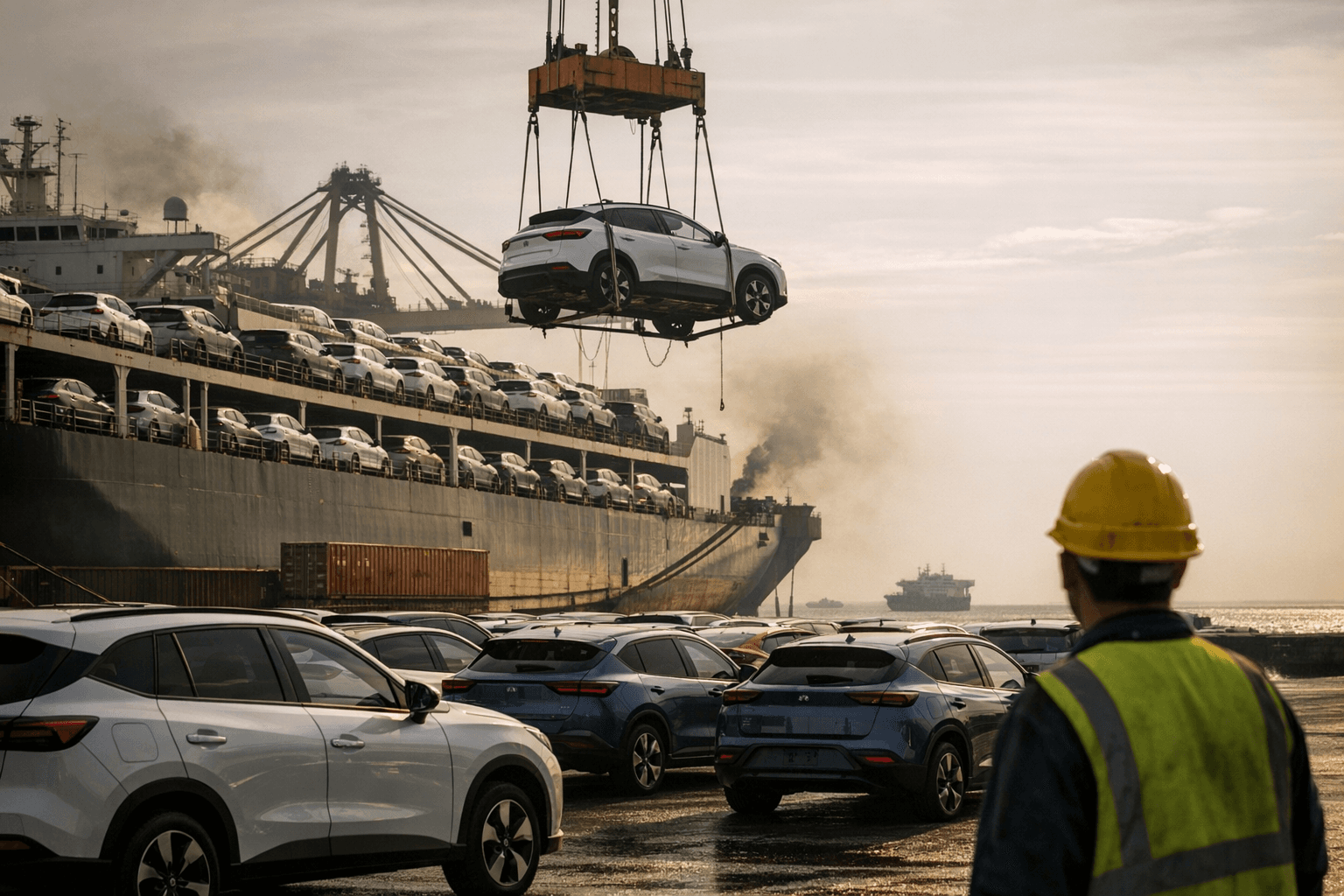
China’s electric-vehicle makers are pushing harder into foreign markets as a years-long price war at home leaves factories with too much capacity, weaker pricing power and shrinking margins. China’s car sales fell 18% in the first quarter from a year earlier, and that slump is forcing automakers to treat exports as one of the few reliable ways to keep volume growing.
The shift is already visible in the numbers. China exported 5.8 million cars last year, almost 20% more than the year before, and the China Association of Automobile Manufacturers expects vehicle exports to rise again to 7.4 million this year, up 4%. With the U.S. market largely closed to Chinese EVs, Europe, Latin America and Southeast Asia have become the main targets for expansion, even after European tariffs raised the cost of entry.
That overseas push is not just a sales strategy. It is a response to brutal competition at home, where years of discounting have eroded margins and made it harder for Chinese automakers to absorb the excess supply built during the domestic boom. Gartner analyst Pedro Pacheco said Chinese automakers have reached the point where it is no longer just about China and now need a roadmap for overseas deployment. The message is that the industry’s growth story is now tied to how much of its spare capacity it can move into foreign markets.
Europe has already begun to draw a defensive line. The European Commission adopted definitive countervailing duties on battery electric vehicles from China under Implementing Regulation (EU) 2024/2754, effective Oct. 30, 2024, after concluding that China’s BEV value chain benefits from unfair government subsidies that threaten EU producers. That sets up a broader trade confrontation as Chinese manufacturers try to turn low-cost engineering and scale into durable share abroad.
Xpeng is showing how far that ambition now reaches. The company said it expects large-scale flying-car production next year and humanoid robot production in late 2026. It has received more than 7,000 orders for flying cars and wants to begin robotaxi tests in Guangzhou this year. The strategy shows that China’s EV makers are no longer selling only cars. They are exporting an industrial model, and the rest of the world is responding with tariffs, scrutiny and a sharper defense of local manufacturing.
This article was produced by Prism’s automated news system from verified source data, official records, and press releases, then run through automated quality and moderation checks before publishing. The system is built and supervised by the people who set the standards it runs under. Read our full AI policy.
Did this article answer your question?