China’s live-fire drills surrounding Taiwan escalate cross-strait tensions
China conducted large-scale live-fire drills around Taiwan at the end of December 2025 into the New Year, simulating blockades and strikes and drawing a public rebuke from Washington. The maneuvers heighten geopolitical risk for regional trade routes and supply chains, complicate U.S.-China relations after a recent $11 billion arms sale to Taipei, and sharpen questions about deterrence and defense planning ahead of a Pentagon benchmark year.

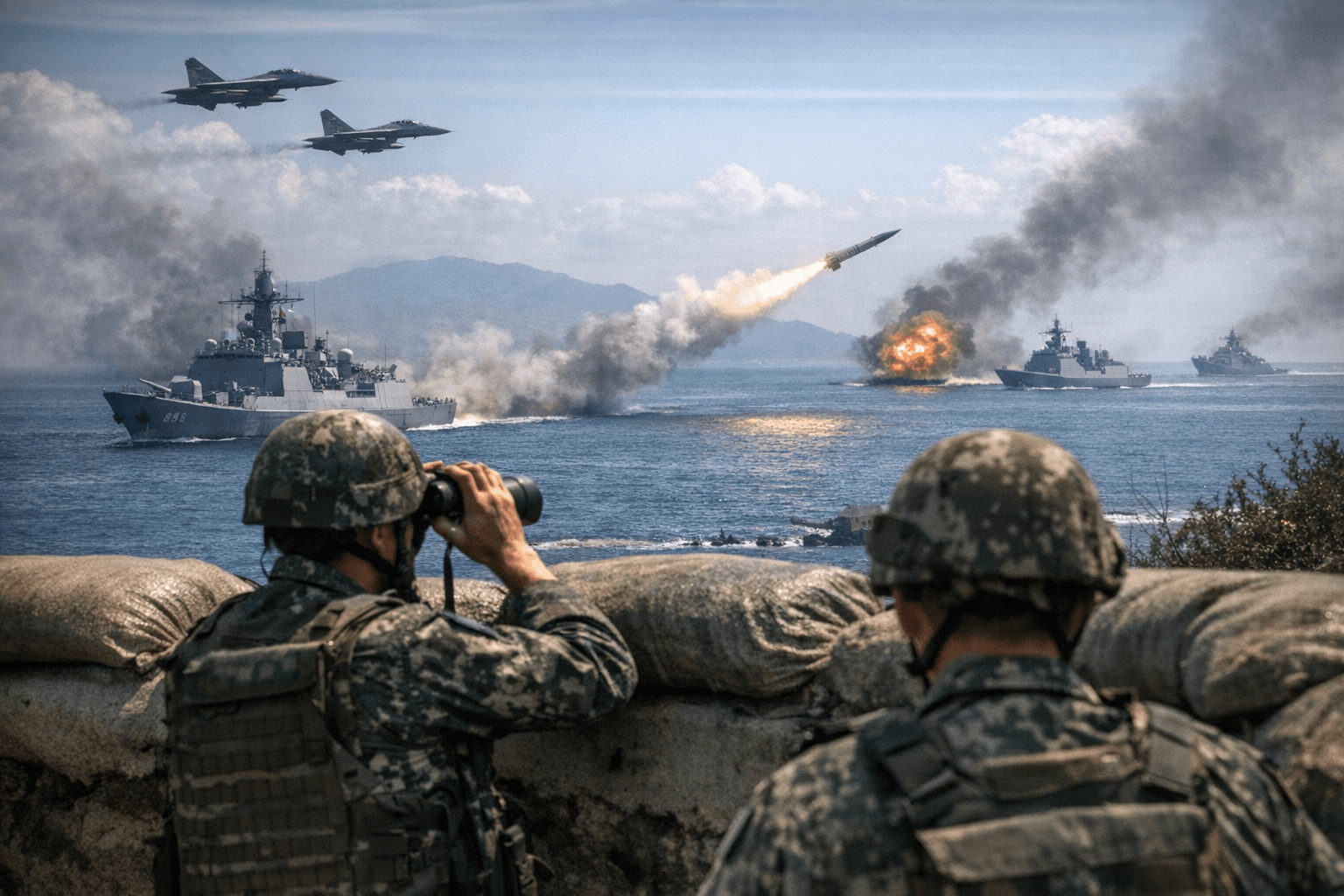
Chinese forces carried out extensive live-fire exercises around Taiwan at the end of December 2025 that continued into the New Year, deploying missiles, aircraft and a reported 19 warships to encircle the island. Beijing’s Eastern Theater Command described the operations on Weibo as a “shield of justice” and state statements called the drills a “stern warning” aimed at what China terms separatist forces. Chinese officials linked the escalation directly to U.S. support for Taiwan, citing a roughly $11 billion arms package approved by U.S. officials in December.
The exercises were described by Chinese authorities as simulating a total air and sea blockade, along with seizures and strikes on key infrastructure. Multiple outlets reported rockets were fired during the drills and that aircraft carriers such as the Liaoning and Shandong and other major surface combatants have been featured in past exercises, underscoring an expanding PLA toolkit that now routinely spans air, land, sea and rocket force elements. Analysts note the pattern of stepped-up activity has been apparent since 2022, with previous multi-domain drills including Joint Sword-2024A on May 23-24, 2024.
The U.S. State Department publicly urged Beijing to show restraint. State Department spokesman Tommy Pigott said China should “exercise restraint, cease its military pressure against Taiwan, and instead engage in meaningful dialogue.” U.S. officials characterized the drills as unnecessarily raising regional tensions, while President Donald Trump had said earlier in the week that he did not believe China planned an invasion of Taiwan in the near term. Meanwhile, the Pentagon’s late-2025 annual assessment warned that Chinese military modernization is approaching capabilities that could enable a cross-strait campaign as early as 2027, a planning horizon that has informed recent U.S. and allied posture adjustments.
For markets and regional economies the exercises raise immediate and longer-term risks. The Taiwan Strait is a critical artery for global trade and the locus of a high concentration of semiconductors manufacturing and advanced supply chains; disruption or the prospect of combat would translate into pronounced supply shocks for electronics industries and create upward pressure on insurance and freight costs. Defense procurement and regional military spending are likely to rise in response, supporting longer-term demand for materiel and sustainment. While direct market moves on Jan. 3 were mixed, strategists emphasize that geopolitical risk premiums typically boost volatility in Asian equities and can lift defense-related equities and sovereign bond spreads in more exposed economies.
Taipei responded with its own exercises and public readiness messaging, underscoring routine defensive preparations. For policymakers, the incident tightens a diplomatic knot: Washington faces pressure to deter escalation without provoking further drills, while Beijing signals it will punish perceived interference. The December-to-January maneuvers thus reinforce a broader trend in which routine signaling has migrated toward more complex rehearsals, complicating crisis management and raising the economic stakes for states and firms reliant on an open Indo-Pacific.
This article was produced by Prism’s automated news system from verified source data, official records, and press releases, then run through automated quality and moderation checks before publishing. The system is built and supervised by the people who set the standards it runs under. Read our full AI policy.
Did this article answer your question?


