China's Tightened Drone Rules Draw Complaints of Overreach From Pilots
China's new drone standards, effective May 1, require continuous flight data transmission to the state and have triggered fines, confiscations, and a sharp drop in commercial pilot work.
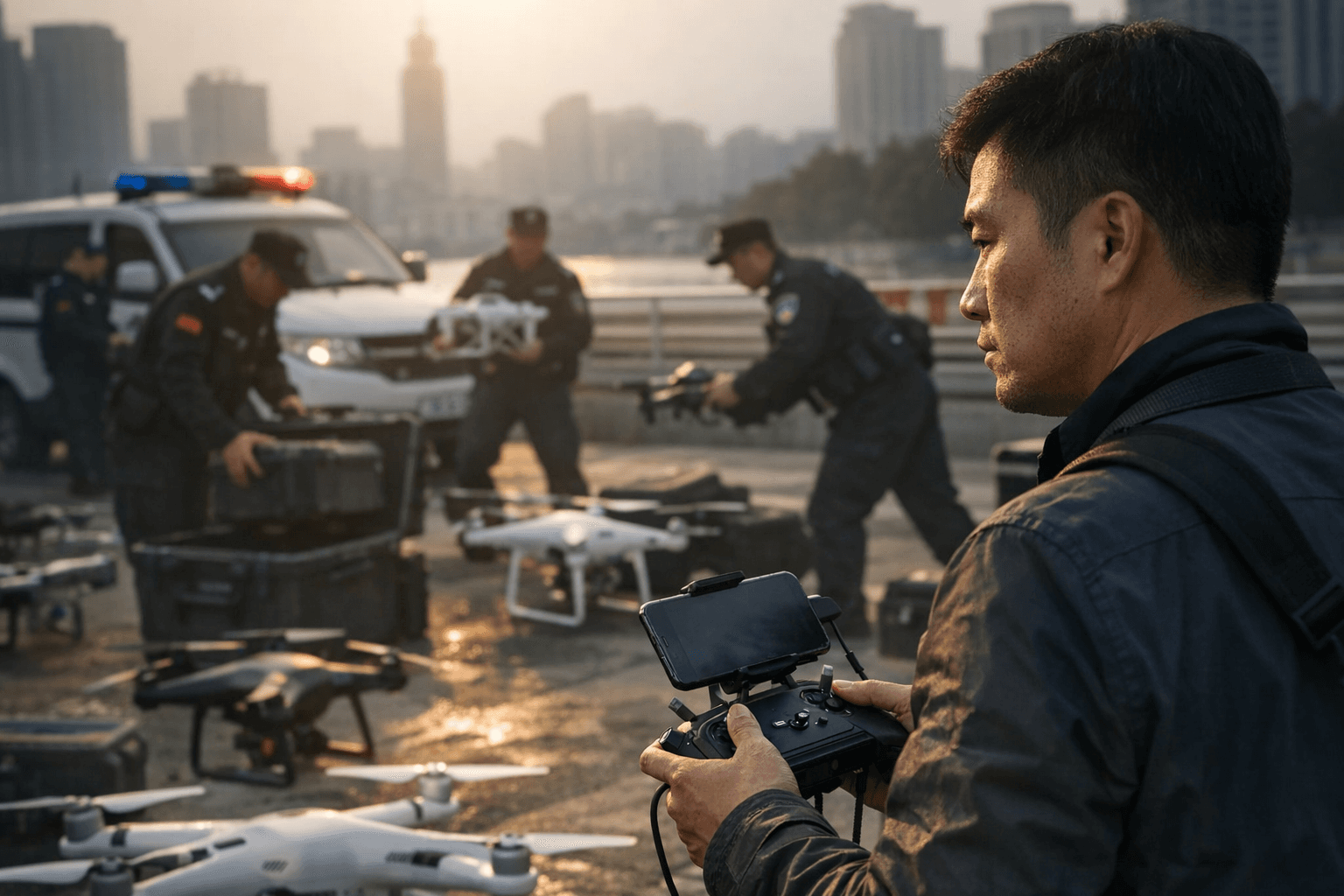
China's sweeping overhaul of drone regulation took a decisive turn this year, moving the country's booming low-altitude economy from loose administrative guidance into the full grip of aviation law, and the pilots, filmmakers, and logistics operators who built businesses around permissive skies are now absorbing the consequences.
The State Administration for Market Regulation approved two mandatory national standards for civil drones set to take effect May 1, 2026. The first requires all drones to be technically incapable of flight before activation and after deactivation, a hardware-level lock designed to prevent unauthorized use. The second mandates that every drone continuously transmit its identification, location, speed, and status data to regulatory authorities from the moment it powers on through the duration of any flight. Combined with a January 1 reclassification of drones as aircraft under national aviation law, and a revised Civil Aviation Law, approved by the Standing Committee of the National People's Congress and set to take effect July 1, the regulatory rollout is the most concentrated push for centralized drone control China has attempted.
A professional drone pilot identified as Nike, using a pseudonym, told the technology outlet 36Kr that the market has been in turmoil since the rules were finalized. Corporate clients, wary of regulatory exposure, have deprioritized freelance pilots for filming work, triggering what Nike described as a cliff-like drop in demand. Some pilots who failed to complete real-name registration have been fined or had their equipment confiscated.
The rules create friction at every level of the industry. Drones weighing 250 grams or more are subject to mandatory safety management and real-time location reporting once airborne. Micro drones are capped at a maximum altitude of 50 meters; light drones are limited to 120 meters. Critically, altitude is measured as true altitude rather than height above the launch point, meaning a pilot launching from the roof of a 100-meter building has only 20 meters of legal climb space remaining for a light drone. Flights in controlled airspace must be filed in advance through the UOM, China's national drone management platform. Major cities and historical sites are now restricted zones without special authorization, and older drone models lacking the required operational identification module may be permanently grounded.
The scale of what is being regulated is considerable. By the end of 2024, roughly 273,000 people held drone pilot licenses issued by the Civil Aviation Administration of China, and more than 2.17 million drones were registered nationwide. The Civil Aviation Administration recorded 9.82 million UAV flight hours in the first half of 2024 alone. The market is projected to reach 1.5 trillion yuan, equivalent to approximately $211 billion, with growth running at 33.8 percent year over year. In 2025, the drone sector was written into China's government work report and incorporated into the 15th five-year plan as an emerging industry slated for state-backed cultivation.
That dual posture, aggressive regulatory control alongside explicit industrial ambition, signals Beijing's intent to shape the global drone economy on its own terms. The revised Civil Aviation Law explicitly requires airworthiness certification for entities involved in the design, production, import, maintenance, and operation of civil drones, pulling the sector into a statutory framework not unlike what governs crewed aircraft. Where the FAA took years to implement a Remote ID standard in March 2024, and still contends with spotty manufacturer compliance, China's centralized data-transmission requirement bypasses voluntary adherence entirely. Whether that model accelerates the country's low-altitude economy or concentrates regulatory risk into a single point of failure will depend on how quickly 2.17 million registered operators can adapt to rules that treat every flight as a matter of state record.
This article was produced by Prism’s automated news system from verified source data, official records, and press releases, then run through automated quality and moderation checks before publishing. The system is built and supervised by the people who set the standards it runs under. Read our full AI policy.
Did this article answer your question?