Chinese Robot Wins Half-Marathon Faster Than Human World Record
A humanoid robot finished Beijing’s half-marathon in 50:26, topping the human world record and exposing both the pace of China’s robotics advance and its limits.
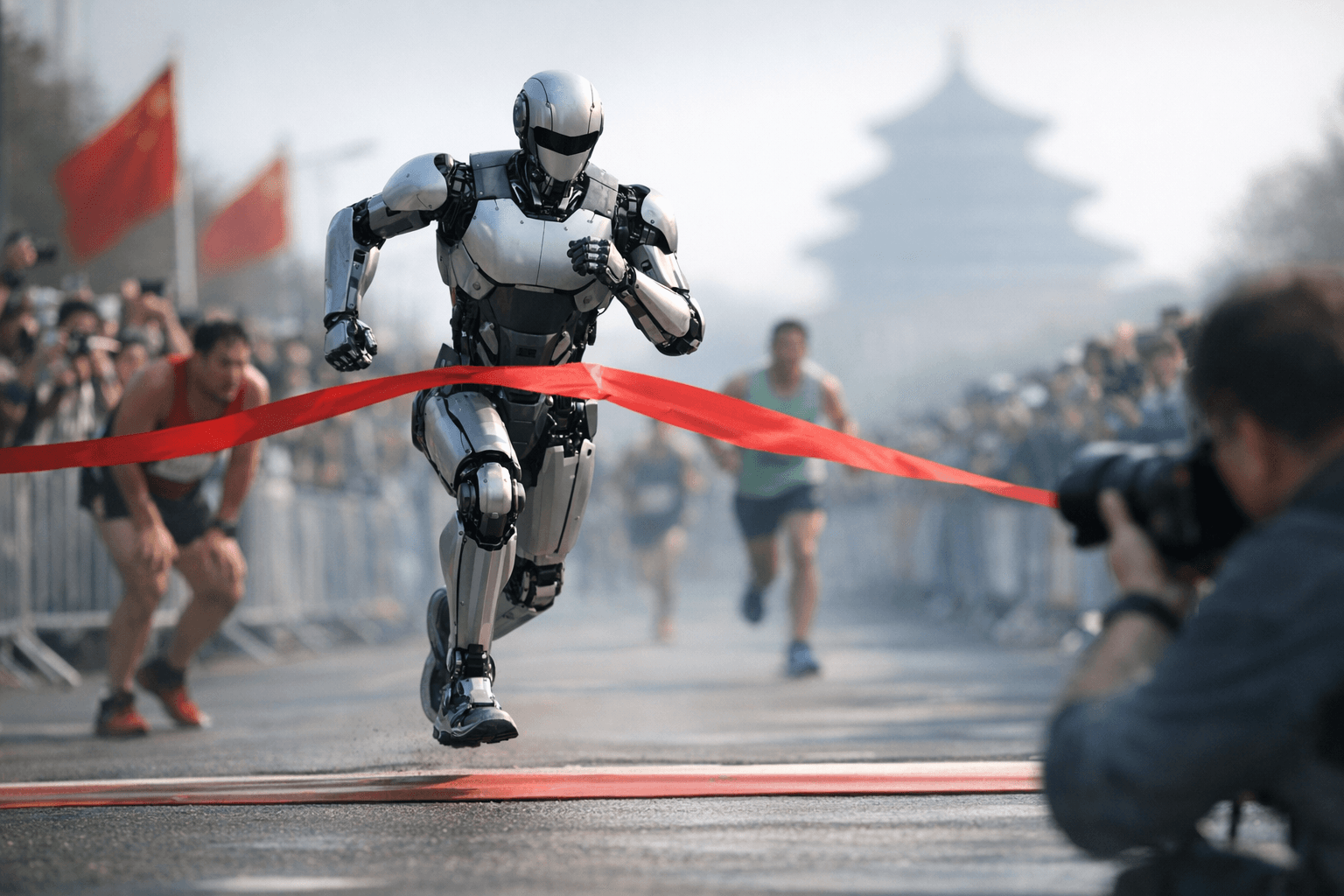
A humanoid robot crossed the finish line in Beijing in 50 minutes and 26 seconds, a pace that beat the current men’s half-marathon world record and turned a carefully staged robotics contest into a global signal about how fast the field is moving. The winner, identified by Xinhua as Flash from Shenzhen Honor Smart Technology Development Co., Ltd., completed the 21.0975-kilometer course at Beijing E-Town on April 19.
The time was faster than Jacob Kiplimo’s 57:20 mark, set in Lisbon on March 8, 2026, according to World Athletics. It also marked a dramatic leap from the first Beijing E-Town humanoid robot half-marathon in 2025, when Tiangong Ultra won in about 2 hours, 40 minutes and 42 seconds. That gap, more than 100 minutes in one year, is the clearest evidence that the competition is measuring real engineering progress, not just spectacle.
The race was not seamless. One robot fell flat at the start line, and another struck a barrier, reminders that balance, recovery and durability remain major hurdles when machines are pushed at speed over long distances. Reuters and the Associated Press reported that some robots ran autonomously while others were controlled remotely, and that they competed on a parallel course to avoid collisions with human runners. One machine even broke apart after a fall and was carried away on a stretcher.
Honor’s test development engineer, Du Xiaodi, said the team was pleased with the result and pointed to practical design choices. Flash was modeled on elite human athletes, with legs about 95 centimeters long, and used a liquid-cooling system largely developed in-house. That combination matters beyond a race course, because cooling, structural stability and efficient motion are the same qualities factories, warehouses and emergency-response systems demand from machines that must work for hours, not minutes.
That is why Beijing framed the event as more than a novelty. The second Beijing E-Town humanoid robot half-marathon built on the 2025 debut, which drew 20 robot teams from Beijing, Shanghai, Jiangsu, Guangdong and other regions. Chinese official coverage said that race accelerated improvements in joint stability and fast battery swapping, while organizers said the 2026 upgrade was meant to turn technical gaps exposed on the course into real-world industrial solutions.
The result will feed China’s broader robotics push, where consumer electronics firms such as Honor are moving deeper into embodied AI and humanoid hardware. For investors and industrial buyers, the key question is no longer whether a robot can finish a race. It is whether the same machine can keep its balance, manage its power and perform reliably enough to leave the track and enter the factory floor.
This article was produced by Prism’s automated news system from verified source data, official records, and press releases, then run through automated quality and moderation checks before publishing. The system is built and supervised by the people who set the standards it runs under. Read our full AI policy.
Did this article answer your question?