Climate change remains a priority for many voters, but far more Democrats than Republicans
Climate still motivates Democrats far more than Republicans, but polling shows the economy is the bigger ballot-box language for most voters.
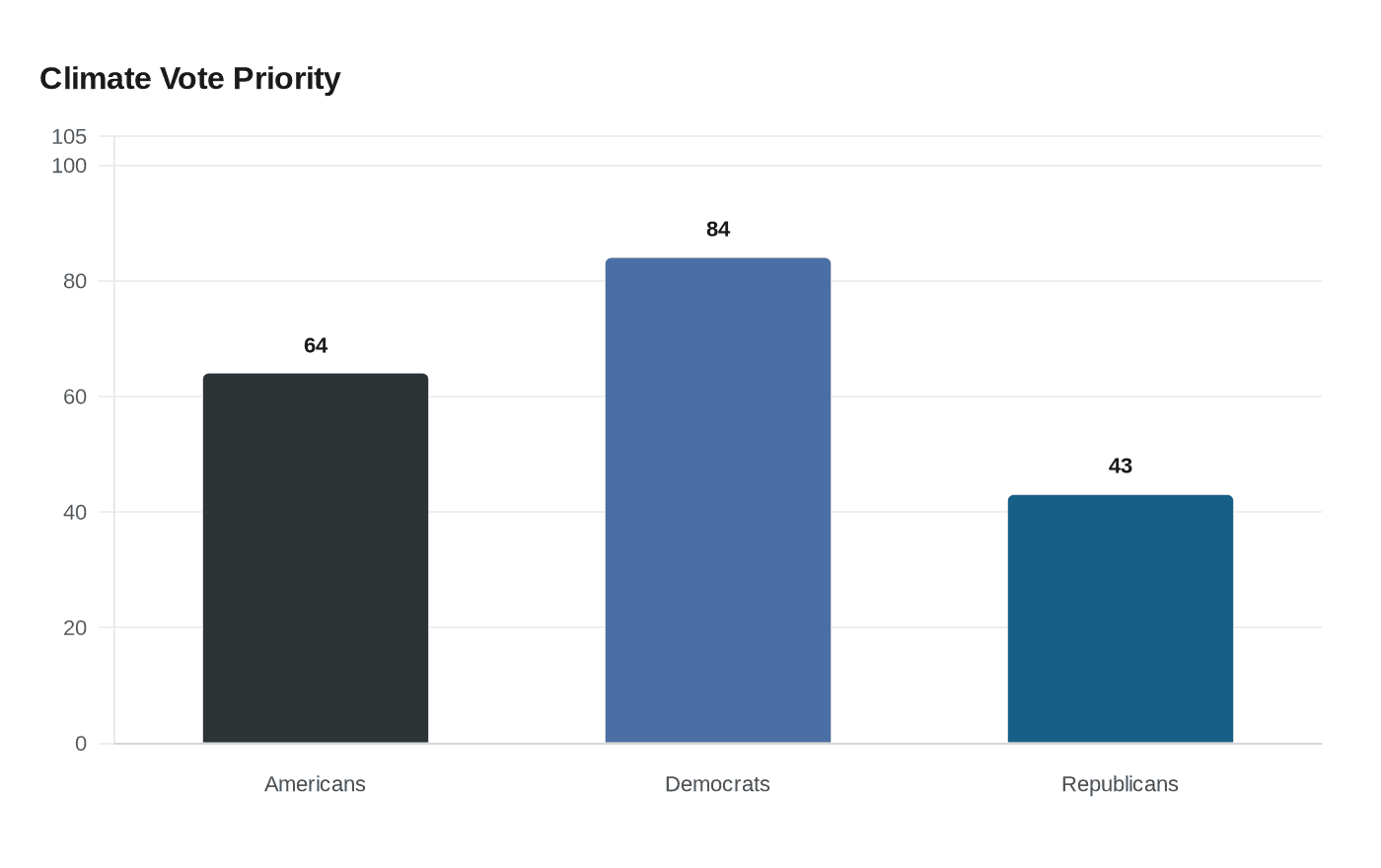
Democrats are recalibrating how much they talk about climate because the numbers still reward urgency inside their coalition, but not nearly as much across the broader electorate. AP-NORC and the Energy Policy Institute at the University of Chicago found that 64% of Americans said climate change was at least one important factor in thinking about their 2024 presidential vote, yet 84% of Democrats said climate policy mattered compared with 43% of Republicans. At the same time, Pew Research Center found that 81% of registered voters said the economy would be very important to their vote, a reminder that affordability is still the louder political language.
That gap helps explain why party strategists are increasingly likely to fold climate into a wider message about costs, jobs and economic security rather than leading with emissions or warming alone. Pew’s Feb. 29, 2024 policy priorities survey found Democrats were far more likely than Republicans to prioritize dealing with climate change, 59% to 12%, which means the issue still has strong ownership on the left. But ownership is not the same as breadth, and Democrats cannot assume climate by itself will move enough swing voters in the places that decide national races.

Yale’s Program on Climate Change Communication put sharper edges on that divide. Its 2024 election resources found 39% of registered voters said global warming was a very important issue for their vote, up from 32% in 2014. Among liberal Democrats, that figure rose to 70%; among moderate or conservative Democrats, 51%. Yale estimated that 37% of U.S. registered voters, about 60 million people, are pro-climate voters, and its Fall 2024 “Six Americas” report found 26% of Americans were Alarmed about global warming, with 54% either Alarmed or Concerned.
The political problem is not that climate has vanished from public life. It is that voters are sorting it through other priorities, especially cost and growth. Pew’s December 2024 climate report found Americans were split 34% to 34% on whether climate policies help or hurt the U.S. economy, while 56% of Republicans said such policies usually hurt. The same survey found 88% of Democrats and 73% of Republicans frustrated by political disagreement over climate, suggesting many voters want practical answers more than partisan combat.
Gallup’s April 14, 2026 polling showed 44% of U.S. adults said they worried a great deal about climate change or global warming, still below the level that would dominate the national agenda. That leaves Democrats with a familiar tradeoff: keep climate high enough to energize core supporters and protect issue ownership, or move it down the list in search of broader persuasion on the economy, even if that risks muting a message many of their own voters still expect to hear.
This article was produced by Prism’s automated news system from verified source data, official records, and press releases, then run through automated quality and moderation checks before publishing. The system is built and supervised by the people who set the standards it runs under. Read our full AI policy.
Did this article answer your question?

