Coast Guard awards $3.5 billion Arctic icebreaker contract to Davie Defense
The Coast Guard locked in five Arctic Security Cutters, a move aimed at closing a stark icebreaker gap as Russia and China press harder in the far north.

The Coast Guard has locked in a $3.5 billion contract with Davie Defense for five Arctic Security Cutters, a fleet expansion that pushes the service’s planned Arctic buildup from strategy into steel. The deal is the first of three final contracts for the program and brings the total number of planned cutters to 11, a scale meant to answer a widening gap in U.S. presence, logistics, and access across the far north.
The new ships are designed to operate in icy waters and support American interests where climate change is opening northern sea routes and intensifying competition over shipping lanes, sovereignty, and resources. Under the contract, three of Davie’s cutters will be built in Texas and two in Finland. The first vessel is scheduled for delivery in 2028, and all five are slated for delivery by February 2035, giving the Coast Guard a long runway to build crews, infrastructure, and maintenance capacity around the new class.
The timing reflects how thin the U.S. polar fleet remains. A June 30, 2025 Congressional Research Service report said the country had only two operational polar icebreakers, the heavy Polar Star and the medium Healy. The service also bought the commercial vessel Aiviq for $125 million in December 2024, later renaming it Storis. Even with that addition, a 2023 Coast Guard fleet mix analysis concluded that the nation needs eight to nine polar icebreakers total to carry out its missions.
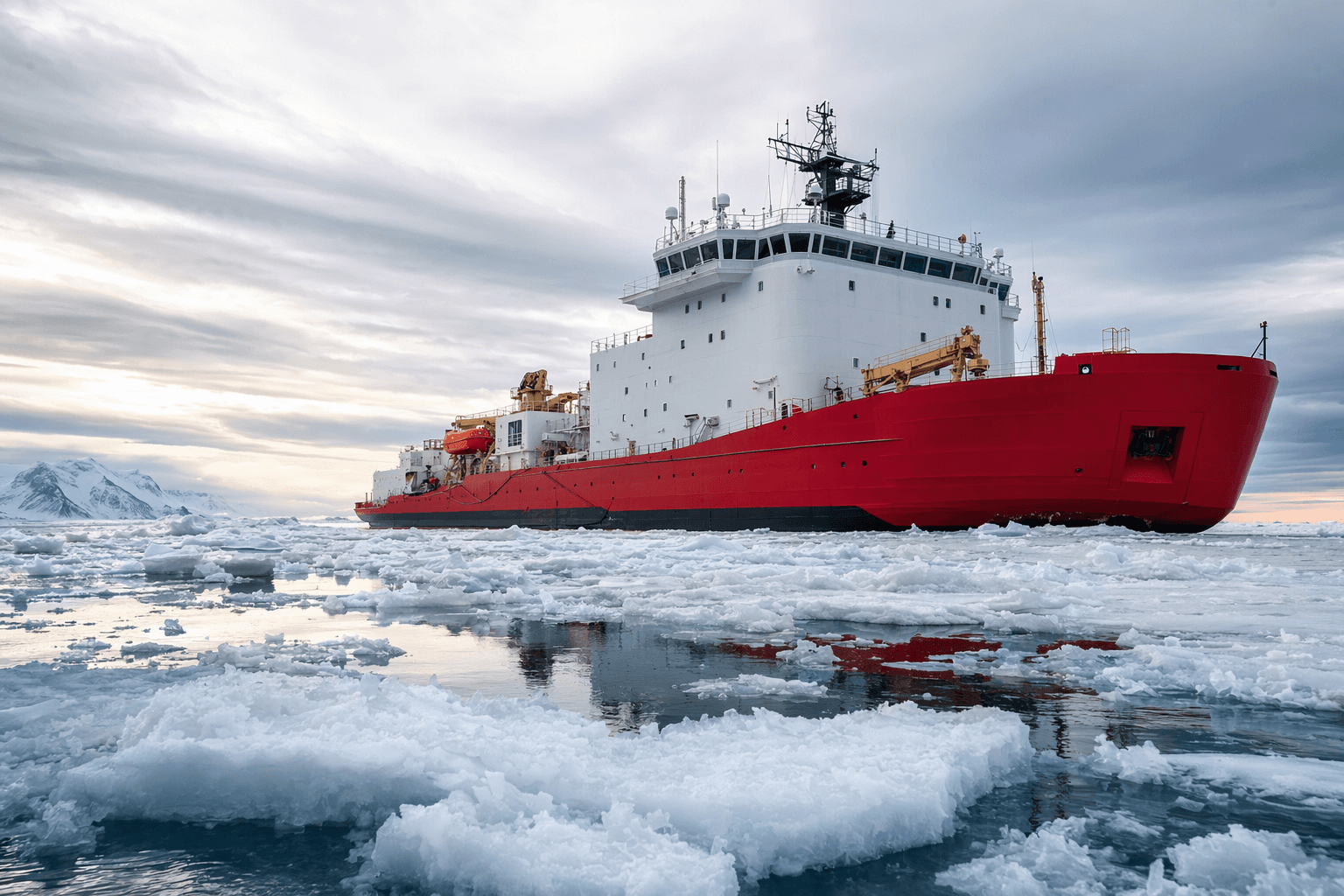
The Arctic Security Cutter program is meant to narrow that shortfall while the Coast Guard waits on heavier icebreaker efforts that have moved slowly for years. By its own accounting, the service had already spent about $1.732 billion on the Polar Security Cutter program through fiscal 2024. The new ASC contracts, including earlier awards of $2.1 billion to Bollinger Shipyards for four cutters and $1.1 billion to Rauma Marine Constructions in Finland for two, add up to $3.3 billion more in 2026 alone.
The Coast Guard announced on April 16 that the first two Arctic Security Cutters will be homeported in Alaska, with infrastructure, training, and housing planning already underway. Officials have tied that decision to the need to defend the United States northern border and maritime approaches, safeguard energy and mineral resources, and counter foreign influence in the Arctic. The Department of Homeland Security said the program is being financed in part by $25 billion in fiscal 2025 budget reconciliation funding, which has already supported more than $13 billion in new fleet investments and capabilities.

The broader political message is plain: Washington is trying to convert years of warnings about Arctic vulnerability into shipbuilding orders, homeports, and operational reach. With Russia still fielding a far larger polar icebreaker fleet and China deepening its Arctic ambitions, the Coast Guard is betting that five more cutters, and the industrial base behind them, will help the United States stay present where access is becoming power.
This article was produced by Prism’s automated news system from verified source data, official records, and press releases, then run through automated quality and moderation checks before publishing. The system is built and supervised by the people who set the standards it runs under. Read our full AI policy.
Did this article answer your question?

