Cockpit Recorder Audio Reveals Pilot Error Before Fatal LaGuardia Crash
The air traffic controller cleared a fire truck onto the same runway as a landing Air Canada jet, then said "I messed up" — 18 minutes after two pilots died.
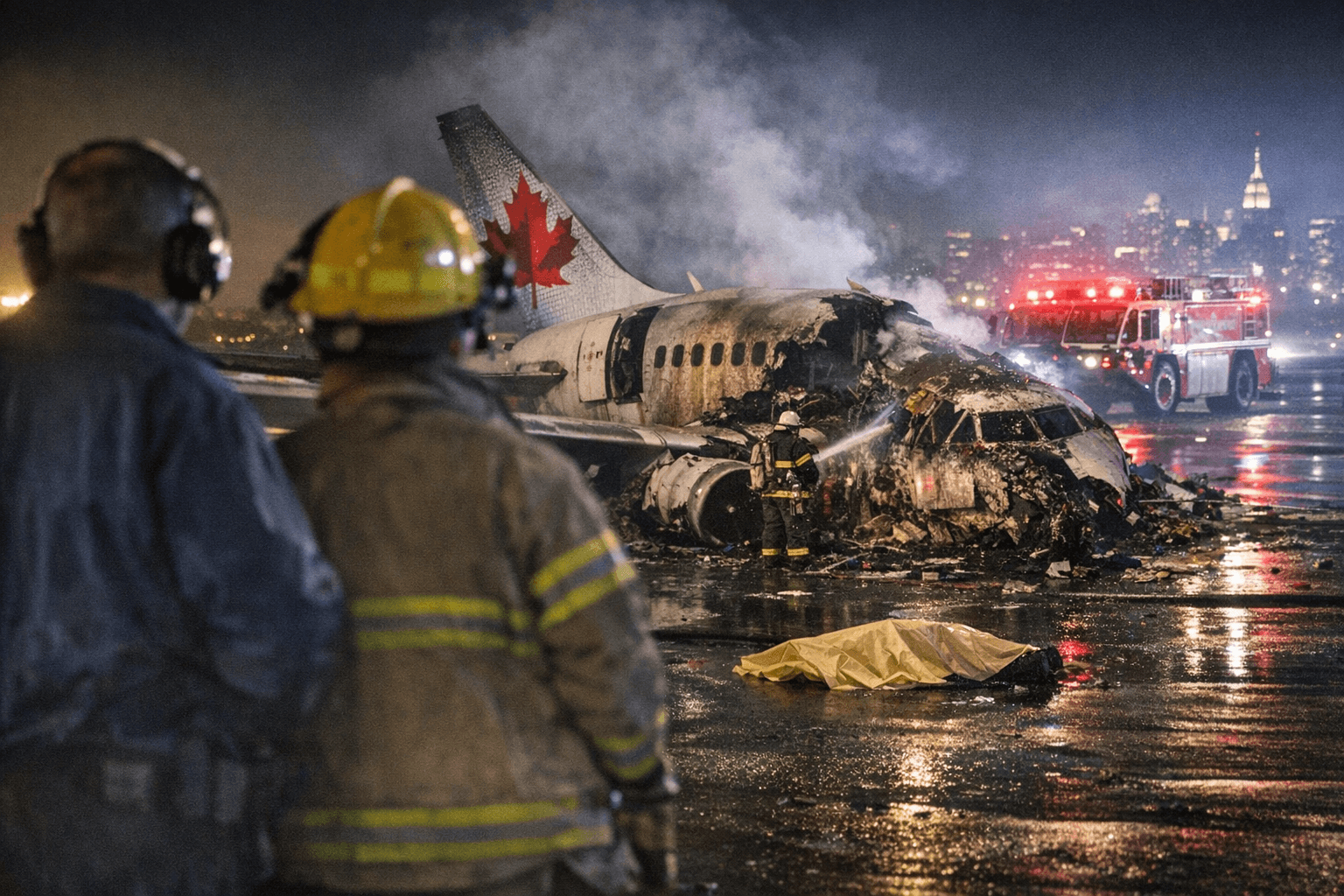
The collision occurred around 11:45 p.m. Sunday, when a CRJ-900 operated by Jazz Aviation touched down on Runway 4 at LaGuardia after its journey from Montréal Trudeau International Airport. The controller in the tower had already cleared the flight to land. He had also, seconds earlier, cleared a Port Authority fire truck to cross that same runway.
The NTSB's investigation has so far revealed there were two air traffic controllers in the tower at the time, and at least one of them was doing several jobs. The controller in charge was also acting as the clearance delivery controller, who gives pilots permission to depart, NTSB Chair Jennifer Homendy said. The NTSB has conflicting information on whether the local controller or the controller in charge was also serving as the ground controller, who manages vehicle activity on taxiways.
The final seconds unfolded with brutal precision. At 25 seconds before impact, the fire truck requested permission to cross Runway 4. At 20 seconds, the tower cleared the truck to cross. At 17 seconds, the fire truck read back the runway crossing clearance. At 9 seconds, the tower told the fire truck to stop. At 8 seconds, there was a sound consistent with the airplane's landing gear touching down on the runway. At 6 seconds, there was a pilot transfer of controls. Homendy said the first officer was flying the plane and transferred control to the captain. At 4 seconds, the tower again instructed the fire truck to stop. The collision followed immediately.
First Officer Mackenzie Gunther was flying into LaGuardia Airport. The NTSB's preliminary listen of the cockpit voice recorder indicates that almost immediately after touchdown, Captain Antoine Forest took what is known as "positive control" of the aircraft. It is possible Forest saw the fire truck, took control, and attempted to steer the plane to the right, away from the truck that entered the runway from the left. The pilots have been credited with saving the lives of the 72 passengers on the plane by quickly braking and minimizing the impact.
The two pilots killed were Antoine Forest and Mackenzie Gunther. Forest was a 30-year-old man from Coteau-du-Lac, Quebec, southwest of Montreal, about 20 kilometres east of the Ontario border. Gunther graduated from Seneca Polytechnic's honors bachelor of aviation technology program in 2023. Flags on campus were lowered to half-staff to honor Gunther. He joined Jazz Aviation right after graduation.
Tower audio captured the controller's attempts to avert disaster. He can be heard repeatedly ordering: "Stop, truck one. Stop. Stop, truck one. Stop." Eighteen minutes after the crash, he told a Frontier Airlines pilot waiting to return to the gate: "I tried to reach out to my staff, and we were dealing with an emergency earlier. I messed up." The Frontier pilot, who witnessed the collision, said, "That wasn't good to watch." The controller replied, "Nah, man, you did the best you could."
The fire truck was not equipped with a transponder, limiting the tower's ability to track it on the airfield. The airport's surface detection equipment, known as ASDE-X, did not generate an alert ahead of the collision "due to the close proximity of vehicles merging and unmerging near the runway, resulting in the inability to create a track of high confidence," Homendy said.
Port Authority and other emergency responders cut a hole in the roof of the plane to retrieve the flight data recorder and cockpit voice recorder. NTSB Chair Jennifer Homendy said the cockpit voice recorder "was not damaged" and has already been transported to Washington, D.C. for analysis. The cockpit voice recorder captured more than 25 hours of audio, while the flight data recorder contained around 80 hours of data.
Two pilots were killed and 41 people taken to hospital after the Air Canada jet carrying 72 passengers and four crew collided with the fire truck. The two Port Authority officers in the emergency vehicle suffered broken bones. There was a "tremendous amount of debris" on the runway and "hazardous material" on the fire truck that was hit, Homendy said.
NTSB Chair Jennifer Homendy said the NTSB will investigate whether the number of people on duty for the midnight shift at LaGuardia was adequate. The airport has a target of 37 controllers. There were 33 certified controllers employed at LaGuardia at the time. Homendy cautioned against "pointing fingers" at individual controllers, noting that "many, many" layers of protection would have had to fail for such a collision to occur. Determining the root cause, the NTSB said, can take a year or longer.
The last fatal crash at LaGuardia happened 34 years ago, according to the NTSB's accident report.
Know something we missed? Have a correction or additional information?
Submit a Tip

