Congress heads for record turnover as retirements surge early
Congress had already reached 68 to 71 retirements by May 15, a pace that could hollow out expertise and make the 2027 agenda harder to pass.

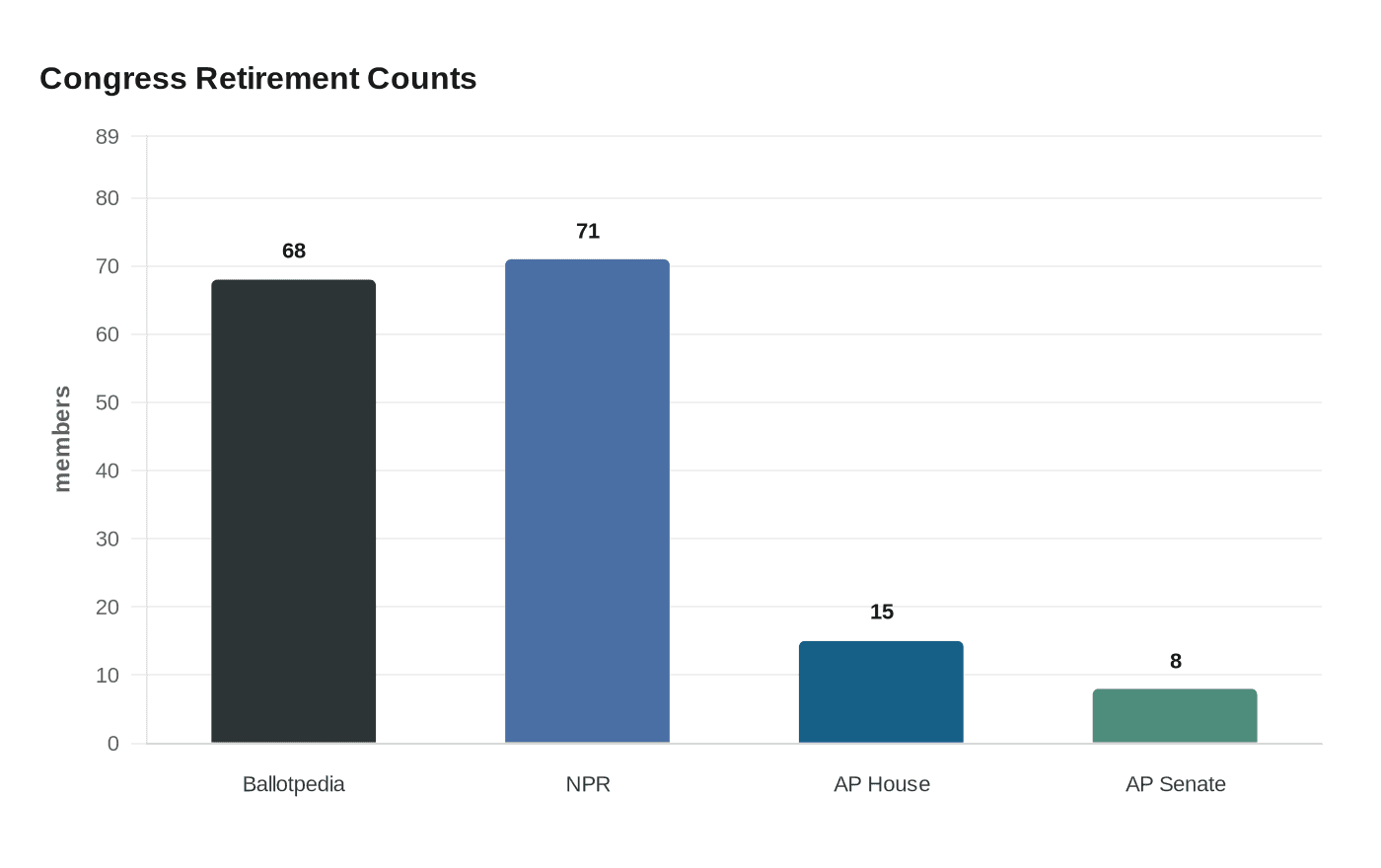
Congress is moving toward a record turnover that reaches far beyond campaign politics. By May 15, Ballotpedia counted 68 voting members, 11 senators and 57 House members, who were not seeking reelection in 2026, while NPR counted 71 current members, including 14 senators and 57 House members, who were retiring or running for another office. The larger consequence is institutional: when veteran lawmakers leave en masse, committees lose memory, fund-raising muscle and policy expertise just as the next Congress will need all three to manage oversight, budgets and bipartisan deals.
The pace of departures has been unusually early. AP’s tracking showed 15 House members announced plans to leave in the first half of 2025, compared with an average of nine in the first six months of a congressional term over the previous decade. Eight senators announced retirements over the same period. Brookings researchers Abby Ward and Molly E. Reynolds wrote in April 2026 that the 119th Congress was seeing the highest number of retirees in more than three decades, underscoring how quickly the exodus has accelerated.
The reasons vary, but the pattern is familiar: exhaustion, redistricting, career changes and the pull of other offices. Some lawmakers have described the job as a nonstop grind that no longer matches the energy required to do it well. Others have said, after deep reflection, that they could serve their cause better outside elected office. That mix of personal fatigue and political calculation is reshaping the field before the first general-election votes are cast.

Redistricting has added another layer of instability. Texas and California both moved to redraw congressional maps with partisan advantage ahead of the 2026 midterms, and that has forced some members into unfamiliar terrain while opening the door to crowded candidate fields. The result is not just more retirements, but more volatile open seats, where both parties may have to spend heavily to defend territory that once looked secure.
That matters because midterm elections usually punish the party holding the White House, which helps explain why more majority-party members often head for the exits. Ballotpedia said the 2026 cycle already had more retirement announcements at this point than 2024, 2022, 2020 or 2018, while other trackers said House retirements were at or near the second-highest level since recordkeeping began nearly a century ago, with 2018 still the benchmark.
The open seats now emerging in Texas, California and other redrawn districts could prove decisive in determining which party controls the next Congress. But the deeper story is about governance: a thinner bench of experienced lawmakers, more turnover in committee leadership and a harder road to building trust in Washington. That is the kind of churn that can shape what Congress is able to pass in 2027, even before the first bill reaches the floor.
This article was produced by Prism’s automated news system from verified source data, official records, and press releases, then run through automated quality and moderation checks before publishing. The system is built and supervised by the people who set the standards it runs under. Read our full AI policy.
Did this article answer your question?

