Costa Rica Agrees to Accept Migrants Deported by the Trump Administration
Costa Rica agreed to a new deportation deal with the Trump administration on the same day the Senate confirmed Markwayne Mullin as DHS secretary, even as 28 migrants from a prior agreement remain detained at a remote shelter near the Panamanian border.
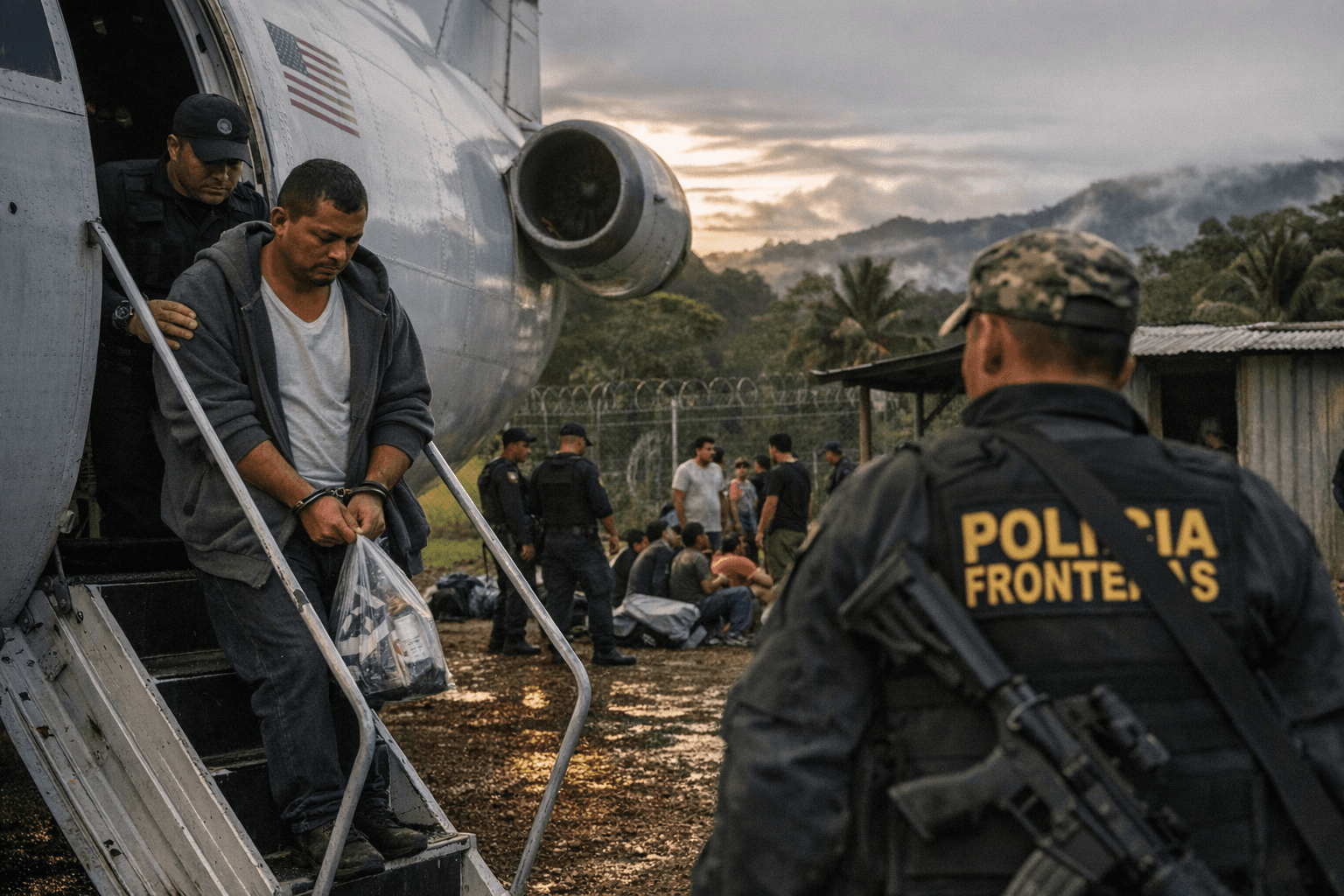
A group of families and children from Uzbekistan, China, Afghanistan, Russia, and more than a dozen other countries climbed down the stairs of an airplane in Costa Rica's capital, the first flight of deportees from other nations that Costa Rica agreed to hold while the Trump administration organized their return. That arrangement, already months deep in legal challenges and court orders, expanded on Monday as U.S. and Costa Rican officials signed a new deportation agreement — on the same day the Senate confirmed Oklahoma Republican Markwayne Mullin as the new Secretary of Homeland Security.
Mullin was confirmed in a 54-45 vote, replacing Kristi Noem, whom Trump had tapped to replace after early March. Trump said Noem would instead take on a newly created role as "Special Envoy for the Shield of the Americas." The new Costa Rica agreement, signed by Noem before her departure alongside Costa Rican President Rodrigo Chaves and president-elect Laura Fernandez, who takes office May 8, allows Washington to deport up to 25 people to the Central American country under the terms of the latest protocol.
The new deal builds on an existing arrangement that has already become deeply controversial. The United States expelled 200 third-country nationals, including 81 children, to Costa Rica on two flights at the end of February 2025. Their countries of origin included Afghanistan, Angola, Armenia, Azerbaijan, China, the Democratic Republic of Congo, Georgia, India, Iran, Kazakhstan, Nepal, Russia, Turkey, Uzbekistan, Vietnam, and Yemen. They were transported to the Temporary Migrant Assistance Center, known by its Spanish acronym Catem, located in Corredores canton, Puntarenas province, 360 kilometers south of San José near the Panamanian border.
Costa Rica's independent ombudsman claimed the migrants had arrived in "visible distress," were unaware of their destination after leaving the United States, were not allowed to contact overseas relatives, had their identity documents taken from them, and did not receive proper medical or other services on arrival.
The detention drew a legal challenge in March. In a 4-3 vote, the Constitutional Chamber of Costa Rica's Supreme Court found that the government had violated the migrants' rights by failing to provide them with "timely and sufficient information" about their immigration status or give them access to legal counsel. The judges gave the government 15 days to release the deported migrants and ordered it to determine their immigration status "individually" and based on the law. As of Tuesday, 28 people remained at the facility, including 13 minors, from Armenia, Russia, Azerbaijan, Afghanistan, Turkey, and Iran.
Among those who stayed was an Afghan woman who, in March, spoke from behind the bars of the Catem center. She had fled Afghanistan because she wanted to study and work and did not want to be forced into the company of a man just to go out. "The Taliban will kill me," she warned, if returned home.
President Chaves acknowledged the economic calculus openly, saying his nation was receiving migrants from the United States because it was "helping the economically powerful brother from the north who, if he puts a tax on the free trade zones, will wreck us." Refugees International reported that Chaves had agreed to receive the asylum seekers "under threat of economic repercussions by the U.S." and that Costa Rica's role was framed as a "bridge" for migrants to return to their countries of origin, with repatriation flights arranged by the International Organization for Migration. The terms of the agreement between the U.S. and Costa Rica have not been made public, and it remains unclear what U.S. funds were used to pay for the migrants' stay or those flights.
Refugees International warned that the situation in Costa Rica "will likely be replicated elsewhere in a graver form and on a larger scale" as the Trump administration pursues deportation agreements across the region. Costa Rica joins Panama, which has held deportees of mostly Asian origin, while Honduras has also facilitated handoffs of deportees between the U.S. and Venezuela. The 252 Venezuelan migrants sent to El Salvador were imprisoned in that country's mega-prison for gang members, accused by the Trump administration, without evidence, of belonging to the criminal gang Tren de Aragua.
Eleanor Acer, Senior Director for Global Humanitarian Protection at Human Rights First, called the deportations "horrifying" and said they "violate U.S. and international laws that protect people from return to political, religious and other persecution." Her organization urged the governments of Panama, Costa Rica, and other nations to refuse what it characterized as unlawful third-country deportations that "lack legal authority, trample on due process and violate refugee law."
In late April, Costa Rica granted humanitarian immigration status to the migrants held at the shelter after a group of human rights lawyers filed a lawsuit before the United Nations Committee on the Rights of the Child, alleging the government had violated the rights of 81 migrant minors. At the time, authorities announced migrants whose passports were confiscated upon arrival would receive their documents back and were free to leave the shelter. The special migratory category is valid for 90 days, with an option to extend.
With Mullin now at the helm of DHS and a new agreement signed in San José, the legal and humanitarian battle over where the United States sends people it cannot or will not deport directly to their home countries is far from resolved.
This article was produced by Prism’s automated news system from verified source data, official records, and press releases, then run through automated quality and moderation checks before publishing. The system is built and supervised by the people who set the standards it runs under. Read our full AI policy.
Did this article answer your question?