Custard apples thrive in dry India, offering farmers a resilient crop
Custard apples are helping dryland farmers earn more from harsh terrain, but storage, processing and market reform will decide whether the crop scales beyond a local success.
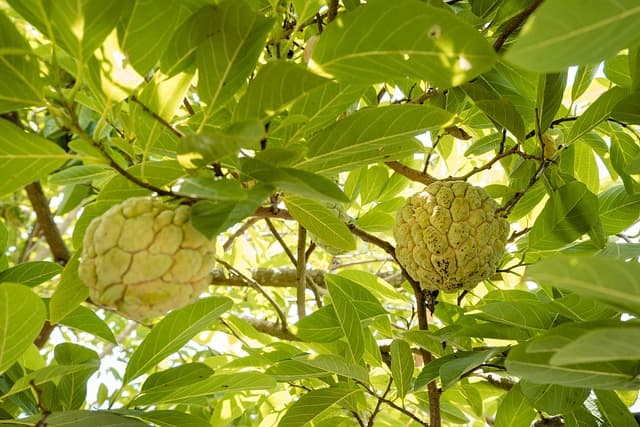
A resilient crop in land that punishes weak roots
Custard apple, also called sitaphal, sharifa or sugar apple, is winning attention for a reason that matters far beyond fruit counters. In dry and climate-stressed regions, it survives on relatively little water, needs limited pesticide input and stays productive in conditions that can knock back more demanding crops. That makes it a practical case study in climate resilience, not just a sweet seasonal fruit.
The crop’s appeal is especially clear in India, where growers and researchers increasingly treat custard apple as an “emerging fruit crop” with both agronomic and economic value. It is used fresh, but also in custards, ice creams and other value-added products, giving it room to move from orchard to processing line if the right market systems are in place.
Why dryland farmers are paying attention
A crop built for harsh terrain
Custard apple fits places where water is scarce and soils are unforgiving. The fruit has shown value in rocky, shallow-soil regions, where farmers often have few durable alternatives and where seasonal risk is high. Its drought tolerance is what makes it so important in the first place, but its lower dependence on pesticide and irrigation also matters in areas where input costs can overwhelm smallholders.
In India, the crop is not confined to scattered backyard trees. It is widely cultivated across the country and is described by the Indian Council of Agricultural Research as a “popular arid fruit.” That matters in a policy sense because crops like this can help diversify farm income in districts that increasingly face heat stress, erratic rain and falling groundwater.
Beed district shows what the crop can do
Income from difficult land
The clearest livelihood story comes from Beed district in Maharashtra, where a 2023 case study found custard apple cultivation supporting tribal and small farmers, especially the Banjara community. The crop is particularly important in rocky areas and shallow soils, where other crops struggle to deliver reliable returns. In that setting, custard apple is less a specialty fruit than a working farm strategy.

The same case study placed India’s annual custard apple output at more than 298,000 tonnes in 2018, underscoring that this is not a marginal crop. In Beed, the geography itself explains much of the crop’s promise: the Balaghat ranges, and talukas such as Dharur, Ambajogai and Ashti, provide the kind of stressed conditions where a hardy fruit can still create income. For farming households on the edge of viability, that resilience is not abstract. It is the difference between a plot that produces and one that fails.
The weak point is not production, but what happens after harvest
Storage and processing decide the economics
Custard apple’s challenge is that production strength does not automatically translate into farm income. A Centre for Environment Education brief warns that post-harvest losses are significant because prices can fall quickly and storage facilities are inadequate. That is a familiar pattern in horticulture, where perishable crops can become distress sales if the market cannot absorb them fast enough.
The processing gap is striking. India is the world’s second-largest custard apple producer after China, yet only 0.7% of production is processed. That leaves most growers dependent on the fresh market, where shelf life is short and bargaining power is weak. In practical terms, this means a crop with resilience at the farm level can still be vulnerable after harvest unless cold chain, aggregation and processing keep pace.
Value addition can lift prices fast
From low farmgate returns to stronger margins
The clearest evidence for a better model comes from an APEDA-linked case study in Maharashtra. It found that farmers who were previously getting only 4 to 5 per kilogram from aggregators saw realizations rise to 12 to 14 per kilogram after a custard apple pulp-processing unit was set up. That kind of jump changes the economics of the crop far more than any promotional campaign.
It also points to the policy lesson hidden inside the fruit. A resilient crop becomes a serious food-security tool only when it is connected to processing, storage and local enterprise. Custard apple pulp can extend shelf life and reduce waste, while also opening the door to products that move beyond the narrow fresh-fruit market. In other words, the crop’s future depends as much on logistics as on orchards.

Breeding and genomics are raising the ceiling
Science is trying to make a hardy crop better
Research institutions are now treating custard apple as a crop worth improving systematically. Scientists at the Indian Institute of Horticultural Research have highlighted improved varieties such as Arka Sahan, which is valued for better quality and productivity. That matters because resilience alone is not enough; farmers also need yield, fruit quality and market appeal.
A 2025 genome study in DNA Research deepened that picture by reporting a 730.4 Mb genome assembled into seven pseudochromosomes. The paper also described Annona squamosa as the most widely cultivated edible Annona species and noted that its effective population size has been in continuous decline, which makes crop-improvement resources more important. For breeders, the genome map is a practical tool: it can support work on productivity, quality and adaptation in climates that are getting less forgiving.
A broader test case for climate-resilient agriculture
Niche fruit or model for the future
Custard apple’s rise in dry India is easy to overstate, and that would be a mistake. It is not a silver bullet for climate stress, and it will not replace staple crops. But it does show how a fruit that tolerates heat, drought and poor soils can give farmers another route to income when conventional options become less reliable.
The policy question is whether institutions will treat it as a niche success story or a serious model for diversification in drought-prone regions. APEDA continues to track the crop within India’s wider fruit economy, and India exported fresh fruits and vegetables worth USD 1,818.56 million in 2024-25, but custard apple still remains largely a domestic-market fruit. That leaves room for expansion if processing, breeding and storage are built around the crop instead of added after the fact.
Custard apple now sits at the intersection of climate adaptation and rural economics. If India invests in the weak links around the fruit, it could become more than a hardy orchard crop. It could become one of the clearest examples of how farmers in dry country turn resilience into income.
This article was produced by Prism’s automated news system from verified source data, official records, and press releases, then run through automated quality and moderation checks before publishing. The system is built and supervised by the people who set the standards it runs under. Read our full AI policy.
Did this article answer your question?


