Day 2 NFL draft steals and reaches spotlight falling stars, rising values
Day 2 redrew the draft market, exposing which teams trusted their boards, which chased need, and which saw opportunity in the gaps.
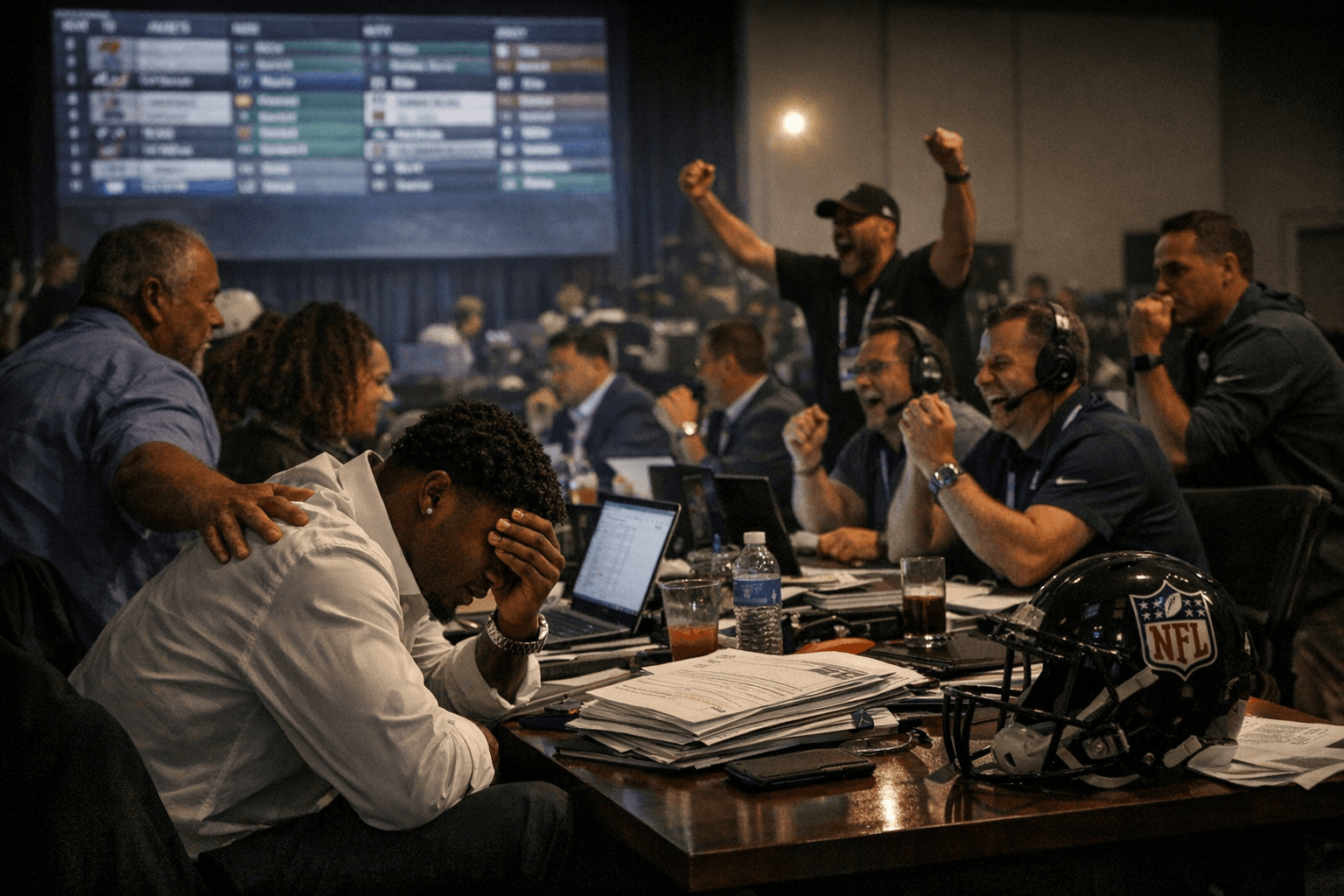
How Day 2 changed the price of a player
The second and third rounds in Pittsburgh have become the draft’s real market-clearing session, where consensus rankings collide with private boards and the gap between the two starts to matter more than pedigree. By the end of Rounds 2 and 3, only four players from Mel Kiper Jr.’s top 32 were still available, and 21 players from his top 100 were still on the board heading into Day 3, a reminder that Friday’s 68 picks stripped the elite layer out of the class quickly. That scarcity is what turns Day 2 into a referendum on risk, projection and scheme fit rather than a simple search for the best available name.
The clearest value swings came from teams willing to wait
Pro Football Focus’ biggest value calls on Day 2 came from players who slid far enough for the gap to become impossible to ignore. Emmanuel McNeil-Warren, C.J. Allen, Avieon Terrell, Cashius Howell and Brandon Cisse all landed as Round 2 values because they fell well below their PFF Big Board placement, the kind of discount that can make a front office look sharp if the player’s role and development curve match the projection. Denzel Boston to Cleveland and Terrell to Atlanta were part of the first wave of those value selections, and they show how teams can separate from the crowd when they believe the tape and the traits are better than the consensus grade.
That is the central economic lesson of Day 2: the market does not price players evenly. Some clubs are buying immediate production, while others are buying longer run upside, special-teams utility, or a cleaner fit in a specific system. When those internal valuations are right, the pick looks like a steal. When they miss, the same move becomes the reach everyone remembers.
De’Zhaun Stribling became the night’s sharpest reach
No player illustrated the divide more clearly than De’Zhaun Stribling. PFF had him at No. 112 on its Big Board, yet San Francisco took him at No. 33 overall after trading back with the Jets, a swing large enough to define the night’s most notable valuation error from the public perspective. Whether the 49ers saw a skill set they could unlock, a role they valued more highly than anyone else, or simply a player they were unwilling to risk losing, the pick captured what Day 2 often rewards: conviction over consensus.
That move also set the tone for how teams attacked the middle of the draft. Once one club is willing to make a big bet against the board, others feel less pressure to behave conventionally, and the night quickly becomes a sequence of team-specific decisions rather than a neat ordering of prospect value. In practice, that means one front office’s reach can create another team’s opportunity, especially when players such as McNeil-Warren, Allen and Terrell are still available for teams willing to let the board come to them.
Quarterbacks still mattered, but the elite pool was thinning fast
The quarterback storyline on Day 2 was real, but it sat inside a much narrower talent environment than the first round. Arizona selected Carson Beck, Pittsburgh took Drew Allar, and both picks reinforced that teams were still willing to chase a quarterback if their internal grade or developmental timeline justified the investment. At the same time, Kiper’s note that only four players in his top 32 remained after Round 2 showed how quickly the class’s top tier was disappearing.

That scarcity changes behavior. With the best players already claimed, teams start leaning harder on role projection and developmental math, which is why Day 2 often produces the most polarizing reactions of the entire draft. A quarterback taken on Friday night is rarely just a quarterback pick; it is a statement about timeline, roster construction and how much risk a team is willing to absorb at the game’s most volatile position.
Minnesota turned Day 2 into an asset-accumulation night
No team made its priorities clearer than Minnesota, where every major move on Friday pointed to defense. After opening with Florida defensive tackle Caleb Banks in Round 1, the Vikings traded down two spots and took Cincinnati linebacker Jake Golday at No. 51, then sent edge rusher Jonathan Greenard and the 244th pick to Philadelphia for a 2026 third-round pick at No. 98 and a 2027 third-rounder. Later, Minnesota used No. 82 on Iowa State defensive tackle Domonique Orange and added Northwestern offensive tackle Caleb Tiernan and Miami safety Jakobe Thomas.
The Greenard trade matters because it was not just a roster move, it was a capital reset. Minnesota had not made a second-round pick since 2022, when it selected Andrew Booth Jr. and Ed Ingram, and it had already traded away its 2023 second-round pick for T.J. Hockenson and its 2024 and 2025 second-rounders for the pick that became Dallas Turner. That history explains why this Day 2 felt less like a sprint for one player and more like a long-term rebuild of draft liquidity.
For the Vikings, the lesson is not subtle. They did not use Friday to chase a splashy offensive fix or force a positional need. They used it to stack defensive bodies, replenish picks and preserve flexibility. In a draft where many teams were trying to win the evening with one bold selection, Minnesota looked intent on winning the next few drafts.
What Day 3 now has to solve
By the time Saturday’s Rounds 4 through 7 begin, the board is thinner, the margins are smaller and the cost of missing on conviction rises. The teams that came away from Friday with clear value, like the ones landing McNeil-Warren, Allen, Terrell, Howell and Cisse, have a chance to turn Day 2 belief into long-term surplus. The teams that reached, especially on a player like Stribling, now have to prove their internal evaluations were worth the gap.
That is why Day 2 matters more than a simple recap of picks. It reveals which franchises trust their own numbers, which ones are reacting to roster pressure, and which ones are willing to pay a premium for a fit the public board does not fully price. In Pittsburgh, the draft’s middle rounds once again showed that value is never fixed for long.
This article was produced by Prism’s automated news system from verified source data, official records, and press releases, then run through automated quality and moderation checks before publishing. The system is built and supervised by the people who set the standards it runs under. Read our full AI policy.
Did this article answer your question?
.jpg&w=1920&q=75)