De La Hoya, Ali Walsh urge Senate to preserve boxing rules
Oscar De La Hoya and Nico Ali Walsh warned senators that a boxing overhaul could put corporate profits first and fighters second.
Washington’s boxing fight turned into a power struggle over who controls fighters, titles and the money around them, as Oscar De La Hoya and Nico Ali Walsh pressed senators to preserve the rules that have governed the sport for a quarter-century.
At a Senate Commerce, Science, and Transportation Committee hearing in SR-253, Chairman Ted Cruz convened lawmakers to examine the Muhammad Ali American Boxing Revival Act, H.R. 4624, after the House advanced it by voice vote. The bill was introduced on July 23, 2025 by Rep. Brian Jack of Georgia and Rep. Sharice Davids of Kansas, cleared the House Committee on Education and Workforce by a bipartisan 30-4 vote on January 21, 2026, and was reported by the House on February 25, 2026.
The legislation would authorize private-sector Unified Boxing Organizations, or UBOs, and could let a single entity combine promotion, rankings, titles and sanctioning under one roof. Under the bill, a UBO could organize matches involving boxers contracted with that UBO while operating alongside existing bodies such as the World Boxing Council. Supporters say that model would make boxing operate more like a modern league. Opponents say it would shift the sport further toward consolidation and away from independent oversight.
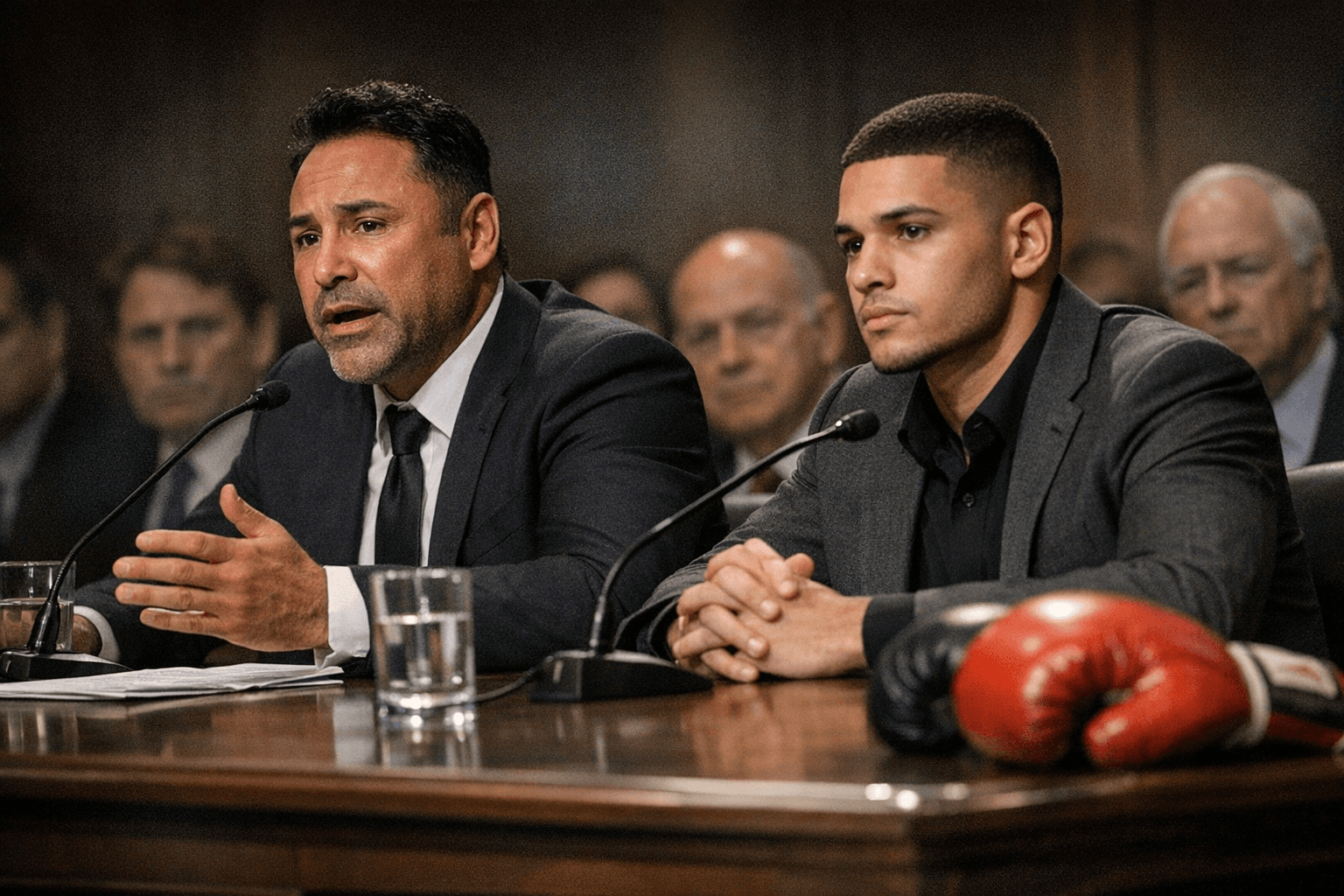
That concern goes to the core of the money and governance fight. If one organization can control the marketplace and the fighters who need access to it, promoters and organizers gain leverage while boxers lose bargaining power. De La Hoya argued that many fighters enter the sport young, trusting and without resources, and that a bad deal can be hard to escape. Walsh backed that view, tying the issue to the principle that the people controlling fighters should not also control the market those fighters depend on.
The current structure was shaped by Congress long before this latest fight. Federal boxing standards began with the Professional Boxing Safety Act of 1996 and were strengthened by the Muhammad Ali Boxing Reform Act, enacted on May 26, 2000. The 2000 law was aimed at unfair and anticompetitive practices, including boxing contracts and objective written criteria for rankings. The revival bill’s backers say it would expand choice and opportunity for professional boxers and strengthen safety precautions, but critics warn it could blur the line between promoter and regulator and deepen conflicts of interest.

For boxing, the debate is no longer only about belts and big fights. It is about who captures value in a fragmented sport, whether reform protects athletes or concentrates power, and how much of Muhammad Ali’s legacy of fighter protection survives the next overhaul.
This article was produced by Prism’s automated news system from verified source data, official records, and press releases, then run through automated quality and moderation checks before publishing. The system is built and supervised by the people who set the standards it runs under. Read our full AI policy.
Did this article answer your question?

