Dead birds in Orange County preliminarily test positive for HPAI; authorities warn
State officials said samples from dead wild birds in Orange County preliminarily tested positive for highly pathogenic avian influenza, a Feb. 27, 2026 confirmation reported by Mid‑Hudson News and News 12 Hudson Va.
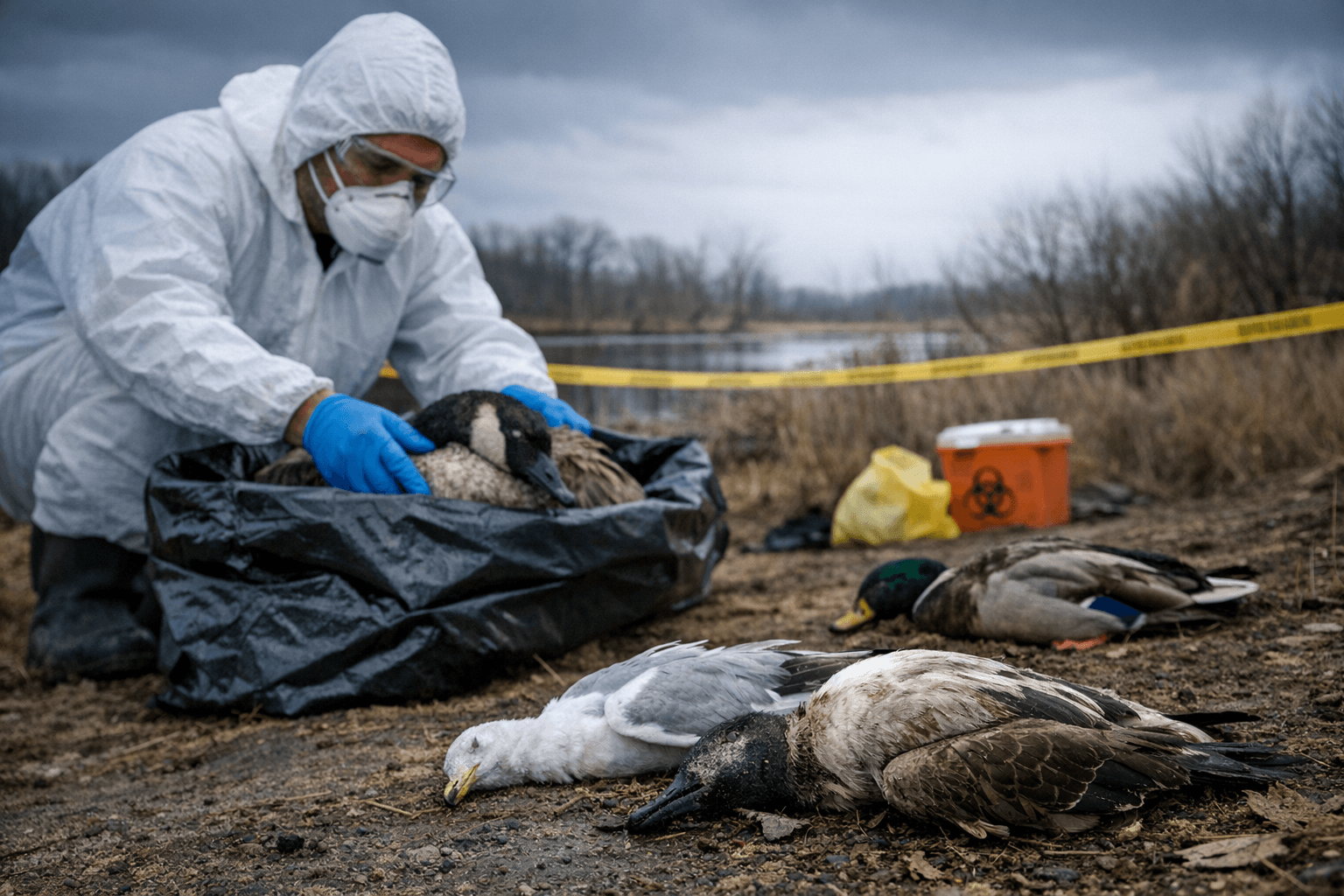
State environmental officials confirmed that samples taken from dead wild birds in Orange County have preliminarily tested positive for highly pathogenic avian influenza (HPAI), officials said Feb. 27, 2026, a confirmation reported by Mid‑Hudson News and News 12 Hudson Va. The announcement labels the results preliminary and does not yet include final confirmation from a national laboratory.
The initial local reports did not specify how many carcasses were involved, which species were tested, where in Orange County the carcasses were found, or the names of the state environmental officials who made the confirmation. That absence of detail leaves unresolved whether samples have been submitted to the National Veterinary Services Laboratory for confirmatory testing and what timeline the state intends to follow for final results.
Samples in HPAI investigations are typically collected by state wildlife agencies and USDA‑Wildlife Services. Prior New York cases were detected using molecular testing at Cornell’s Veterinary Diagnostic Lab and confirmed by the National Veterinary Services Laboratory, which Cornell’s bulletin referenced as being in "Aimes, Iowa." Those steps outline the usual testing pipeline pending confirmation for the Orange County samples.
National surveillance provides context for potential community risk. The Centers for Disease Control and Prevention notes that "Since 2022, many different wild bird species have been reported with HPAI A(H5N1) virus infection" and that detections in wild birds have been reported "in 50 states or territories," with outbreaks in commercial poultry or backyard flocks in 48 states since February 2022. Conservation reporting states that "Nationally, more than 7,000 wild birds have been confirmed dead from the virus over the past 18 months, but that’s only up about 500 in recent months after 6,500 were reported in the first year of the outbreak."
New York State experience includes a long list of affected species compiled by Cornell’s wildlife health team, including snow goose, Canada goose, tundra swan, mute swan, sanderling, black skimmer, Caspian tern, herring gull, great black-backed gull, American black duck, American wigeon, gadwall, green-winged teal, lesser scaup, mallard duck, northern pintail, northern shoveler, redhead duck, ring-necked duck, wood duck, pied-billed grebe, hooded merganser, common loon, great blue heron, double-crested cormorant, bald eagles, peregrine falcon, merlin, barred owl, eastern screech owl, great horned owl, snowy owl, cooper’s hawk, red-shouldered hawk, red-tailed hawk, American crow, common raven, fish crow, ruffed grouse, Black vulture, and turkey vulture.
Cornell’s past case reporting also documents mammal spillover: "A striped skunk was found dead in proximity to deceased Canada geese in late February in Tompkins County. The skunk and one Canada goose were collected and submitted for diagnostic evaluation. Both animals tested positive for HPAI (H5N1). This is the first skunk to test positive for Highly Pathogenic Avian Influenza (HPAI) in NYS."
Public health guidance from CDC highlights exposure risks and personal protective equipment. CDC lists examples of "HIGH RISK OF EXPOSURE" including "People in direct contact with sick or dead wild birds" and "Wildlife agency employees in direct contact with sick or dead wild birds, including defeathering, carcass removal and disposal." CDC also states that "Personal protective equipment (PPE) should be worn when in direct or close contact (within about six feet) with sick or dead animals" and enumerates PPE items including "properly fitted unvented or indirectly vented safety goggles, disposable gloves, boots or boot covers, a NIOSH‑Approved particulate respirator (e.g., N95® filtering facepiece respirator, ideally fit‑tested), disposable fluid‑resistant coveralls, and disposable head cover or hair cover."
Federal activity on vaccines remains preliminary; USDA reporting cited by conservation groups says vaccine trials began as of May 1 and that four existing bird flu vaccines are not applicable to the highly pathogenic strain, with single-dose and two-dose trial timelines previously described but "no official reports from the USDA yet."
Confirmatory lab results, species identification, and local response actions for the Orange County finding remain pending. State and county agencies have been identified as the primary contacts for follow-up; officials have classified the samples as preliminary and final confirmation from a national lab will determine next steps for wildlife handling, poultry protections, and any targeted public-health guidance.
Know something we missed? Have a correction or additional information?
Submit a Tip