Deep-Focus 6.0 Earthquake Shakes Tyrrhenian Sea Near Naples
A strong earthquake struck off Italy's west coast early Tuesday, rattling Naples and southern Italy with no immediate reports of casualties or major damage.
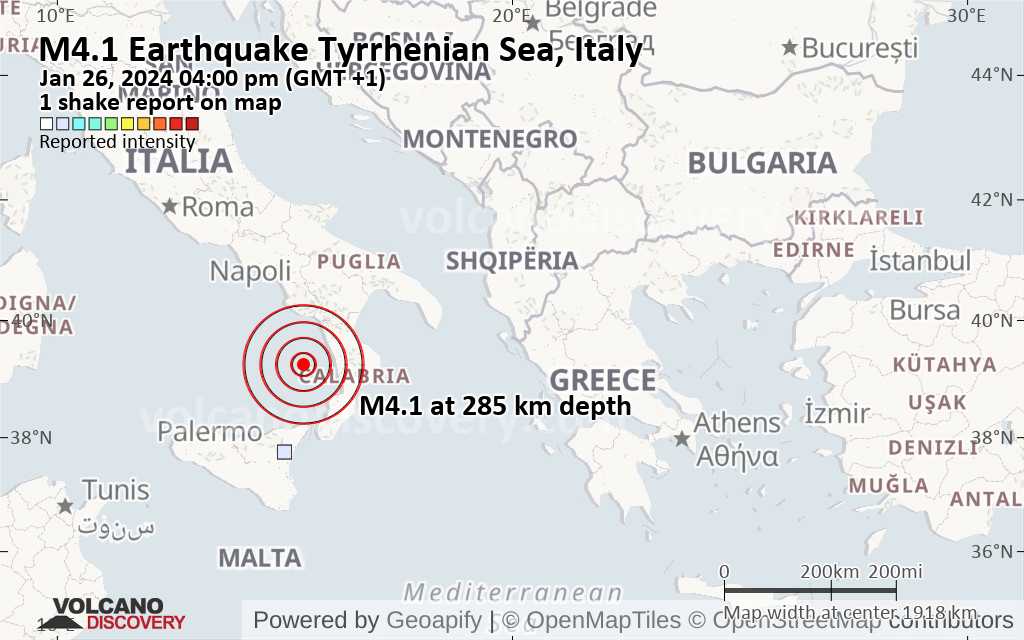
A strong earthquake registering magnitude 6.0 struck the Tyrrhenian Sea early Tuesday, with tremors rolling across southern Italy and reaching the streets of Naples, according to the U.S. Geological Survey. The epicenter was located roughly 10 miles southeast of Sant'Angelo, Italy, at coordinates 40.564°N, 13.975°E, with the temblor hitting at 12:03 a.m. Central European Time on March 10, 2026.
The earthquake's most striking characteristic was its extraordinary depth. The German Research Centre for Geosciences placed the magnitude at 6.1 and measured the quake at approximately 377 kilometers, or 234 miles, below the seabed, classifying it formally as a deep-focus earthquake. USGS data placed the depth at approximately 373 kilometers. Both readings tell the same fundamental story: the rupture occurred far below the earth's surface, in the lower mantle transition zone, which profoundly shapes how energy travels upward and dissipates across wide distances.
Deep-focus earthquakes behave differently from shallow ones. Because the energy must travel through hundreds of kilometers of dense rock before reaching the surface, shaking tends to spread across a broader geographic footprint but with reduced intensity at any single point. That dynamic likely explains why tremors were felt across parts of southern Italy, including the major city of Naples in the Campania region, without producing the localized catastrophic shaking that shallow quakes of comparable magnitude can cause. There were no immediate reports of major damage or casualties.
The two agencies reported slightly different magnitudes, 6.0 from USGS and 6.1 from GFZ, a routine discrepancy that reflects differing measurement methodologies and processing timelines. USGS seismologists cautioned that the reported magnitude may be revised as additional data are reviewed, and that shake-severity maps will be updated accordingly. Shaking intensity is assessed using the Modified Mercalli Intensity scale; the USGS map of the event highlighted areas registering an intensity of 4 or greater, which the agency defines as "light," while noting the earthquake could be felt beyond those mapped boundaries.

Authorities were monitoring the situation for aftershocks in the hours following the initial event. USGS protocols track aftershocks within 100 miles and seven days of a qualifying quake, with updated data incorporated into shake maps as readings are processed. Aftershock data compiled as of 1:18 a.m. Eastern Time on Tuesday was already factored into early monitoring maps.
The Tyrrhenian Sea sits within one of Europe's most seismically complex zones. The region reflects the ongoing collision between the African and Eurasian tectonic plates, a process that has produced some of Italy's most destructive historical earthquakes, particularly across the Apennine mountain chain and the Campania region. The deep-focus nature of Tuesday's event, however, distinguishes it from the shallow crustal quakes that have historically caused significant destruction in towns and cities across central and southern Italy.
Italian authorities and seismologists were expected to continue monitoring the area as scientists refined their analysis of the event and assessed whether significant aftershock activity would follow.
This article was produced by Prism’s automated news system from verified source data, official records, and press releases, then run through automated quality and moderation checks before publishing. The system is built and supervised by the people who set the standards it runs under. Read our full AI policy.
Did this article answer your question?


