Democracy Day protests in Lagos target Nigeria’s economic hardship
Hundreds marched in Lagos on Democracy Day, turning a civic celebration into a protest over hunger, joblessness and insecurity. The anger echoed poverty at 63% and fresh school kidnappings.
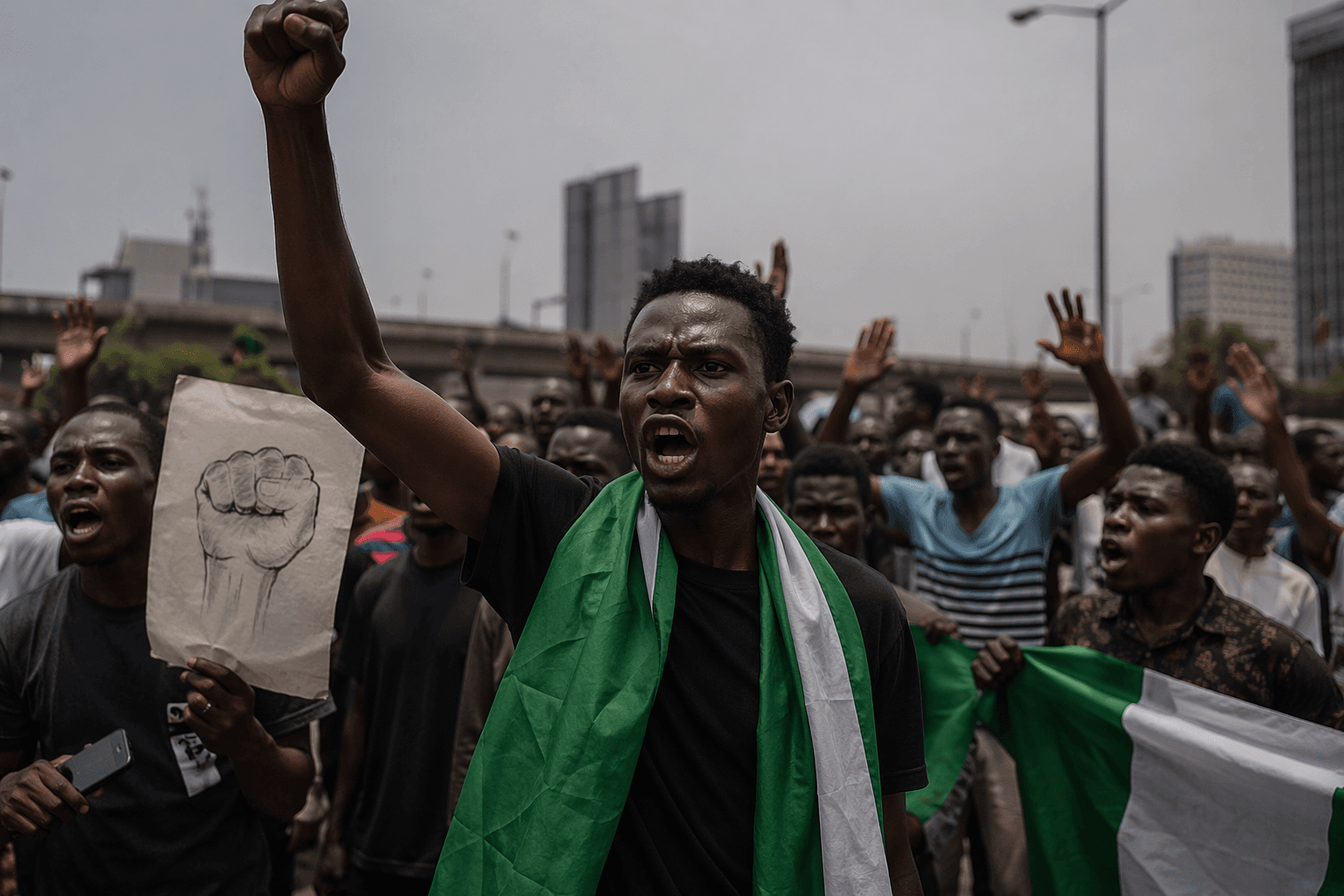
Hundreds of demonstrators took to the streets of Lagos on Friday, June 12, turning Nigeria’s Democracy Day into a protest against rising living costs, unemployment and worsening insecurity. Carrying placards and chanting for action, they demanded relief from hardship and the rescue of schoolchildren recently abducted in different parts of the country.
The federal government had declared Friday, June 12, 2026, a public holiday for the commemoration, but the anniversary exposed the distance between the country’s democratic symbolism and daily reality. June 12 marks the 1993 presidential election, widely regarded as Nigeria’s freest and fairest vote, won by Moshood Kashimawo Olawale Abiola before the military regime annulled the result. Restored as Democracy Day in 2018, replacing May 29, the date is meant to honor the struggle against military rule, yet for many Nigerians it now underscores how little civilian government has changed life on the ground.

Civil society groups helped organize the nationwide action, with Femi Falana and other activists backing the protests over insecurity, hunger and deteriorating living conditions. Their message was blunt: more than a quarter-century of civilian rule has not shielded ordinary Nigerians from inflation, joblessness and fear. The demonstrations in Lagos reflected that frustration in public, as protesters used the holiday to press the state on food prices, employment and the safety of children.
The economic backdrop has sharpened the anger. The World Bank says poverty in Nigeria rose to an estimated 63% in 2025, with about 7 million more people falling into poverty that year. It has also warned that poor households can spend up to 70% of their income on food, a burden that leaves little room for rent, transport or school costs. For families already stretched by high prices, the cost of living has become a daily emergency, not an abstract policy debate.
Security worries have compounded the strain. Nigeria continues to face attacks by Boko Haram and its splinter faction, Islamic State West Africa Province, alongside armed bandit groups that abduct people for ransom in other parts of the country. Protesters pointed to recent kidnappings of schoolchildren in Oyo State, Borno State, Kebbi State and Zamfara State as proof that the government has not been able to protect civilians. The memory of the Chibok abduction, when nearly 300 girls were taken in 2014, still hangs over the country’s conscience.
President Bola Ahmed Tinubu used his Democracy Day address to call for national unity and urged Nigerians to keep faith in democratic institutions. He said the country had recorded 27 unbroken years of civilian rule since May 29, 1999, and tied the anniversary to upcoming elections in Ekiti State and Osun State, urging peaceful and credible polls. But in Lagos, the day’s message was more immediate: a democracy that cannot ease hunger or insecurity is facing a growing public test.
This article was produced by Prism’s automated news system from verified source data, official records, and press releases, then run through automated quality and moderation checks before publishing. The system is built and supervised by the people who set the standards it runs under. Read our full AI policy.
Did this article answer your question?