Democrats see narrow path to Senate majority in 2026 battlegrounds
Democrats have a map, but it is thin: they must defend three seats, win four more, and hope candidate quality and turnout break their way.
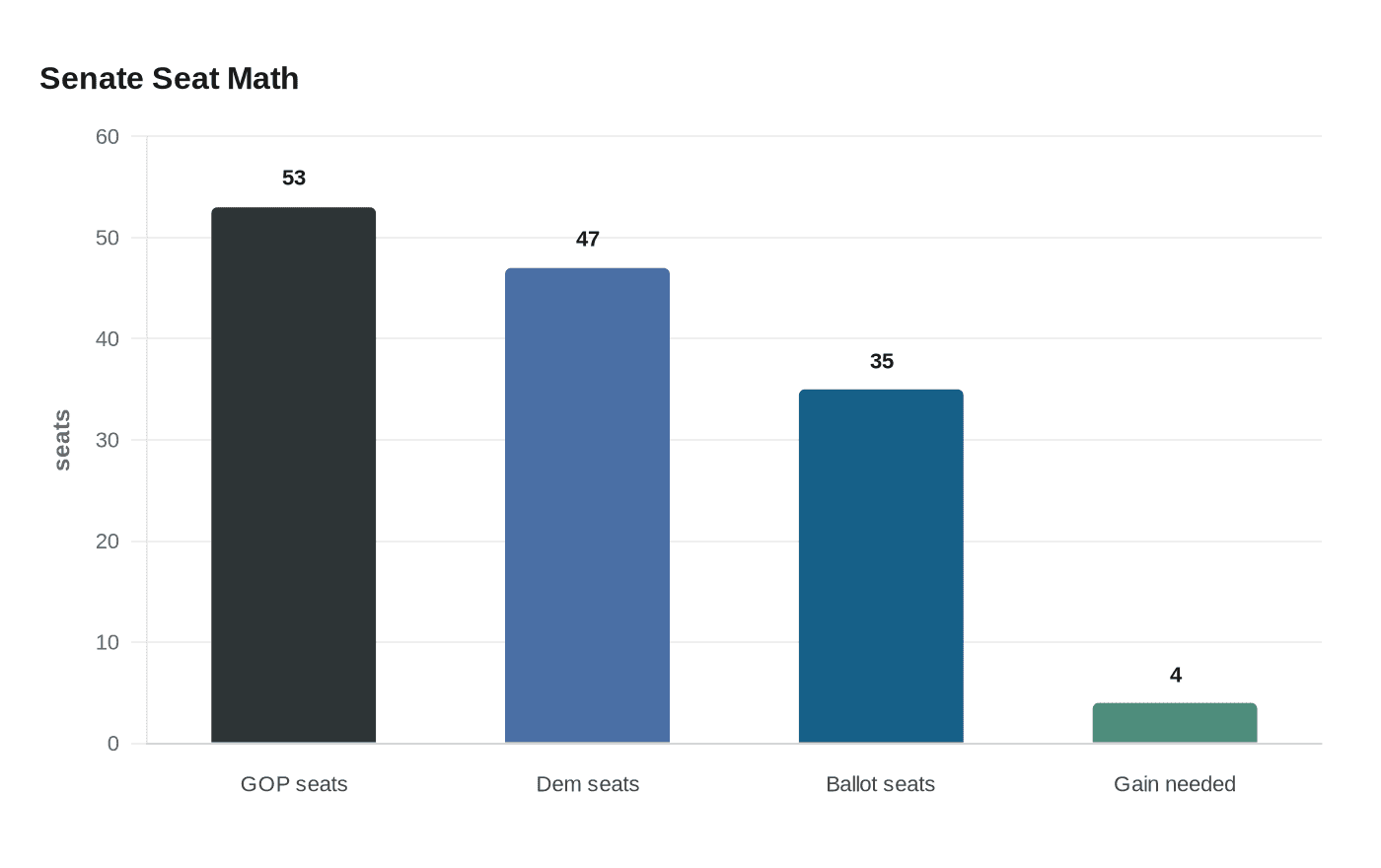
The Senate map is narrow before it is competitive
Democrats are not looking at a wave year. They are looking at a math problem. Republicans hold a 53-47 Senate majority, 35 seats are on the 2026 ballot, and Democrats need a net gain of four seats to take control in 2027. Even a three-seat gain would leave Republicans positioned to keep power through the vice president’s tie-breaker, which is why strategists describe the party’s route back to the majority as “incredibly narrow.”
That makes the battleground map more revealing than a simple list of close races. Ballotpedia has identified 11 general-election battlegrounds, but the real story is how concentrated the fight is inside a handful of states where turnout patterns, candidate quality, and local conditions could matter as much as national mood. Democrats’ challenge is not just to find openings. It is to find the right openings, in the right places, with the right nominees.
What Democrats are trying to hold, and what they are trying to flip
The party’s campaign arm is treating Michigan and New Hampshire as must-hold seats while aiming offensively at Alaska, Maine, North Carolina, and Ohio. That is a telling strategy because it assumes Democrats cannot waste resources chasing every competitive contest. They need a disciplined map that protects existing seats and identifies a few Republican-held races where the numbers are at least plausible.
The defensive side is not trivial. Jon Ossoff is seeking reelection in Georgia, a state that has become central to Senate control fights, and Democrats also have to navigate the usual presidential-year turnout shifts in states that are less forgiving when the top of the ticket is competitive. On the Republican side, Susan Collins in Maine and John Cornyn in Texas are among the incumbents facing strong challenges, which shows that the overall field is wider than the six-state core Democrats are publicly emphasizing.
Why the seat math keeps pointing back to six states
The current structure of the cycle explains why the map feels both crowded and unforgiving. There are 35 Senate seats on the ballot, and the 2026 class includes special elections in Florida and Ohio, adding complexity to the balance of power. Ohio is especially notable because one of those contests will fill the remainder of JD Vance’s term, creating an extra opening in a state already on the list of Republican-held targets.
That matters because Senate control is not determined by how many races are competitive in the abstract. It turns on where the party can convert narrow opportunities into actual flips while holding every seat it is expected to defend. The current forecast still leaves Republicans with the more favorable map, even as Democrats argue that their best path runs through a limited set of states where turnout changes and candidate quality could create room for an upset.
Michigan and New Hampshire are the base, not the breakthrough
For Democrats, Michigan and New Hampshire are the foundation of the strategy because any route to the majority starts with defending seats that should remain in the party’s column. TIME notes that the Democratic-held trio of Michigan, New Hampshire, and Georgia were previously won by Democrats with an average of 52% of the vote. That is not a landslide cushion, but it is a useful reminder that these seats are not all equally vulnerable.
The broader political lesson is that the party’s best offensive hopes depend on preserving core terrain first. If either Michigan or New Hampshire slips, Democrats would have to replace those losses with even more difficult pickups elsewhere. In that sense, the holds are part of the offensive map, because they determine whether Democrats can keep enough bandwidth to contest the Republican-held targets that look even remotely winnable.
The Republican-held targets are hard for different reasons
Alaska, Maine, North Carolina, and Ohio are the states Democrats are actively targeting, but none of them resembles a clean pickup. TIME’s historical framing is sobering: Republicans won those seats six years ago with 54% in Alaska, 51% in Maine, 49% in North Carolina, and 53% in Ohio. Those margins suggest four very different kinds of fights, from a more secure incumbent position to a seat that was already won by a single-digit edge.
That spread is why party wish-casting can outrun the numbers if Democrats are not careful. Maine may be the most obvious place to look because Susan Collins has survived repeated challenges, yet her durability is also the reason the seat remains difficult. North Carolina and Ohio are more obvious presidential-year battlegrounds, where turnout can tighten the gap, but they are still states where Democrats need a strong candidate, a favorable national climate, and a message that lands beyond the party base.
Candidate quality and Trump’s role may matter as much as the map
Republican leaders are worried about two forces that do not show up in a simple ratings chart: Donald Trump’s influence in primaries and the quality of the eventual nominees. If Trump pushes the nomination process toward weaker candidates, Democrats could gain openings in races that otherwise would have favored the GOP. That is especially important in states where a nominee’s personal strengths can either blunt or amplify national headwinds.
The flip side is that Trump’s neutrality could help Republicans avoid self-inflicted damage. In a map this tight, the difference between a disciplined incumbent and a nominee weakened by intraparty conflict can decide whether a race stays out of reach or becomes contestable. That is why GOP leaders are not just watching polling; they are watching the shape of the primary calendar and who emerges from it.
Why Democrats call it narrow, not easy
The strongest evidence against overreading the map is the baseline itself. Republicans still have the more favorable terrain, Democrats need four net gains, and the cycle includes special elections that complicate the arithmetic rather than simplifying it. With 11 battlegrounds spread across a 35-seat ballot, the party has multiple theoretical paths, but theory is not the same as a winnable coalition of states.
That is also why recent reporting about multiple Democratic paths, including some deep-red states, should be read cautiously. A path exists only if it connects candidate strength, presidential-year turnout, suburban drift, and local issues in the same races at the same time. For now, the most accurate way to describe the 2026 Senate landscape is not as a wave in waiting, but as a highly constrained test of whether Democrats can squeeze four gains out of a map that still tilts the other way.
This article was produced by Prism’s automated news system from verified source data, official records, and press releases, then run through automated quality and moderation checks before publishing. The system is built and supervised by the people who set the standards it runs under. Read our full AI policy.
Know something we missed? Have a correction or additional information?
Submit a Tip