Democrats Sue Trump Over Executive Order Reshaping Mail-In Voting Rules
Major Democratic groups filed suit Wednesday against Trump's mail voting order, which would ban USPS from delivering ballots to anyone not pre-screened by the federal government.
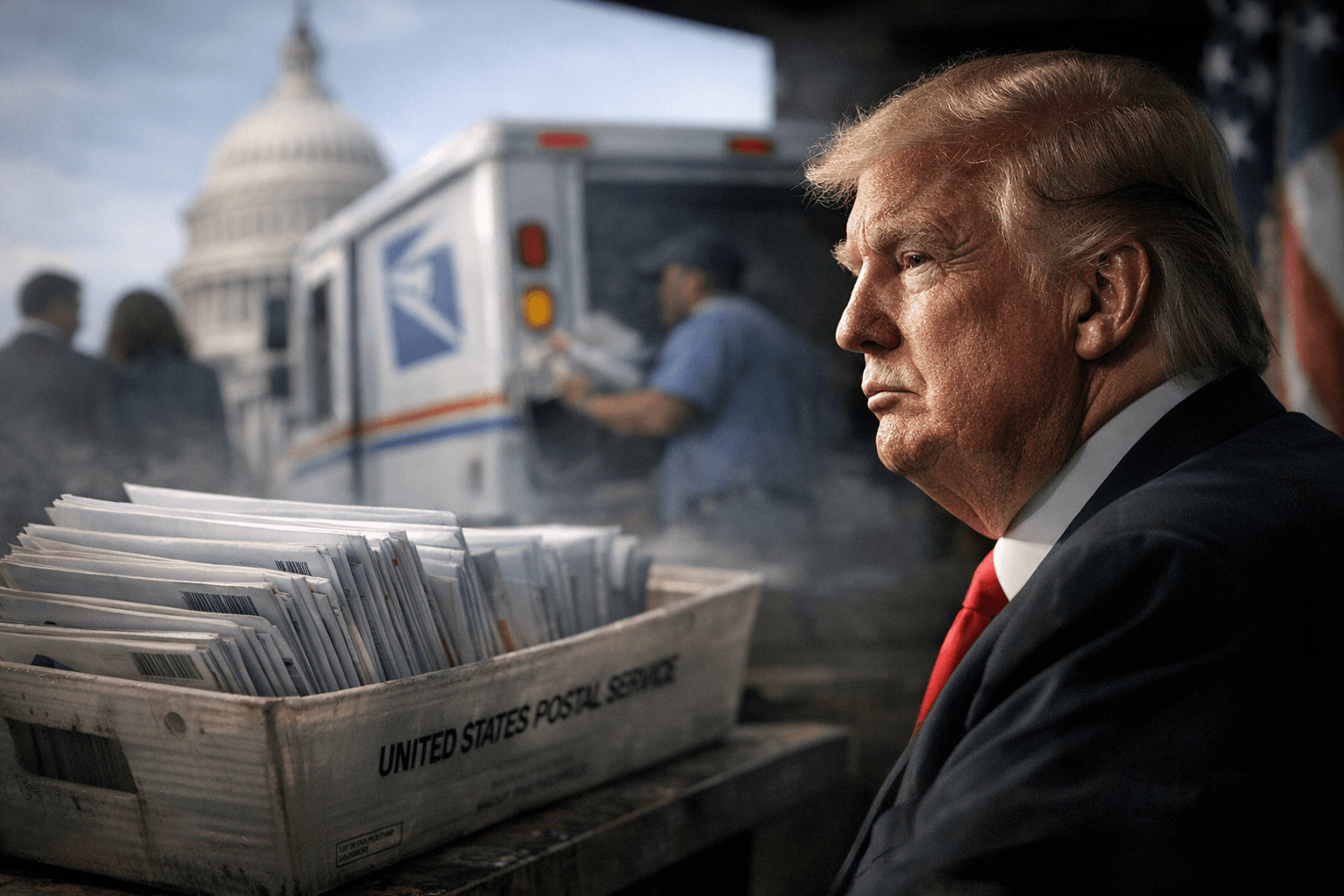
A coalition of the Democratic Party's major national organizations filed the first legal challenge to President Trump's executive order on mail-in voting Wednesday, arguing the White House is attempting the same unconstitutional power grab that three federal courts already blocked.
The Democratic National Committee, Democratic Governors Association, and the party's two major congressional campaign committees, joined by Senate Minority Leader Chuck Schumer and House Minority Leader Hakeem Jeffries, sued in U.S. District Court for the District of Columbia two days after Trump signed the order on March 31. At its core, the lawsuit frames the dispute as a federalism fight: the Elections Clause of Article I, Section 4 assigns authority over federal election procedures to states and Congress, not the president.
The order, titled "Ensuring Citizenship Verification and Integrity in Federal Elections," would change how mail ballots are requested, verified, and delivered. DHS Secretary Markwayne Mullin would compile "State Citizenship Lists" using Social Security Administration data and transmit them to state election officials. USPS would be barred from delivering any mail ballot to a voter not pre-verified on those lists. States would have to submit their mail-voter rolls to USPS at least 60 days before a federal election, and Attorney General Pam Bondi would be authorized to investigate and potentially prosecute local election officials who issue ballots to ineligible voters.
That 60-day cutoff would effectively lock out entire categories of voters. A college student who registers close to Election Day, a service member deployed overseas, or a married woman whose name change appears in state records but not yet in federal databases could each find themselves barred from receiving a ballot. Wisconsin Elections Commission chair Ann Jacobs raised the conflict directly: Wisconsin law allows voters to request mail ballots far closer to Election Day, leaving unresolved what happens to those voters if federal lists exclude them.
The Brennan Center for Justice, which successfully challenged Trump's first election executive order, warned that federal citizenship lists are "incomplete and inaccurate," compounding what it described as the postal service's existing operational strain. National Rural Letter Carriers' Association president Don Maston was more direct: "The Postal Service is not an election administration agency. It is not a substitute for state election administrators, and it is not equipped or authorized to decide who is or is not entitled to vote."
The legal terrain here is already mapped. Executive Order 14248, signed in March 2025, sought similar changes to mail voting and voter registration and was blocked by three federal courts. Judge Colleen Kollar-Kotelly ruled that "our Constitution does not allow the President to impose unilateral changes to federal election procedures." UCLA election law expert Rick Hasen said the new order faces identical constitutional obstacles and that implementing the citizenship list and 60-day infrastructure by November would be "virtually impossible" even without a court injunction.
The joint plaintiff statement called the order "an unconstitutional power grab from Donald Trump that attacks vote by mail, gives DOGE sensitive personal information and makes it harder for states to run their own free and fair elections." State officials in Arizona, Colorado, Nevada, Minnesota, Oregon, and Wisconsin separately signaled plans to sue.
The order's stated rationale, combating mail voting fraud, runs into a 2025 Brookings Institution report finding fraud in just 0.000043 percent of ballots, roughly four cases per 10 million. In 2024, nearly a third of all American voters cast mail ballots, and eight states automatically mail ballots to every registered voter. The Supreme Court is also expected to rule this year on whether Mississippi may count ballots postmarked by Election Day but received after it, a decision that could further define the limits of federal authority over mail voting before November's midterms arrive.
This article was produced by Prism’s automated news system from verified source data, official records, and press releases, then run through automated quality and moderation checks before publishing. The system is built and supervised by the people who set the standards it runs under. Read our full AI policy.
Did this article answer your question?

