Despite Heavy Losses, Iran Retains Missiles, Nuclear Material, and Regional Proxies
One month into Operation Epic Fury, Iran still fires missiles, holds enriched uranium the IAEA can't locate, and coordinates regional proxies despite heavy U.S.-Israeli strikes.
One month into Operation Epic Fury, the Trump administration is weighing a wind-down of its air campaign against Iran even as the five objectives it set at the war's outset remain either partially fulfilled or impossible to verify on the ground.
The goals Trump laid out publicly are specific enough to grade: obliterate Iran's ballistic missile arsenal and production capability, annihilate its navy, sever its support for terrorist proxies, ensure Iran never acquires a nuclear weapon, and, in the fifth objective added last week, achieve complete degradation of Iranian missile capability. Trump himself stated the aim as to "destroy their missiles and raze their missile industry to the ground," and his administration acknowledged the capability had been "significantly degraded." The gap between "degraded" and "obliterated" is where the scorecard gets complicated.
Iranian missiles continue to disrupt shipping through the Strait of Hormuz. Analysis of Iran's 2026 strikes on Israel showed the number of missiles launched was far lower than during the Twelve-Day War in 2025, when Iran commonly fired large barrages to overwhelm Israeli defenses, a reduction attributed to joint U.S.-Israeli efforts to eliminate as many as three-quarters of Iranian launchers and storage locations. Reduced is not eliminated. Iran's Sejjil missile, a solid-fuel system, offers faster launch readiness than liquid-fuel variants, giving Iran survivable, responsive options even when expecting incoming strikes.
The nuclear accounting is murkier still. By mid-2025, Iran had stockpiled approximately 441 kilograms of uranium enriched to 60 percent, enough fissile material for multiple nuclear weapons if further enriched to weapons-grade 90 percent. Two rounds of U.S.-Israeli strikes, in June 2025 and February through March 2026, severely degraded Iran's enrichment capacity, but the fate of much of that stockpile remains unknown. Trump in June 2025 declared the U.S. had "obliterated" Iran's nuclear program after striking Fordow, Natanz, and Isfahan with GBU-57 bunker-buster bombs, but IAEA inspectors have been unable to verify the location of the near weapons-grade uranium since that operation. The lack of inspections has made it difficult to know exactly where the material is located. IAEA Director General Rafael Grossi stated on March 9 that some of the 60 percent enriched uranium may still be at Natanz.
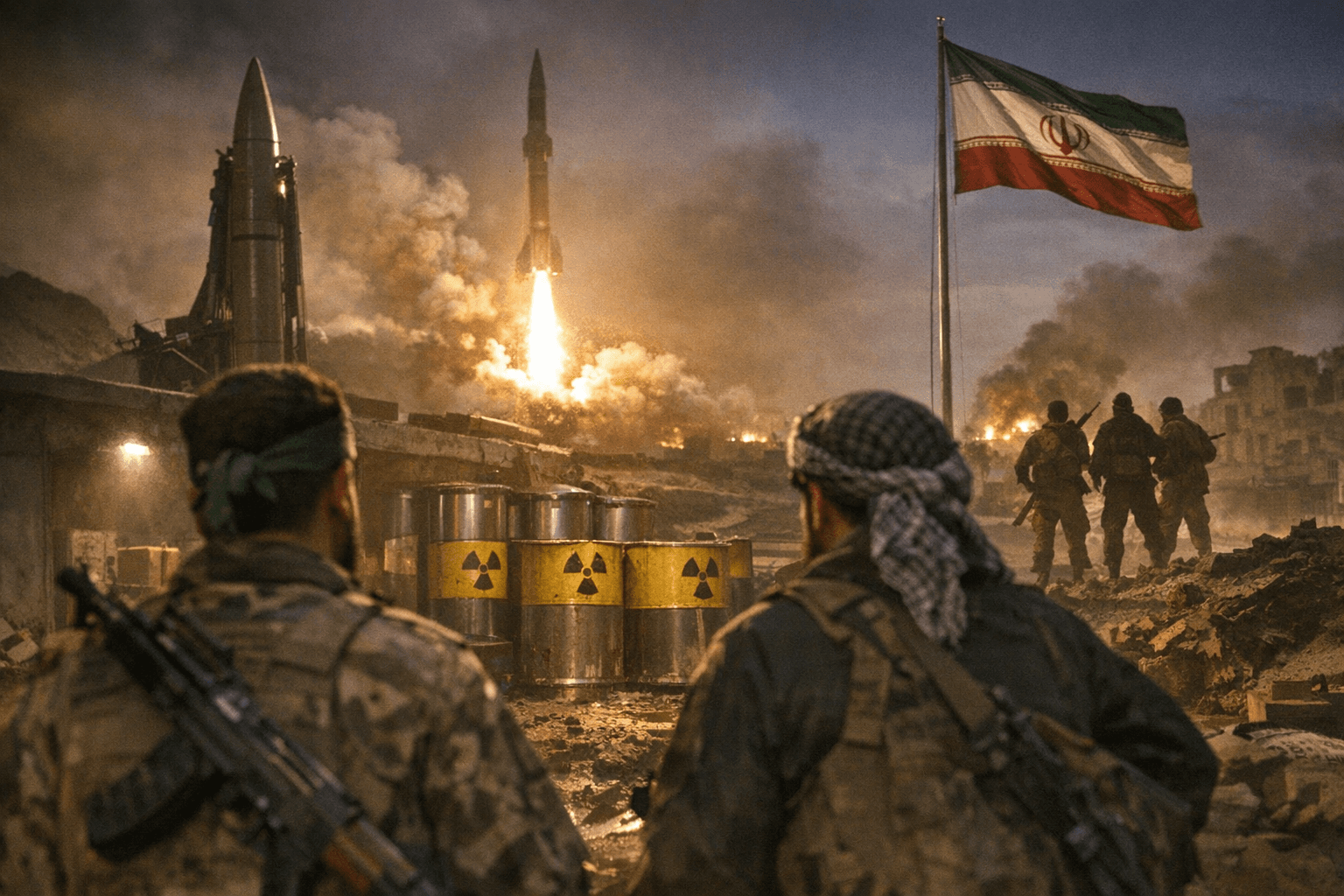
On proxy networks, the results are mixed. The Israeli strategy over the past two years, which transformed from containing Iranian proxies to directly striking Iran, succeeded in neutralizing Hezbollah's second-strike threat in Lebanon. But neutralizing a second-strike threat is not the same as severing Iran's coordination with regional militias entirely. Iran's current doctrine combines a semblance of willingness for diplomacy with the West while prioritizing rehabilitation of air defense capabilities, restoration of the ballistic missile program, and acceleration of fortifying nuclear facilities deep underground.
It is unclear how much of Iran's Revolutionary Guard navy remains or whether it has planted mines in the Strait of Hormuz, leaving that objective unverifiable by any open measure.
The central problem with Trump's framework is the absence of defined exit criteria. He has suggested the operation may soon be "winding down," but none of the five objectives carries a measurable threshold for success. Without one, the war ends when the president decides it does, not when Iran's missiles, nuclear material, or proxy networks are gone.
This article was produced by Prism’s automated news system from verified source data, official records, and press releases, then run through automated quality and moderation checks before publishing. The system is built and supervised by the people who set the standards it runs under. Read our full AI policy.
Did this article answer your question?