DJI Avata 360 Drone Brings Integrated Spherical Camera to Compete With Rivals
DJI's Avata 360 launches today with an integrated 8K spherical camera at roughly $496 — undercutting Antigravity's competing A1 drone by more than $1,100.
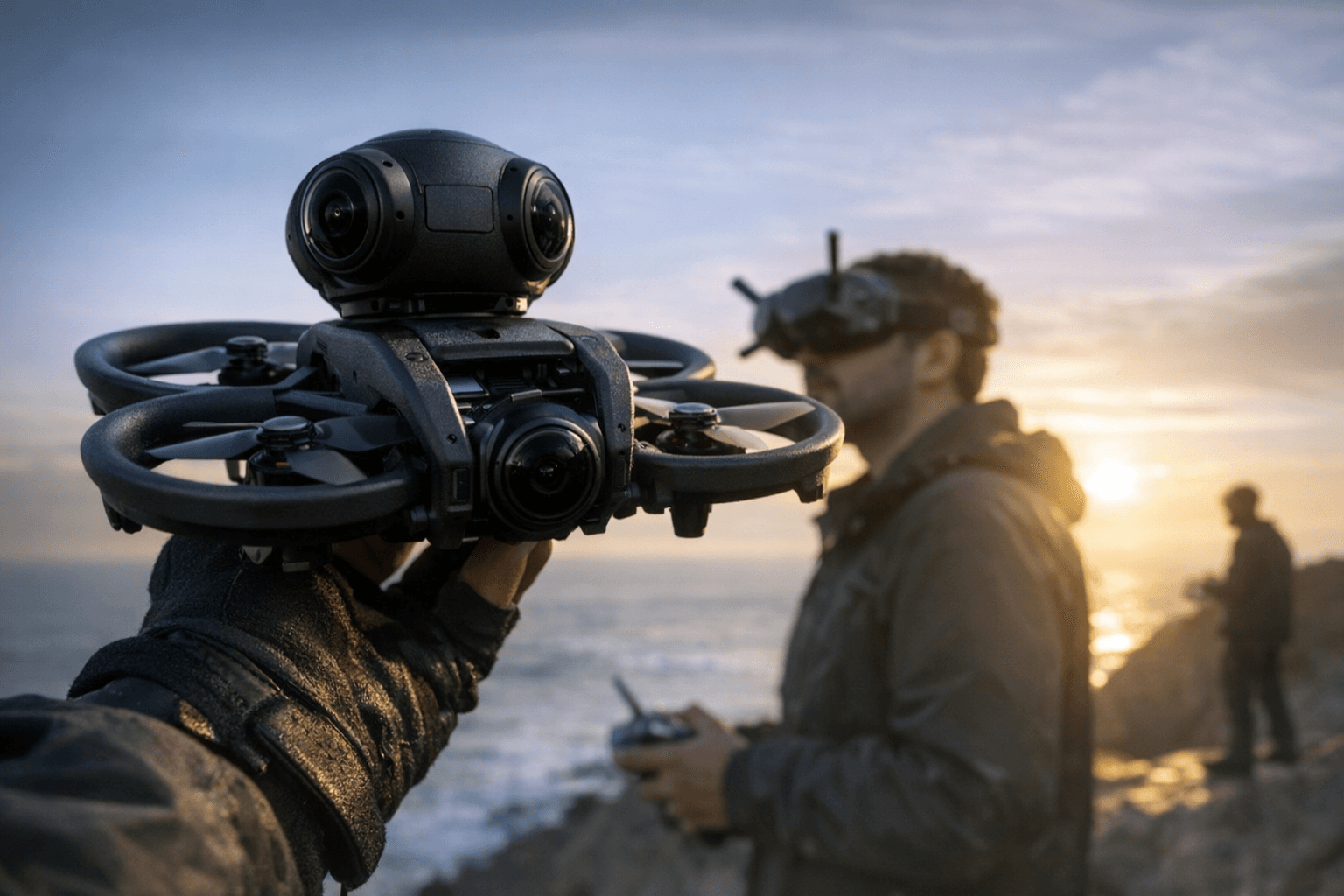
At a drone-only price of roughly $496, the DJI Avata 360 undercuts the Insta360 Antigravity A1 by more than $1,100 — and that price gap may say as much about DJI's competitive strategy as any spec sheet ever could.
Just as DJI geared up to release the Avata 360 FPV drone, it launched a legal offensive against fast-growing rival Insta360, combining its FPV drone expertise with fully immersive 360-degree capture in a product slated for a March 26 release. The Avata 360 is only the second consumer drone to integrate a native 360-degree camera system directly into the aircraft. The first was Insta360's Antigravity A1, which launched last year and established the 360-degree drone category.
The hardware itself draws heavily from DJI's existing Avata lineage. The Avata 360 appears slightly larger than its predecessor, the Avata 2, with a grey cinewhoop-style frame and full spherical guards. The camera module rotates so one lens faces upward and the other downward, capturing a complete sphere around the drone. Leaks and teasers point to 8K 360-degree video capture, upgraded obstacle sensing, LiDAR-assisted navigation, and compatibility with DJI's latest video headsets and motion controllers. The design prioritizes safety and indoor-outdoor versatility, though the tradeoff is weight: the drone exceeds the 250-gram regulatory threshold that determines registration requirements in most major markets.
One of the more practical engineering choices is an automatic mode-switching system. When landing on rough surfaces, the camera module rotates to a single forward-facing configuration, with rubber pads protecting the protruding bottom lens. Once airborne, the drone switches back to full 360-degree mode automatically. Pilots can also trigger the single-lens mode manually via controller — producing footage that, according to early testers, "flies much more like a standard FPV drone" and can be used straight from storage without reframing or keyframing in post.
That post-production workflow, handled through DJI Studio, is a significant selling point. Compatibility with DJI's existing RC 2 controller, Goggles N3, and Motion 3 means anyone already inside the DJI ecosystem faces a shorter, cheaper upgrade path. With goggles, a head-tracked immersive experience lets pilots look around freely while the drone continues flying straight. The Avata 360 slots directly into DJI's existing RC 2, Goggles N3, and Motion 3 ecosystem, while the Antigravity A1 doesn't have that ecosystem depth — it's a standalone product at a standalone price.
Animated keyframes inside DJI Studio allow a single flight to produce footage with dynamic camera movements otherwise requiring advanced FPV piloting skills. Exports are available in multiple aspect ratios for both horizontal and vertical platforms. The drone is also reportedly removed from the stitched 360-degree video in post, though the precise mechanism for that feature has not been fully detailed ahead of launch.
The pricing gap with the Antigravity A1 is already applying pressure. The Antigravity A1 drone discount arrived before an April feature update, with Oscar Liang noting the company recently began offering a 20% discount on the $1,599 A1, which he characterized as possibly driven by competition pressure from DJI.
For U.S. buyers, the story carries a harder edge. The DJI Avata 360 stands as the most recently FCC-authorized DJI product — one of the last models American buyers can still purchase through legitimate channels, having cleared authorization before the December cutoff. The FCC added unmanned aircraft systems produced in foreign countries to its Covered List under a December 22, 2025 deadline in the 2024 National Defense Authorization Act. DJI filed a lawsuit against the FCC on February 20, 2026 in the Ninth Circuit, but that case will not resolve before launch.
A newly updated banner on DJI's official Amazon US storefront now points to March 30 at 8 a.m. EST as the release timing for the Avata 360, subtly overriding the March 26 worldwide launch window. Orders appear to be going live in other parts of the world today, while US sales or preorders won't begin until March 30 — a pattern that's becoming increasingly common for DJI launches in the US because of regulatory scrutiny and import hurdles. For now, global buyers can move immediately; American pilots will have to wait a few more days — and then decide whether to act before the window closes entirely.
Know something we missed? Have a correction or additional information?
Submit a Tip