DOJ Sues Idaho Over Failure to Produce Voter Registration Records
Idaho's top election official signed a voter data-sharing agreement, then reversed course. Now the federal government is suing.
Idaho Secretary of State Phil McGrane signed a data-sharing agreement with the Justice Department last fall, appeared poised to comply with federal election record demands, and then in February 2026 reversed course entirely, telling federal officials there was "no clear legal duty" to turn over the requested data. That reversal landed Idaho in federal court when the DOJ's Civil Rights Division filed suit on April 1, compelling disclosure of the state's complete statewide voter registration list.
The lawsuit invokes a provision of the Civil Rights Act of 1960, under which the DOJ argues it holds broad authority to demand election records. Under that statutory framework, the Attorney General need only demonstrate that a written request was made and denied; as the complaint states, "the court does not adjudicate any further."
Federal officials demanded the database "with all fields," including names, addresses, birthdates, and either driver's license numbers or the last four digits of Social Security numbers. Idaho's initial response fell short of that standard: the state had provided the federal government a list of all registered voters, but with personal information censored.
The DOJ formally requested Idaho's statewide voter registration list in September 2025 as part of an investigation into compliance with federal election laws, including the Help America Vote Act. McGrane initially appeared willing to comply, with the Secretary of State's office acknowledging the DOJ's authority, but by February 2026 the state reversed course, claiming "no clear legal duty exists" and pointing to Idaho law's strict governance of voter information disclosure.
Assistant Attorney General Harmeet K. Dhillon, who leads the Civil Rights Division, framed the lawsuit as the department's statutory obligation. "Many state election officials, however, are choosing to fight us in court rather than show their work," Dhillon said. "We will continue to verify that all States are carrying out critical election integrity legal duties."
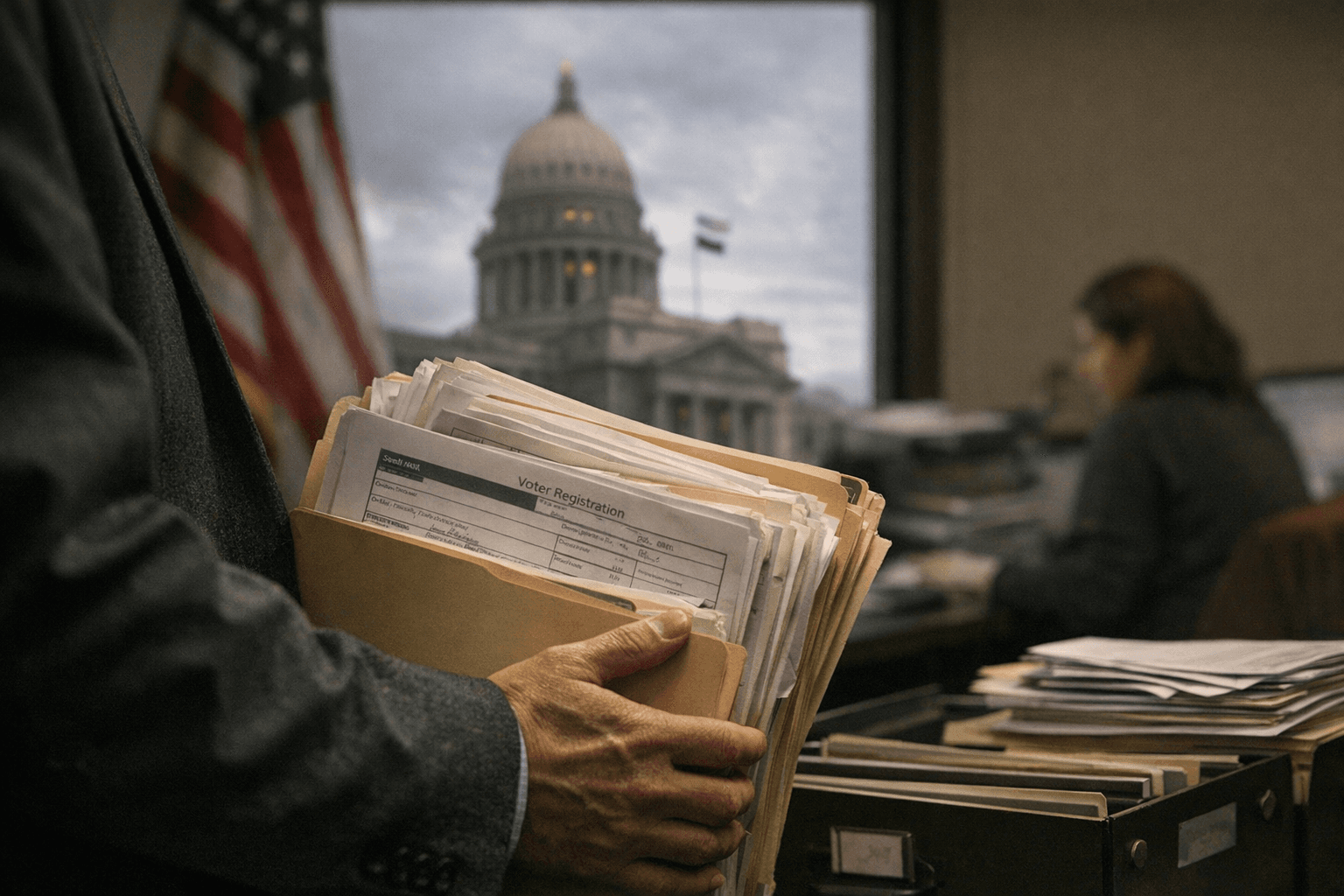
The case makes Idaho one of 30 states, plus the District of Columbia, now facing similar federal actions. That scale signals the DOJ views access to voter registration rolls as a structural pillar of federal oversight rather than a case-by-case intervention, and that states withdrawing earlier cooperation will face litigation rather than renewed negotiation.
The enforcement pattern is now predictable: federal requests are sent, an initial compliance window opens, and lawsuits follow when states withhold data fields or revoke agreements. The case comes as the department presses forward with its voter roll campaign despite mounting setbacks in court, meaning that judicial rulings in cases like Idaho's could either validate or significantly constrain the department's inspection theory across all remaining jurisdictions simultaneously.
For state election administrators who have not yet faced formal demands, the Idaho timeline is instructive. What began as a cooperative agreement McGrane signed in fall 2025 became a constitutional fault line over data fields and the boundaries of federal inspection authority. With the 2026 midterm election cycle underway, any ruling on whether the Civil Rights Act of 1960 strips courts of discretion to examine the underlying rationale for federal data demands will carry consequences well beyond Boise.
This article was produced by Prism’s automated news system from verified source data, official records, and press releases, then run through automated quality and moderation checks before publishing. The system is built and supervised by the people who set the standards it runs under. Read our full AI policy.
Did this article answer your question?

