DOL Guidance Clarifies When Volunteer Service Falls Outside FLSA Employee Status
DOL guidance clarifies when unpaid volunteers are not employees under the FLSA and warns nonprofits and public employers how to avoid wage-and-hour liability.
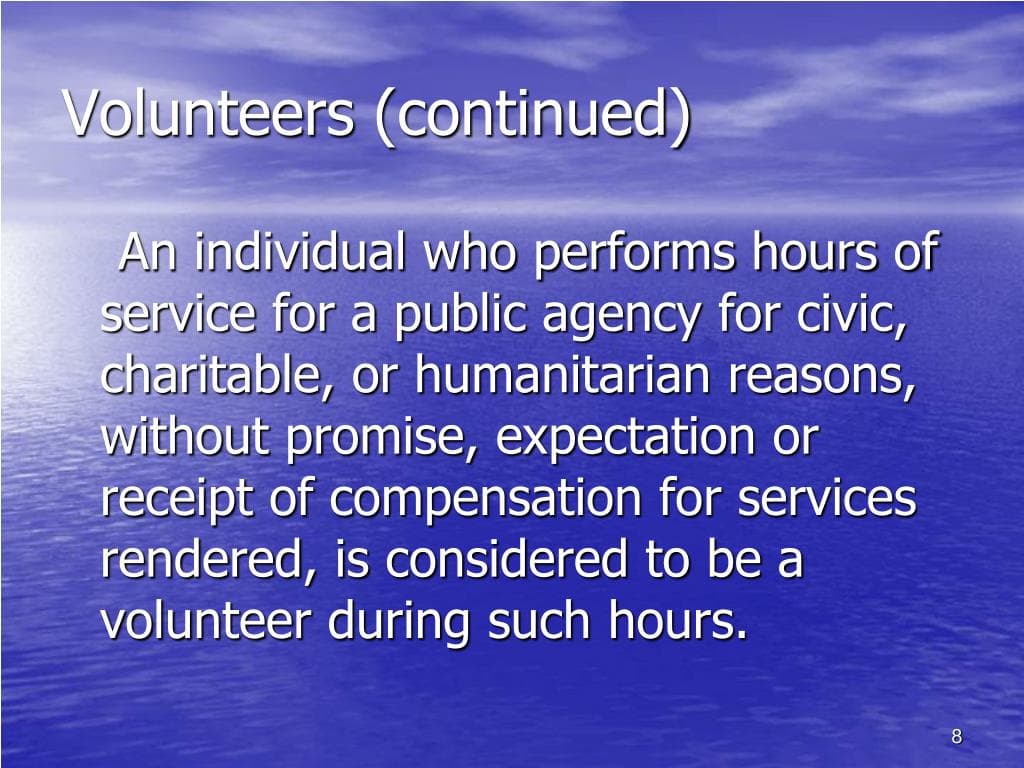
The Department of Labor has laid out the lines between voluntary service and employment under the Fair Labor Standards Act, giving nonprofits, public agencies, and employers clearer markers to avoid wage-and-hour disputes. The guidance reiterates that unpaid service given for public service, religious, or humanitarian objectives normally falls outside the FLSA’s minimum wage and overtime rules, but it also highlights several common traps that turn volunteers into employees.
The agency uses the FLSA’s statutory framework to draw that line. The DOL follows the act’s definition of employment and the Supreme Court’s caution that the FLSA was not intended "to stamp all persons as employees who without any express or implied compensation agreement might work for their own advantage on the premises of another." The department cites Sections 203(e)(4) and 203(e)(5) when describing exclusions for public agencies and nonprofit humanitarian programs. One excerpted statutory fragment reads in part: "(4)(A) The term 'employee' does not include any individual who volunteers to perform services for a public agency ... (5) The term 'employee' does not include individuals who volunteer their services solely for humanitarian purposes to private non-profit food banks and who receive from the food banks groceries." The text also notes subsection (4)(B) permitting an employee of one public agency to volunteer for another, including mutual aid partners.
Not every unpaid contribution is protected. The DOL states plainly, "Individuals may volunteer time to religious, charitable, civic, humanitarian, or similar non-profit organizations as a public service and not be covered by the FLSA." It adds that "A volunteer generally will not be considered an employee for FLSA purposes if the individual volunteers freely for public service, religious or humanitarian objectives, and without contemplation or receipt of compensation." At the same time, the guidance warns that "Individuals generally may not, however, volunteer in commercial activities run by a non-profit organization such as a gift shop," and multiple sources emphasize that volunteering is not available as a way to provide unpaid labor to for-profit employers.
Legal advisers and practitioners stress practical limits. WilliamsParker summarizes the DOL view of a volunteer as someone who "donates services to religious, charitable, or other similar nonprofit organizations, usually on a part-time basis," acts "without coercion," and serves "without the expectation or receipt of compensation in cash or in in-kind benefits." The firm also cautions that "If a volunteer does displace a regular employed worker or performs work that would otherwise be performed by regular employees, that volunteer would likely be considered an employee under the FLSA."

For nonprofits that run or receive corporate employee volunteer programs, Venable highlights the agency’s opinion guidance and practical guardrails. "The DOL's recent Opinion Letter FLSA2019-2 outlines some of the key guidelines to protect nonprofits against such employee wage and hour claims," the firm notes, and it adds that a volunteer program to fall outside the FLSA "must be optional and designed to promote volunteering generally or incentivize employees to engage in community service and charity activities during the employees' non-work time, at their own discretion, and generally without the nonprofit's supervision or direction." Venable emphasizes that "Activities performed pursuant to such programs will not count as 'hours worked' for FLSA purposes, if the employee's involvement is truly voluntary, meaning that the nonprofit does not unduly pressure employees to participate and there are no negative consequences for employees who do not participate."
The DOL and practitioners also list common permissible volunteer activities and individual-coverage caveats, from driving a school bus for a band trip to folding bandages for the Red Cross, while noting that work forming part of interstate commerce can create individual FLSA coverage. The overall message is procedural: labeling someone a volunteer is not enough. Nonprofits and public agencies must design optional, noncoercive programs, avoid substituting volunteers for paid staff, and be careful how they treat expenses, benefits, or nominal fees so those payments are not treated as wages.
For workers and managers, the guidance clarifies when an unpaid role is genuinely voluntary and when it creates an employer-employee relationship that triggers pay protections. Organizations that depend on volunteer labor should review program design, supervision, and any incentives tied to participation to reduce legal risk.
Know something we missed? Have a correction or additional information?
Submit a Tip