Dresden Defuses 250-Kilogram British WWII Bomb After 18,000 People Evacuated
A World War II bomb found near Dresden's collapsed Carola Bridge triggered the city's largest evacuation since 1945, forcing 18,000 people from a historic city centre.

A 250-kilogram British World War II bomb discovered near the reconstruction site of Dresden's collapsed Carola Bridge was successfully defused on March 11, police said, after authorities ordered roughly 18,000 residents, tourists and commuters to clear a sweeping section of the city centre in what officials called the largest evacuation in Dresden since the end of World War II.
Workers found two suspicious objects on the banks of the Elbe River on March 10 during ongoing efforts to rebuild the Carola Bridge, which collapsed in 2024. Bomb disposal experts confirmed that one of the objects was a British-made explosive device. Residents and commuters were ordered to leave a 1,000-metre exclusion zone by 9 a.m. Wednesday, with emergency accommodation opened at the Dresden Exhibition Centre from 7 a.m.
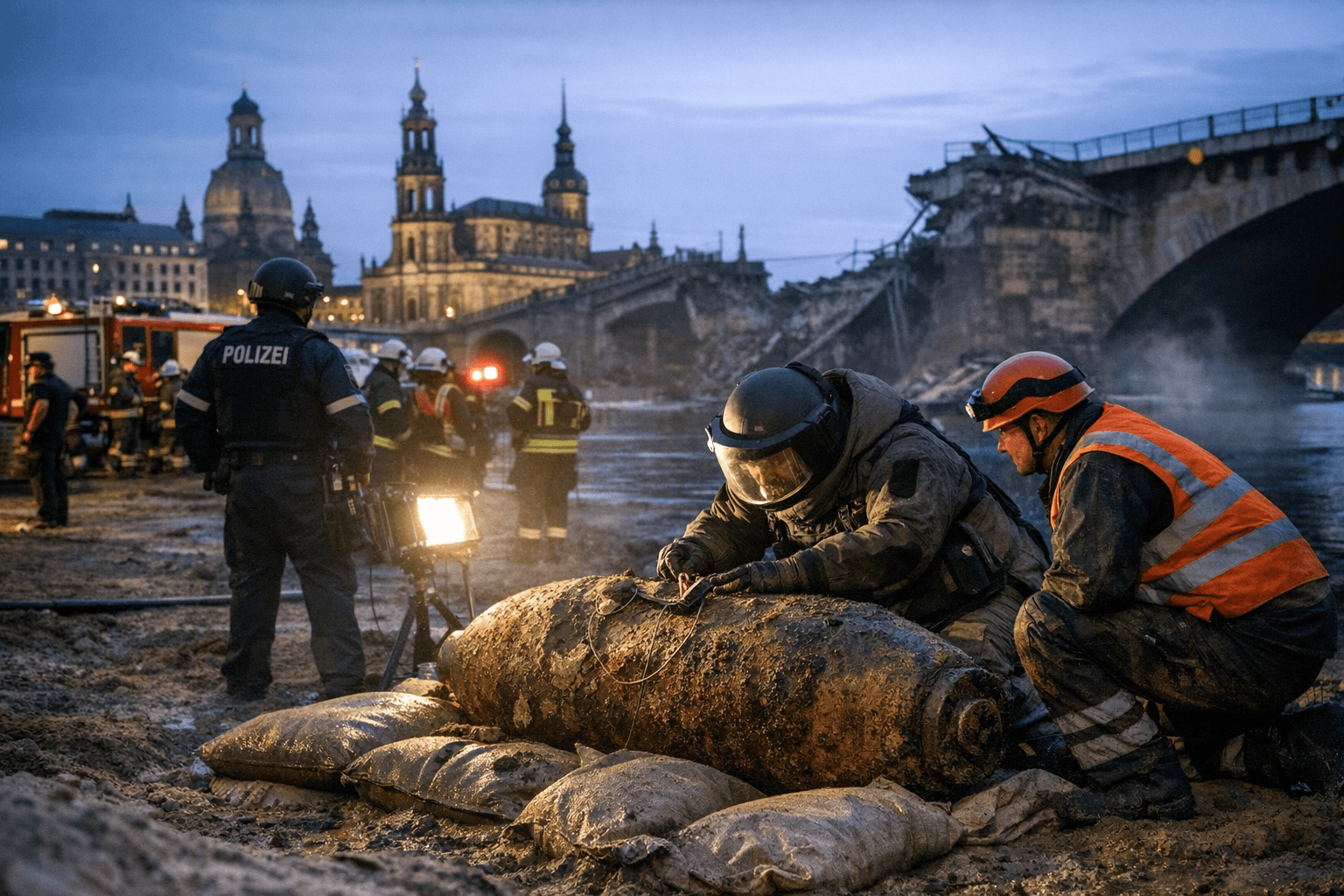
The evacuation zone swept across one of Europe's most architecturally significant city centres. The Frauenkirche, the Semperoper opera house and the Zwinger Palace all fell within the perimeter. So did police headquarters, the Saxon state parliament, several government ministries, retirement homes, daycare centres and dozens of hotels and residential buildings.
It was the second consecutive year that wartime ordnance had forced mass evacuations from the same site. Four bombs were found during demolition work at the Carola Bridge in 2025, triggering evacuations of approximately 17,000 people, with incidents recorded in both January and August of that year. The bridge reconstruction project has now become one of Germany's most active sites for wartime bomb discovery, reflecting a broader reality: unexploded ordnance from the Allied bombing campaigns of the 1940s continues to surface regularly across Germany during construction work, eight decades after the war's end.
The device's origin gives the operation a particular resonance in Dresden. British aircraft attacked the city on February 13, 1945, and in the days that followed, British and American bombers dropped nearly 4,000 tons of explosives on the city. The firestorm that resulted killed approximately 25,000 people and devastated a centre once described as the Jewel Box for its Baroque and Rococo architecture. The Frauenkirche, which sat within Wednesday's evacuation perimeter, was rebuilt after lying in ruins for decades following that assault.
That history makes the recurring discovery of British-made munitions at the Carola Bridge site more than a logistical challenge. Each find compresses the distance between the present city and its most catastrophic chapter.
The scale of Wednesday's operation surpassed Dresden's previous record evacuation, set just months earlier during the 2025 Carola Bridge incidents. Dresden's population of roughly 560,000 means that 18,000 represents only a fraction of the city, but the concentration of government institutions, historic landmarks and care facilities within the exclusion zone made coordination substantially more complex than the numbers alone suggest.
On the same day, authorities in Cologne discovered and quickly defused a separate 50-kilogram American bomb, underscoring how routinely German cities still contend with this buried legacy of the Second World War.
With the Carola Bridge reconstruction project still in its early phases, Dresden's bomb disposal teams are unlikely to have cleared the site for good.
This article was produced by Prism’s automated news system from verified source data, official records, and press releases, then run through automated quality and moderation checks before publishing. The system is built and supervised by the people who set the standards it runs under. Read our full AI policy.
Did this article answer your question?


