Drones Fall Near Dubai Airport, Injuring Four as Gulf Crisis Escalates
Two drones struck near Dubai International Airport on Wednesday, injuring four people from three countries as the 12th day of the Iran crisis deepened regional instability.
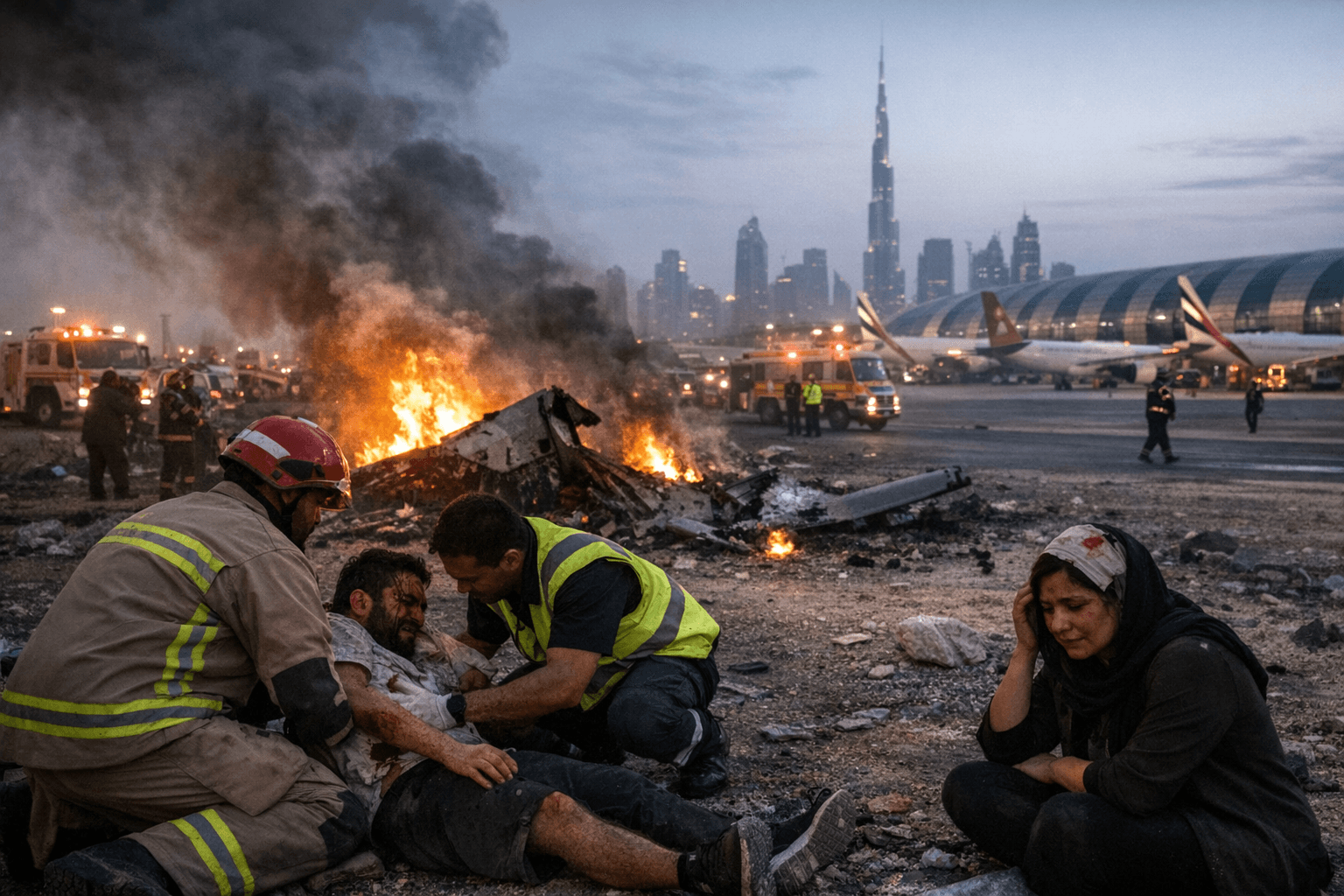
Two drones fell in the vicinity of Dubai International Airport on Wednesday, injuring four people and delivering a fresh blow to the world's busiest international hub as attacks on Gulf infrastructure entered their twelfth consecutive day.
Dubai's media office confirmed the incident in a post on X. "(The) authorities confirm that two drones fell in the vicinity of Dubai International Airport a short while ago," the office stated, adding that air traffic is operating as normal.
The four injured represent a cross-section of the migrant workforce that underpins the UAE economy. Two Ghanaian nationals and one Bangladeshi national sustained minor injuries; one Indian national was moderately injured. No fatalities were reported, and no official statement addressed the origin or nature of the drones.
The attack struck an airport that handled nearly 100 million passengers in 2025, making it the single busiest international aviation hub on the planet. That Dubai's media office moved swiftly to reassure travelers and airlines that operations were continuing normally reflects the enormous economic pressure on the emirate to project stability, even as the region fractures around it.
The broader crisis, which began February 28, has reshaped air travel across the Middle East in ways not seen since the early days of the Covid-19 pandemic. Most regional airspaces, including Qatar's, remain closed over missile and drone concerns. Airlines worldwide have been forced into cascading rounds of cancellations, schedule revisions and lengthy reroutings. Emirates and Etihad, the UAE's two flagship carriers, have resumed some services since the crisis began but are still operating well below normal capacity.
The conflict has also transmitted financial pain far beyond the aviation sector. An associated energy crisis has pushed fuel prices sharply higher, adding costs to airlines already bleeding revenue from reduced passenger loads and longer flight paths.
Wednesday's drone incident fits a pattern that has unfolded systematically across Gulf states since late February. Kuwait's airport and a Bahrain desalination facility were struck in separate incidents as the campaign against regional infrastructure has broadened in scope and target selection.
What remains unclear is who launched the two drones that came down near Dubai's airport, whether they constituted a deliberate strike on the facility or represented some other failure, and whether any airport infrastructure sustained physical damage beyond the human casualties. UAE security authorities and the General Civil Aviation Authority had not issued detailed statements on those questions at the time of publication.
The incident places the UAE in a delicate position. Abu Dhabi has historically maintained back-channel relationships with Tehran while simultaneously deepening its security ties with Washington and a close economic partnership with Israel. The outbreak of direct US-Israeli military action against Iran has collapsed that diplomatic middle ground, forcing choices on Gulf states that had spent years carefully avoiding them.
For now, Dubai's message to the world is that its airport remains open. Whether that posture can be sustained as the crisis enters its second week with no diplomatic resolution in sight is the central question facing the emirate's leadership.
This article was produced by Prism’s automated news system from verified source data, official records, and press releases, then run through automated quality and moderation checks before publishing. The system is built and supervised by the people who set the standards it runs under. Read our full AI policy.
Did this article answer your question?


