Drones Reshape Modern Warfare From Ukraine to the Middle East
Ukrainian drone attacks rose more than 127 times since Russia's invasion, as cheap UAVs reshape every battlefield from Gaza to Nagorno-Karabakh.
When Azerbaijani forces repurposed agricultural biplanes as decoy drones in 2020, they weren't deploying cutting-edge technology. They were improvising. Armenian air defenses revealed their positions to shoot down the decoys, and then Azerbaijani combat drones and artillery eliminated those anti-aircraft sites, handing Baku control of the skies over Nagorno-Karabakh. UK Royal Air Force Flight Lieutenant Chris Whelan, writing in a 2023 paper, called it "a new established trend amongst UCAV users, especially nations which do not have large resources to invest in military technology."
That engagement now reads as a preview. Since 2020, drone warfare has expanded from a tactical edge into a defining feature of modern conflict, reshaping battlefields from Ukraine to Gaza to Myanmar and prompting even the U.S. Army to rethink what belongs in a soldier's backpack.
The Army recently ordered a potential 5,880 drone systems from Red Cat's Teal Drones, each small enough to fit in a backpack, under a contract spanning over five years. Red Cat CEO Jeff Thompson said the company built the system, dubbed the Black Widow, around needs identified by the Army. The system can be operated by a single person, resists Russian jammers, carries strike capabilities, and can fly in GPS-denied zones. Each of those capabilities reflects lessons drawn directly from the war in Ukraine.
The procurement signals a fundamental shift in how the military values its unmanned fleet. For years, the Pentagon invested heavily in Predator and Reaper drones, multimillion-dollar platforms designed for intelligence collection and long-range missile strikes. It is the small, cheaply made UAVs, however, that are now changing battlefield dynamics.
"These handheld, small UAS systems that you are able to take a drone with a bomb strapped to it [have become] basically an artillery shell now. It's guided artillery shells," said Brett Velicovich, a drone expert and former U.S. Army intelligence and special operations soldier. "Frankly, it's changing how countries are going to fight wars in the future, and the U.S. has been so slow to get ahead of this."
The scale of transformation in Ukraine alone is stark. According to the Global Peace Index 2025 analysis, published June 17, 2025, the number of companies manufacturing drones exploded from six in 2022 to over 200 by 2024. More than 2.5 million drones were expected to be produced in Ukraine in 2025, with Ukrainian forces' drone attacks rising by more than 127 times compared to the early days of the conflict with Russia.
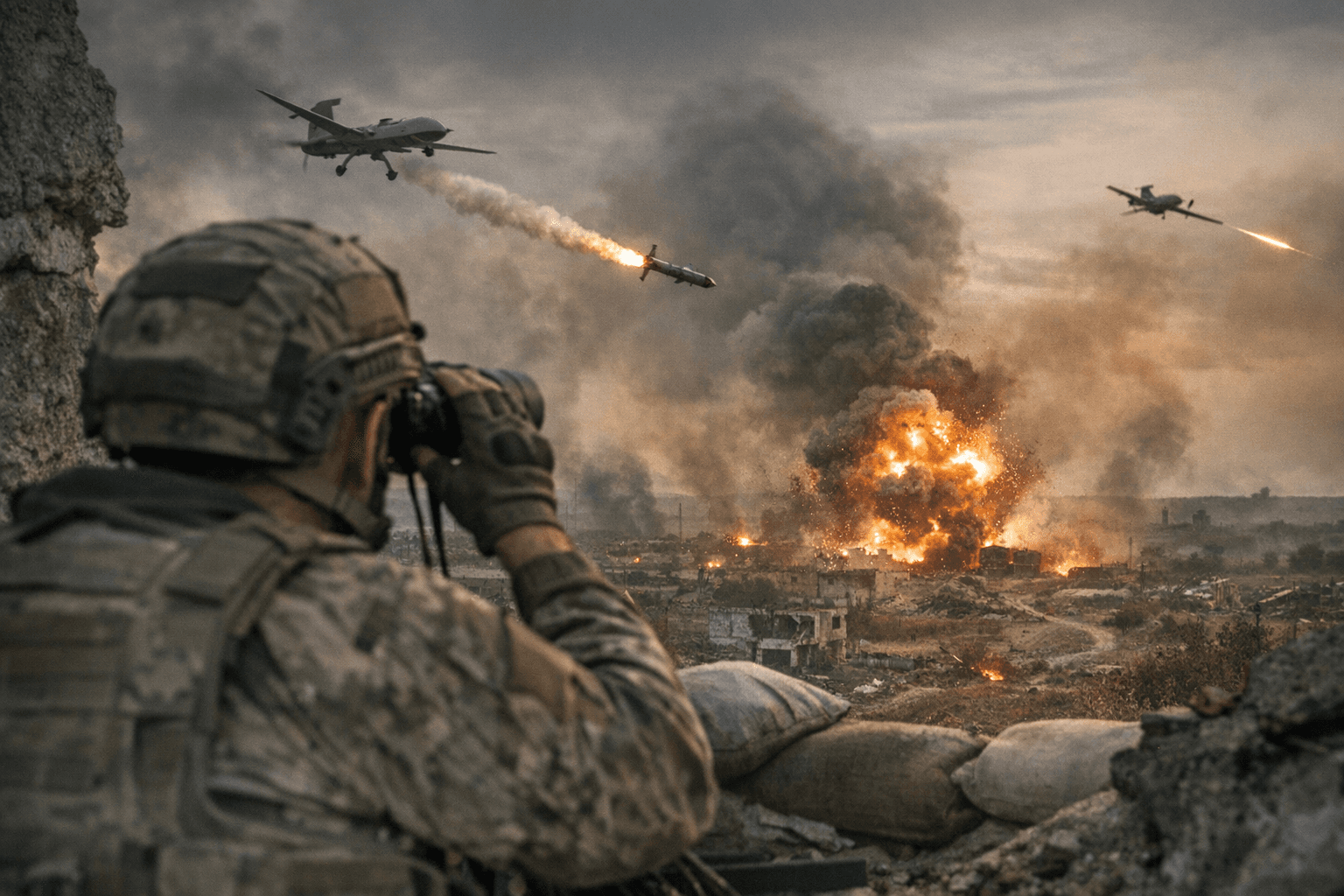
Hamas leveraged the same logic before the October 7, 2023, raid into southern Israel, using drones to knock out Israeli observation posts ahead of the assault. That attack precipitated a war that has killed more than 60,000 Palestinians. In Myanmar, opposition forces exploited UAVs to shift the conflict's trajectory. "There's been a major shift in the balance of power in Myanmar over the past two years and in large part this is due to the ability of opposition forces to incorporate UAVs in their fighting doctrine," said a source identified as Michaels.
Patrick Shepherd, a former U.S. Army officer, put it plainly: "It's like gunpowder. That's how insanely it's changed the war."
The Global Peace Index 2025 warns that the next generation of drones will be AI-enhanced, with autonomous navigation, swarm coordination, and precision targeting. The analysis flags South Sudan, Ethiopia, Syria, and the Democratic Republic of the Congo as high-risk regions for drone-enabled escalation, while noting that in the Sahel, ongoing violence and arms shipments already threaten to destabilize vast regions of sub-Saharan Africa. Drug cartels, the report adds, are also innovating with drones for future narco-warfare.
Much like the Kalashnikov rifle in the previous century, drones have become the asymmetric weapon of choice for forces facing long odds. Artificial intelligence is only accelerating that reach.
This article was produced by Prism’s automated news system from verified source data, official records, and press releases, then run through automated quality and moderation checks before publishing. The system is built and supervised by the people who set the standards it runs under. Read our full AI policy.
Did this article answer your question?