Dwarkesh Patel turns deep-dive podcast into A.I. power hub
Dwarkesh Patel’s podcast has become a private gate into A.I. power, where executives, researchers, and policymakers test narratives before a devoted audience.
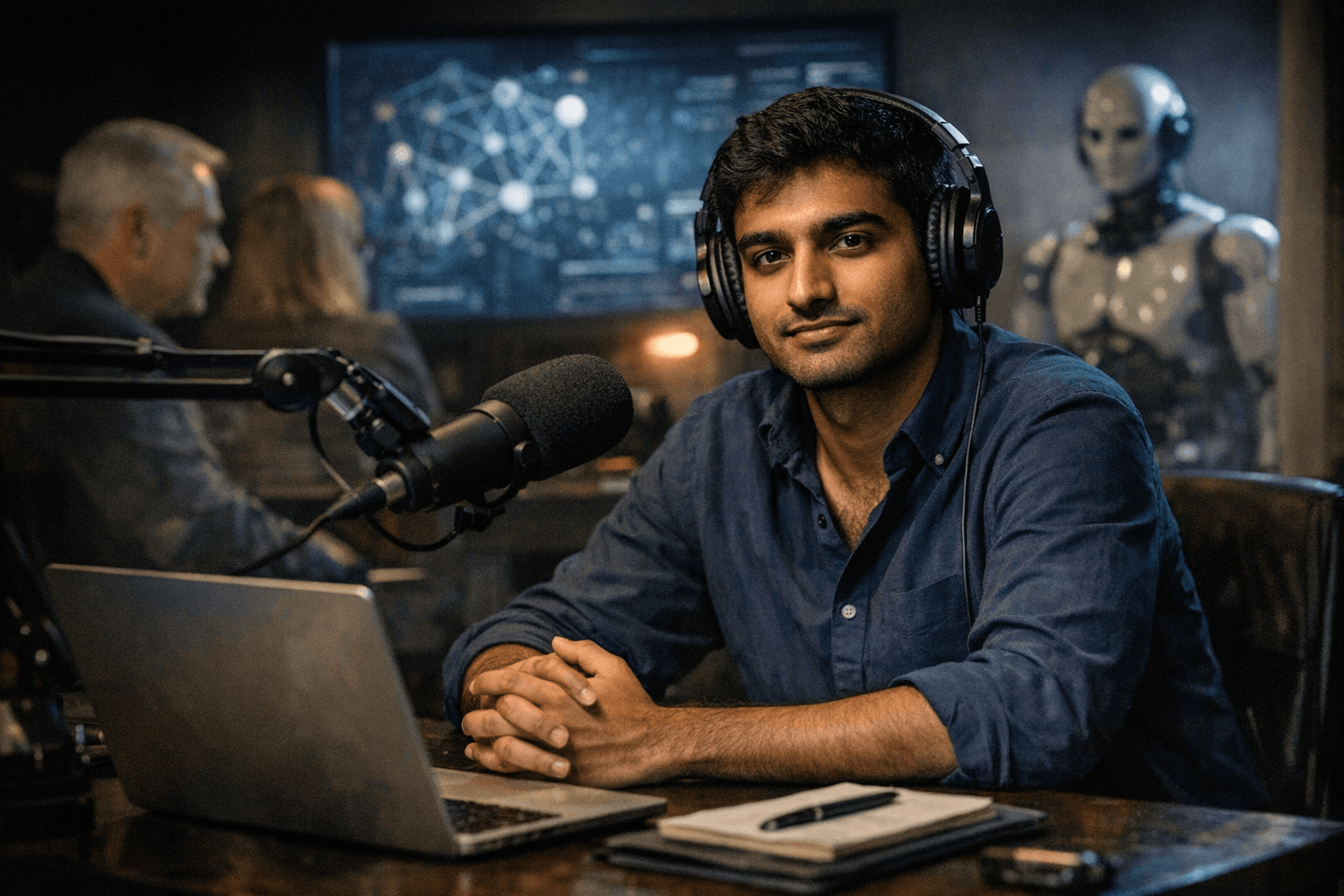
From bored student project to A.I. power hub
Dwarkesh Patel began as a bored college sophomore looking for intellectual stimulation. What started in 2020 as the Lunar Society Podcast has become the Dwarkesh Podcast, a long-form interview series that now sits inside the machinery of elite A.I. culture rather than outside it.
The scale matters. By April 2026, the show had roughly 125 episodes on YouTube, and Patel had moved from curiosity-driven conversations into interviews with the people who set the tone for the industry. In recent months alone, his guests have included Jensen Huang, Michael Nielsen, Terence Tao, Dylan Patel, Dario Amodei, Elon Musk, Satya Nadella, Andrej Karpathy, and Richard Sutton.
Why the format has become a gatekeeping venue
Patel’s advantage is not celebrity access alone, but the kind of access he offers. The show typically runs one to two hours and is built around detailed, technical questioning rather than banter or quick-hit promotion. That structure makes it a place where A.I. leaders can unpack strategy, explain model development, and present their own framing of the field in a controlled but unusually substantive setting.
That is why the podcast matters as a gatekeeping venue. Executives and researchers are not merely interviewed there; they are invited to narrate where A.I. is headed, which bottlenecks matter, and which rival ideas deserve attention. In a media environment where access can shape coverage, Patel’s preparation and fluency give him unusual leverage over which arguments reach a wide, highly engaged audience.
The guest list shows where A.I. authority now lives
The most revealing feature of the show is the range of people who treat it as worth their time. Jensen Huang’s April 15, 2026 appearance placed the chief executive of Nvidia in the same conversational space as academic and technical voices such as Terence Tao, Michael Nielsen, and Richard Sutton. That mix suggests the center of gravity in A.I. discourse now stretches far beyond one company, one lab, or one discipline.
Mark Zuckerberg’s appearances show how the podcast works as a venue for product-era narrative setting. Patel interviewed him about Llama 3 in April 2024 and again about Llama 4 in 2025, turning the show into a place where Meta could explain its model strategy over time. When the same interviewer returns to the same executive across product cycles, listeners get more than news coverage; they get a running record of how the company wants its A.I. story understood.
What the audience learns, and what it still misses
The podcast’s value is its specificity. Recent episodes have dug into TPU competition, A.I. compute bottlenecks, AGI timelines, and the relationship between A.I., math, and science. Those topics are hard to cover well in short interviews, and Patel’s style gives researchers room to disagree, refine terms, and walk through technical assumptions.
But the same format also has limits. When the main window into A.I. comes through an independent interviewer with strong access, readers are often hearing the field through the people building the systems, funding the labs, or racing to ship products. That can produce clarity, but it can also narrow the frame, leaving less room for labor questions, public oversight, community impact, and the social costs of concentration in a few powerful firms.
How Patel built a pipeline for elite attention
Patel’s rise has been formalized by outside recognition. TIME included him in its TIME100 AI 2024 list, describing him as a 23-year-old Bay Area resident who had spent the previous four years building one of the most deeply researched podcasts on artificial intelligence. That profile captured the unusual combination that now defines his influence: youth, technical fluency, and an audience that expects long answers instead of sound bites.
By January 2026, the bottleneck had become obvious enough for Patel to name it publicly: finding excellent guests. He said he was hiring part-time guest scouts at $100 an hour, fully remote, for five to 10 hours a week, and wanted people who could help identify future interview subjects in bio, history, economics, math and physics, and AI hardware. In practical terms, that means the podcast is no longer just a show. It is an expanding editorial operation with a deliberate pipeline for identifying who gets airtime.
From interviews to a permanent record of the field
Patel’s reach now extends beyond the microphone. Stripe Press published The Scaling Era: An Oral History of AI, 2019-2025, drawing on his interview work to create a book-length record of the field’s self-description. The book includes conversations with Dario Amodei, Demis Hassabis, Ilya Sutskever, Eliezer Yudkowsky, and Mark Zuckerberg, turning the podcast’s oral history approach into something closer to an archive of elite A.I. memory.
That matters because A.I. is no longer just a technical domain. It is a prestige topic for technology, policy, and finance, and the people who speak most persuasively about it now help shape funding, regulation, and public expectations. Patel’s success shows how a carefully prepared independent interviewer can become a central conduit between the public and the A.I. power structure, not by pretending to be outside it, but by becoming one of the places where its leaders go to explain themselves.
This article was produced by Prism’s automated news system from verified source data, official records, and press releases, then run through automated quality and moderation checks before publishing. The system is built and supervised by the people who set the standards it runs under. Read our full AI policy.
Did this article answer your question?


