Eating out linked to higher obesity risk worldwide, study finds
Nearly half of adults worldwide eat out weekly, and in low-income countries that habit tracked with 39% higher obesity rates.
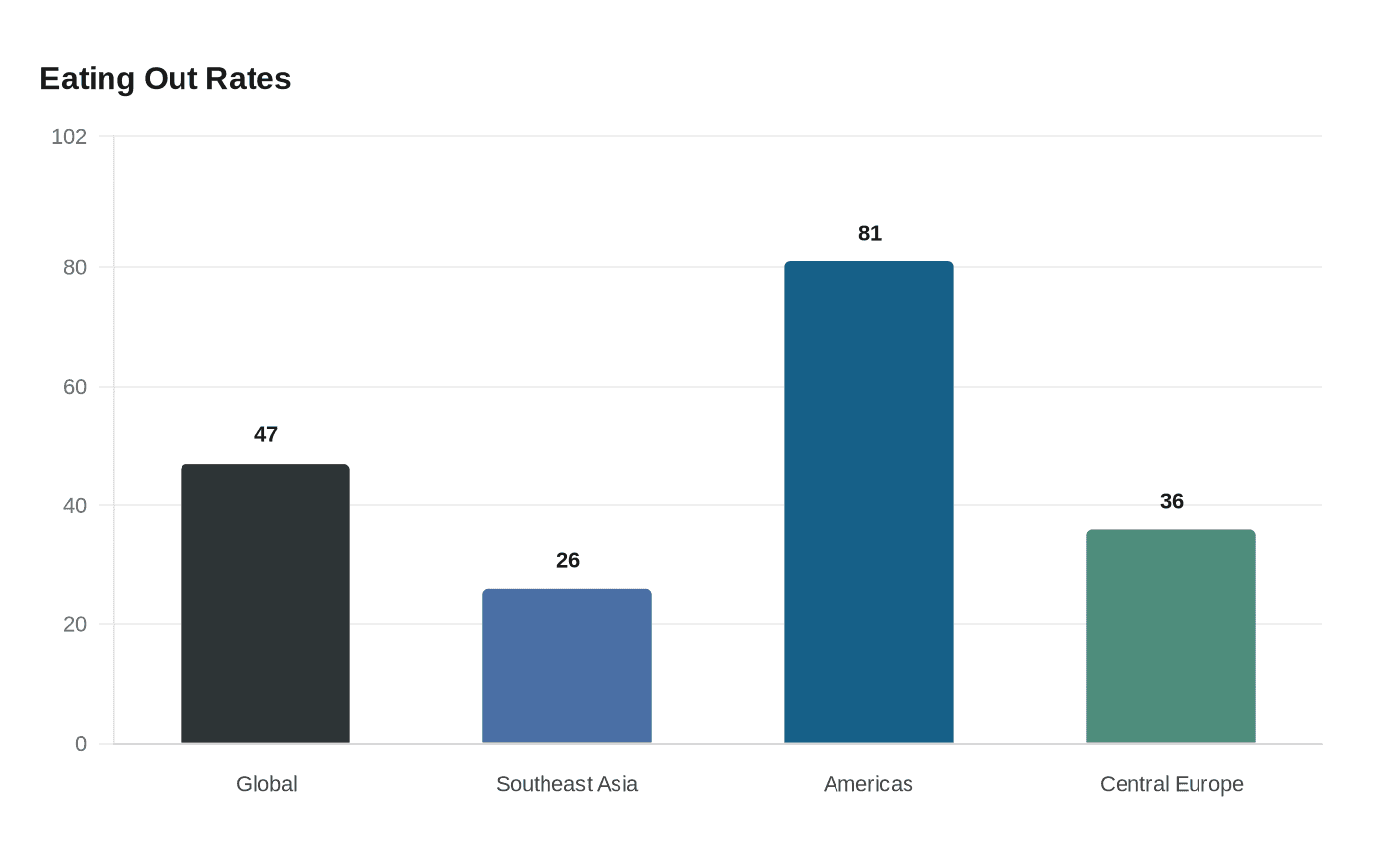
Eating out at least once a week has become a global habit for 47% of adults, and a study spanning 65 countries linked that routine to higher obesity risk across income levels. The analysis, presented at the European Congress on Obesity in Istanbul, drew on pooled health survey data from 280,265 adults collected between 2009 and 2021.
The pattern was broad and uneven at the same time. Eating out rates ranged from 26% in Southeast Asia to 81% in the Americas, while central Europe stood at 36%. In the study release, 8 in 10 adults in the United States said they ate out about four times a week, compared with 1 in 10 adults in Timor-Leste who said they ate out three times a week. The gap underscores how differently countries eat, even as the health consequences appear to follow a similar direction.
Researchers from Göttingen University and Heidelberg University led the work, which found that eating out was consistently associated with excess weight in both wealthier and poorer countries. In low-income countries, people with obesity ate out 39% more often than people at a healthy weight, while those who were overweight ate out 28% more often. Mubarak Sulola of Heidelberg University said the findings suggest eating away from home is consistently associated with obesity in low- and lower-middle-income countries, likely because of a nutrition transition and the growing availability of large portions of energy-dense foods.
The study points to a food-environment problem rather than a narrow issue of individual choice. Meals prepared outside the home are often more processed and higher in salt, sugar and unhealthy fats, and they are commonly sold in larger portions than retail equivalents. That makes frequent restaurant and fast-food meals more than an occasional indulgence; over time, they can become a regular source of excess calories in everyday life.
The evidence is substantial, but it is still evidence of association, not proof that eating out alone causes obesity. The analysis used survey data and adjusted for country characteristics such as geography and cultural food norms, as well as differences by income, sex, age and education. That makes the cross-country pattern more credible, but it does not isolate every factor that shapes weight gain, including income, local food prices and physical activity.
The public-health stakes are large. The World Health Organization says adult obesity has more than doubled since 1990 and reported that in 2022, 2.5 billion adults were overweight and 890 million were living with obesity. WHO has also said the out-of-home food sector often serves foods higher in energy, saturated fats, sugar and salt, in larger portions than retail equivalents. That is why the next front in obesity policy may be less about meals alone and more about the commercial food environment that makes eating out so routine.
This article was produced by Prism’s automated news system from verified source data, official records, and press releases, then run through automated quality and moderation checks before publishing. The system is built and supervised by the people who set the standards it runs under. Read our full AI policy.
Did this article answer your question?