Effort intensifies to save the frosted flatwoods salamander from extinction
The salamander is hanging on only because people now have to manufacture the conditions wild places no longer provide. Its rescue is a lesson in the labor, cost and uncertainty of saving a species after habitat collapse.
A species saved one pond, one burn, one lab at a time
The frosted flatwoods salamander is no longer being protected by nature alone. Its survival now depends on prescribed fire, wetland restoration, captive breeding, repeated surveys and the kind of coordination that can only happen when federal agencies, nonprofits and refuge managers all keep showing up year after year.
That is the hidden cost of preventing extinction once a species has been pushed to the brink. For this salamander, the cost is measured not just in dollars, but in staff time, scientific uncertainty and the painstaking effort required to recreate the conditions that once existed across a much wider landscape.
A species reduced to a few scattered strongholds
The frosted flatwoods salamander, Ambystoma cingulatum, was listed as threatened in 1999. A decade later, the original flatwoods salamander was split into two species, the frosted flatwoods salamander and the reticulated flatwoods salamander, which is listed as endangered. That split sharpened the conservation picture, but it did not make the species easier to save.
Federal analyses now place the frosted flatwoods salamander in only four general sites and nine populations. Documentation ties those remnants to Liberty County, Georgia; Liberty County, Florida; Wakulla County, Florida; and Berkeley County, South Carolina. Critical habitat was designated in 19 sub-units totaling 22,970 acres, or 9,297 hectares, a large footprint on paper that still covers only fragments of what the species once had.
The refuge that matters most is St. Marks National Wildlife Refuge near Tallahassee, Florida. According to the U.S. Geological Survey, it is the only National Wildlife Refuge where flatwoods salamanders continue to persist. Even there, the population is watched pond by pond, because survival depends on a delicate seasonal rhythm that is easy to break.
Why this salamander is so hard to save
The species breeds in ephemeral, seasonally flooded ponds embedded in longleaf pine-wiregrass habitat. Adults lay eggs at the base of plants, where the eggs need to stay damp long enough to develop. If a pond dries too soon, larvae can be stranded. If water comes and goes in the wrong pattern, the whole breeding cycle can fail.
That fragility is why habitat loss and fire suppression hit so hard. The salamander depends on fire-maintained landscapes, and when prescribed fire is suppressed, the habitat changes in ways that make breeding less reliable. Irregular weather compounds the problem, and climate change threatens the ephemeral ponds that the species needs to reproduce at all.
The result is a conservation challenge that is part ecology, part emergency response. U.S. Fish and Wildlife Service materials have gone so far as to say the outlook is bleak enough that the species arguably warrants an endangered designation. That is not just a label. It is a warning that the margin for error has already disappeared.
The recovery effort now spans institutions and states
Saving the frosted flatwoods salamander has become a multi-partnership campaign involving federal, state and nonprofit groups, along with refuge managers and research teams. The roster includes the U.S. Fish and Wildlife Service, the U.S. Geological Survey, the Georgia Department of Natural Resources, the Florida Fish and Wildlife Conservation Commission, the Savannah River Ecology Laboratory, The Orianne Society, the U.S. Army, Friends of St. Marks Wildlife Refuge, the Warm Springs Fish Technology Center, the Amphibian Foundation and the Amphibian and Reptile Conservancy.
The people attached to that effort include Mark Mandica, Crystal Mandica, Valerie Kearny, Maya Bass, Harold Mitchell, Daniel Sollenberger, Brooke Talley, Pierson Hill, Ryan Means and Melinda Sylvester. Together, they represent the kind of dispersed, long-haul conservation work that species recovery now requires when wild populations are too small to rebound on their own.
At St. Marks, refuge work has centered on prescribed fire, habitat management and surveys. In spring 2023, U.S. Fish and Wildlife Service reporting said salamanders were found in 29 of 65 freshwater ponds sampled at the refuge. That kind of sampling is more than a count. It is a measure of how carefully managers have to monitor whether breeding habitat is still functioning from one season to the next.
The lab has become part of the habitat
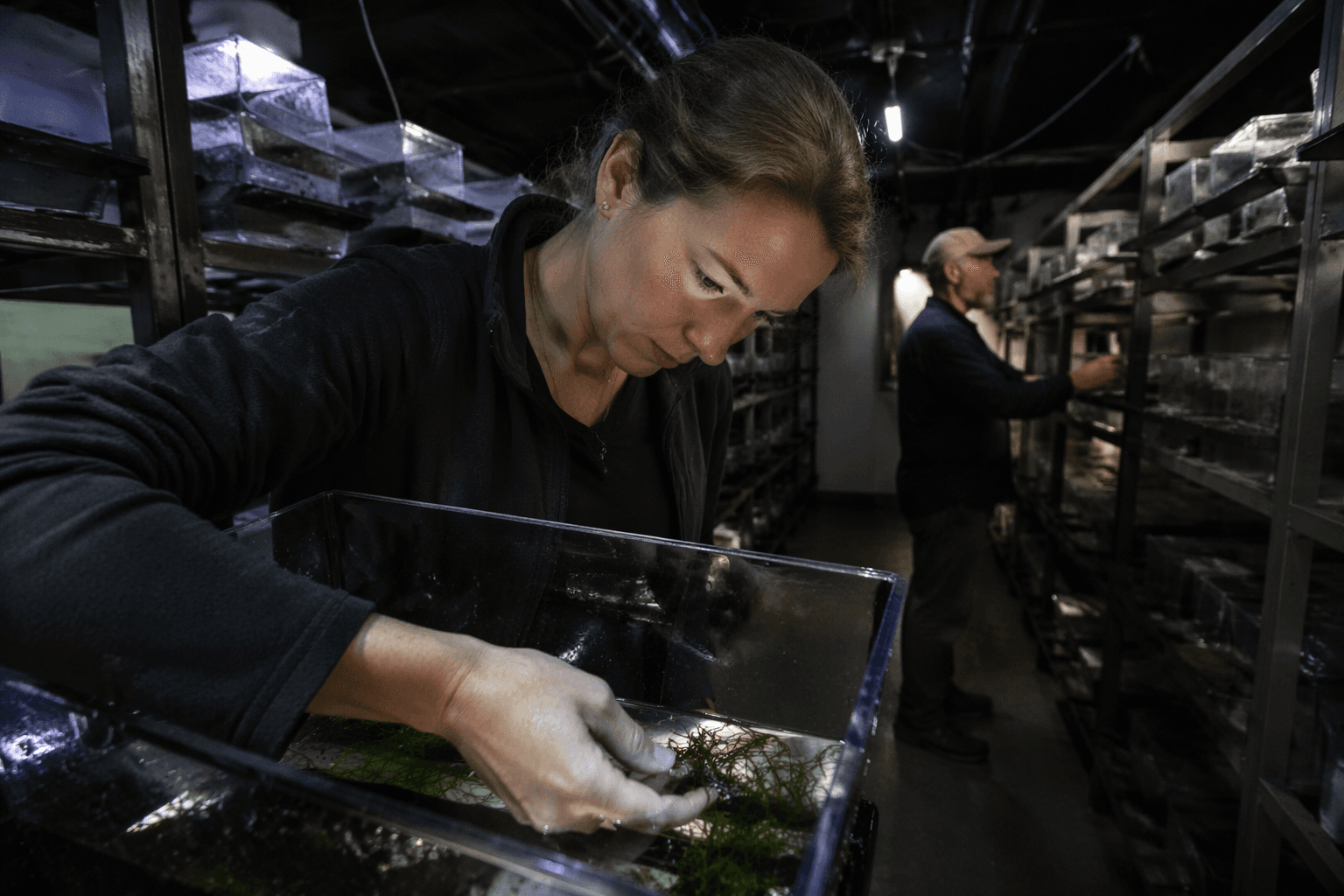
The Amphibian Foundation in Atlanta has emerged as a key captive-breeding partner. Founded by Mark and Crystal Mandica, the foundation received frosted flatwoods salamanders as water-stressed eggs collected in Florida by the Florida Fish and Wildlife Conservation Commission in 2017 and 2018. By 2018, the foundation said it had hatched more than 400 larvae in its biosecure Atlanta laboratory.
That work did not end there. The foundation reported its first successful captive breeding of the species in 2022, and an Associated Press report in 2024 said hatching had begun in Atlanta after years of work. For a species this imperiled, that matters because a lab can serve as a bridge, buying time while wetlands are restored and wild habitat is repaired.
The scale of that bridge became clearer in April 2025, when biologists released the 1,204th federally listed threatened frosted flatwoods salamander larva into a restored Florida Panhandle wetland. Those releases are part of a head-starting and repatriation effort that tries to move young salamanders from controlled conditions back into landscapes where they can eventually persist on their own.
What recovery really means here
The U.S. Fish and Wildlife Service recovery plan and recovery implementation strategy are built around one goal: restoring healthy, self-sustaining populations across the species’ historic range. They also estimate the cost of the actions needed to get there, which is a reminder that conservation at this stage is not a single rescue but a sustained program.
That program asks hard questions about the limits of intervention. It can restore ponds, ignite fire on a schedule, raise larvae in biosecure labs and move animals back into the wild. What it cannot do easily is recreate the old balance that once allowed the species to persist without so much help.
The frosted flatwoods salamander has become a symbol of that reality. It is also a test of whether society is willing to keep paying the price of damage already done, one burned flatwoods, one monitored pond and one carefully released larva at a time.
This article was produced by Prism’s automated news system from verified source data, official records, and press releases, then run through automated quality and moderation checks before publishing. The system is built and supervised by the people who set the standards it runs under. Read our full AI policy.
Know something we missed? Have a correction or additional information?
Submit a Tip