Electric Cars Were Once the Future, Before Gasoline Won the Road
America’s EV fight is an old story in new clothes. Electric cars once ruled city streets before gasoline, policy, and infrastructure tipped the road away.

The debate is older than it looks
America’s argument over electric cars is often sold as a futuristic leap, but it is really a rerun. The first electric vehicles were not science-fiction promises, they were working machines built in the 1830s, and by the turn of the 20th century they were part of everyday urban life. That early rise mattered because it shows the present transition is not about inventing the electric car from scratch; it is about deciding whether the country will finally build the systems that earlier generations never finished.
The old barriers were familiar: battery limits, charging access, and cost. Some of those obstacles have changed with better technology, but the deeper lesson has barely moved. When policy, infrastructure, and public investment tilt toward one kind of vehicle, that choice can shape the road for decades.
How the first electric car era began
Thomas Davenport built a small battery-powered electric motor in 1834 and used it to power a small car on a short stretch of track. That experiment was not a curiosity in isolation, but an early milestone in electric transportation. It proved that electric motion could be practical long before gasoline became dominant.
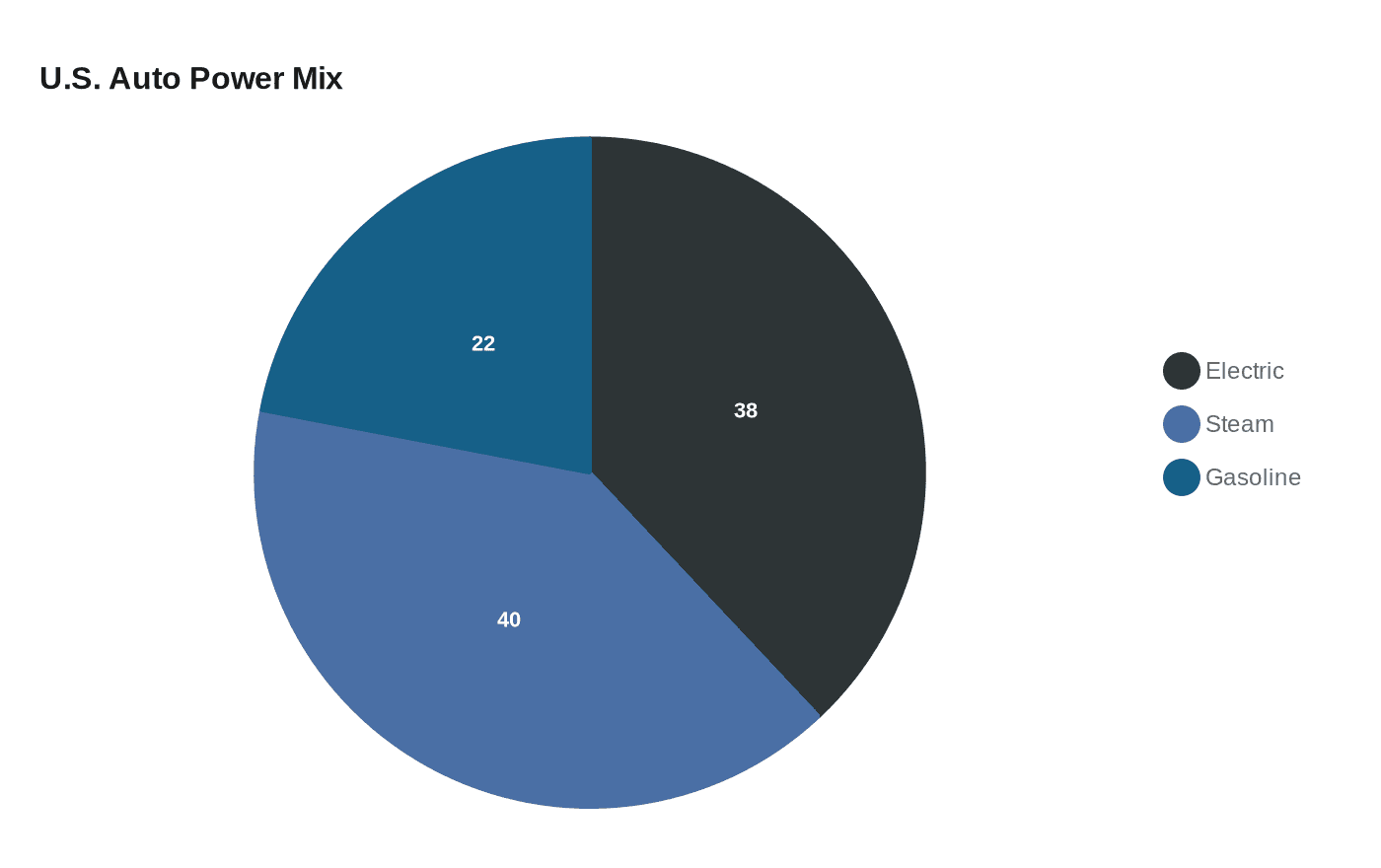
By the late 1880s and 1890s, battery-powered automobiles had become commercially viable. Around 1900, U.S. automobiles were roughly 38% electric, 40% steam, and 22% gasoline, according to Britannica. The U.S. Department of Energy says electric vehicles were especially popular from 1900 to 1912 and accounted for around a third of vehicles on the road. In other words, EVs were not a niche. They were a serious contender in a mixed transportation market.
Why cities embraced electric vehicles first
Urban America gave electric cars their first real audience because city life exposed the costs of dirty, noisy transportation. New York City’s first motorized taxicabs launched in 1896, and they were electric, not gasoline-powered. The first fleet became known as the Electrobats, and by the early 1900s the Electric Vehicle Company was operating hundreds of electric taxis in the city, with some accounts putting the number above 600 in New York alone, alongside smaller fleets in Philadelphia, Boston, Baltimore, and other eastern cities.
The attraction was not abstract. Manhattan’s horse problem had become a public health crisis: an estimated 150,000 horses produced about 22 pounds of waste each per day. Streets clogged with manure, flies, and filth made cleaner transportation more than a convenience. Electric cars were marketed as quiet, easy to drive, and free of smelly pollutants, which made them especially appealing to urban riders and to women, who found the vehicles more manageable than the rougher, louder alternatives.
That point matters today because transportation technology has always been shaped by public health, not just engineering. People chose cleaner rides because they wanted cleaner air, quieter streets, and a city that was less punishing to navigate.
What made the early lead disappear
Electric vehicles did not lose because they were useless. They lost because the broader system moved away from them. By 1914, EVs had lost nearly all of their market share to internal combustion cars after gasoline vehicles improved and infrastructure shifted in their favor. The market did what markets often do when one technology gets more fueling support, more manufacturing scale, and more policy alignment: it crowned the better-supported winner, not necessarily the better urban fit.
That reversal is the central policy lesson. The early electric era showed that consumer interest alone is not enough. A technology can be practical, popular, and even socially preferred in cities, then be sidelined when investment, roadbuilding, and fueling systems point elsewhere. Once gasoline cars got the advantage, electric cars were pushed out of the mainstream for generations.
What the old story says about the new one
Today’s EV transition repeats the same three pressure points in updated form. Battery limits still shape how far a car can go, charging access still determines whether ownership is easy or exhausting, and upfront cost still decides who can participate first. The names of the obstacles have changed less than the structure around them: who gets to charge, where they can charge, and whether public policy treats clean transportation as a shared necessity or a private luxury.
That is where equity enters the story. In the first electric age, cleaner vehicles flourished in dense urban corridors where the harms of horse waste and noise were impossible to ignore. The same pattern is visible now when charging networks cluster in wealthier neighborhoods or when access is easier for people with garages than for renters, apartment dwellers, or workers who rely on curbside parking. If the transition is left to chance, the benefits of cleaner air and quieter streets can be unevenly distributed, while the burdens fall hardest on communities already carrying more traffic pollution.
The policy lessons America ignored
The biggest lesson from the early electric era is that technology does not win by merit alone. It wins when public policy backs the infrastructure it needs. In the early 1900s, gasoline vehicles benefited from the slow but decisive buildout of fueling systems and the broader industrial logic that favored combustion. Electric cars, despite their urban strengths, never got the same durable support.
That history should sharpen today’s decisions. If charging remains scarce, if home charging remains out of reach for too many households, and if the cost of entry stays high, the country risks repeating the same mistake with a new label. The public health case for EVs is straightforward: fewer tailpipe emissions mean less pollution in neighborhoods that have long absorbed the worst traffic harms. But the policy case is just as important: cleaner transportation only becomes widely accessible when government and industry treat infrastructure as part of the product.
What the road ahead should remember
The first electric-car boom shows that America has already lived through an EV future once before. It was quieter, cleaner, and in many cities more humane than what followed. Yet it was also fragile, because the systems needed to sustain it were never built with enough resolve.
That is why the current transition should be judged less by hype than by whether it expands access, lowers pollution, and avoids repeating old inequities. Electric vehicles do not need another mythic debut. They need the infrastructure, affordability, and policy discipline that were missing when gasoline won the road the first time.
This article was produced by Prism’s automated news system from verified source data, official records, and press releases, then run through automated quality and moderation checks before publishing. The system is built and supervised by the people who set the standards it runs under. Read our full AI policy.
Did this article answer your question?