Eli Lilly, Insilico Medicine Strike $2.75 Billion AI Drug Discovery Deal
Eli Lilly committed up to $2.75 billion to AI drug designer Insilico Medicine to surface biology that conventional research might never find.
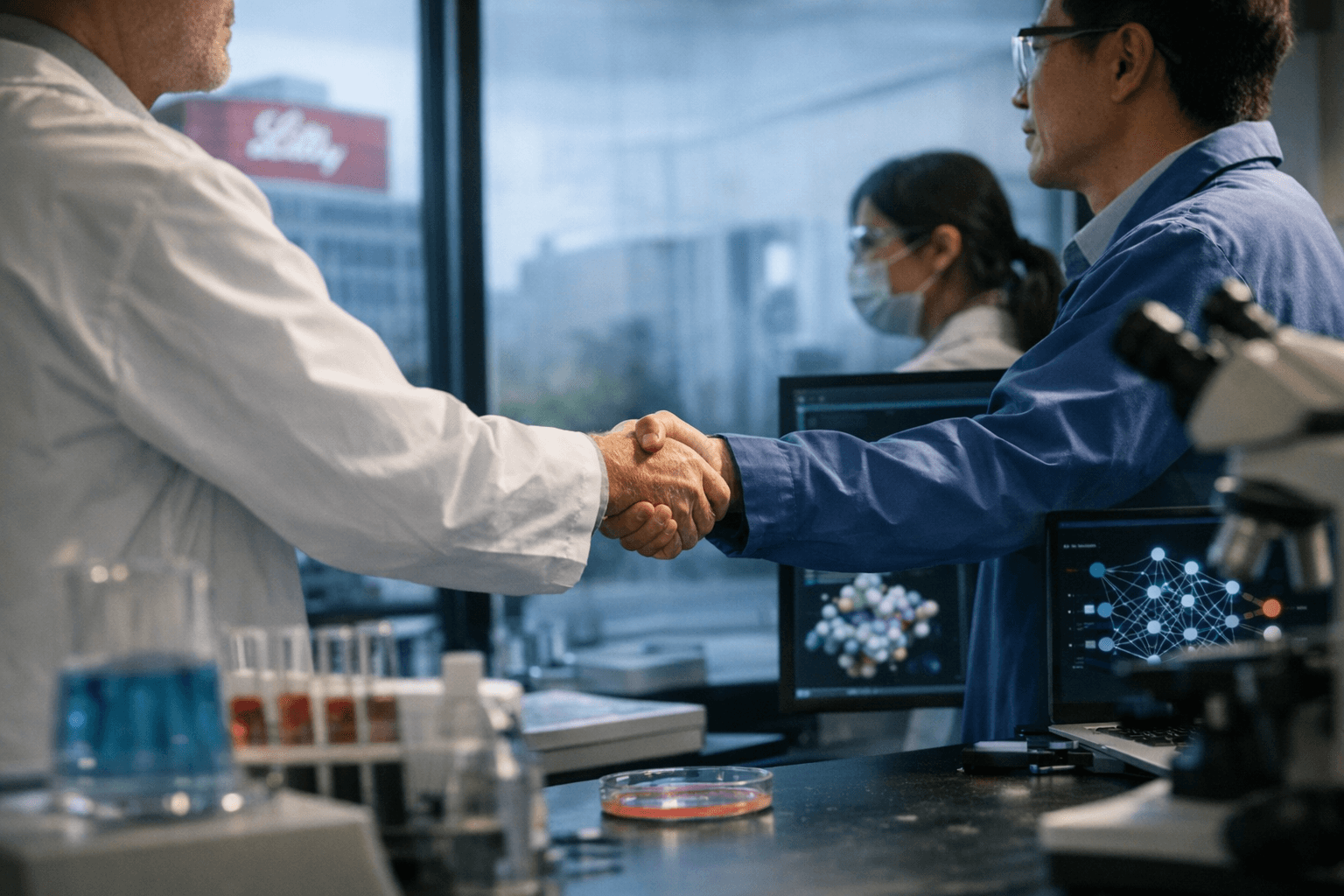
Eli Lilly & Co. placed a $2.75 billion bet on artificial intelligence, striking a deal with Insilico Medicine that the companies say could fundamentally reshape how small-molecule drugs are discovered and developed.
The agreement pairs Lilly, one of the world's largest pharmaceutical companies, with Insilico Medicine, a private AI drug-design firm that uses generative and predictive models to identify molecular candidates. Under the terms, the two companies will combine resources and capabilities to accelerate the path from biological target identification to investigational new drug filings, a stretch of R&D that has historically consumed years and hundreds of millions of dollars.
"Can we find more biology using AI? That is really the Holy Grail," a Lilly executive said, framing the collaboration not merely as a workflow accelerator but as a potential window into biological mechanisms that conventional research methods would never surface.
The $2.75 billion figure represents the deal's potential ceiling, with a significant portion tied to milestone payments that trigger only if Insilico's models produce validated targets, successful preclinical results, or drug candidates that reach human trials. That structure limits the immediate hit to Lilly's balance sheet while preserving the commercial incentive for Insilico to deliver.
The timing is pointed. Pharmaceutical R&D costs have climbed steadily for decades without a corresponding surge in pipeline productivity. Large drugmakers have responded by acquiring AI-focused biotechs, building internal data science teams, and signing partnerships of increasing scale. Lilly's move signals that AI drug design has crossed from experimental curiosity to core corporate strategy.
If generative models can reliably produce safe, effective candidate molecules, the economics of drug development would shift considerably: leaner discovery teams, hypothesis-free exploration of unexplored biology, and faster lead optimization. Investors and rivals will monitor the collaboration for early scientific signals, particularly any public disclosures of validated targets or first-in-human dosing milestones that would confirm the approach is translating beyond the computational layer.
Skeptics point to a persistent gap between in-silico promise and clinical reality. Molecules that perform well in computational models have repeatedly failed in animal studies or human trials on safety or efficacy grounds. Critics also flag concerns about proprietary AI systems trained on commercial datasets, warning that limited transparency around training data could create reproducibility problems that regulators will eventually be forced to confront.
The U.S. Food and Drug Administration and international counterparts will need to clarify how AI-designed drug candidates are validated and how the data used to train underlying models are documented, a regulatory conversation the industry has been circling for years without resolution.
The deal's scale sends a clear market signal regardless: the race to embed AI into pharmaceutical R&D has moved well past pilot programs, and the companies willing to commit the largest upside are betting that machine learning will find biology that decades of conventional science missed.
This article was produced by Prism’s automated news system from verified source data, official records, and press releases, then run through automated quality and moderation checks before publishing. The system is built and supervised by the people who set the standards it runs under. Read our full AI policy.
Did this article answer your question?

