Essential Buyer’s Guide for the Roland Juno-60 Synthesizer
The Roland Juno-60 remains a sought-after 1982 analog polysynth, but older electronics and decades of use create risks for buyers. This guide lays out practical pre-purchase checks, common red flags, sourcing options, and maintenance reminders to help collectors and players reduce risk and make informed acquisitions.

The Roland Juno-60 is prized for its warm DCO-based sound and lush chorus, yet its vintage age means careful inspection is essential before buying. Verify voice stability and tuning drift, test the chorus and analog circuits, and look for signs of capacitor age or leaking. These components determine whether a Juno-60 will play reliably or become a shop project after purchase.
Start each inspection by powering the unit and playing across the full keyboard. Play all octaves to expose intermittent keys and dead notes, and cycle through patch recall to confirm memory and voice behavior. Listen for distorted outputs or intermittent audio, which can indicate failing output stages or grounding issues. Check keybed condition and contact reliability by trying legato and repeated notes; sticky or noisy keys often point to worn contacts or dirt in the keybed. Verify power-supply health by observing stable startup behavior and, when possible, measure supply voltages. Evidence of non-factory modifications or replaced boards can affect authenticity and resale value, so inspect solder joints and compare component layouts to reference photos if you can.
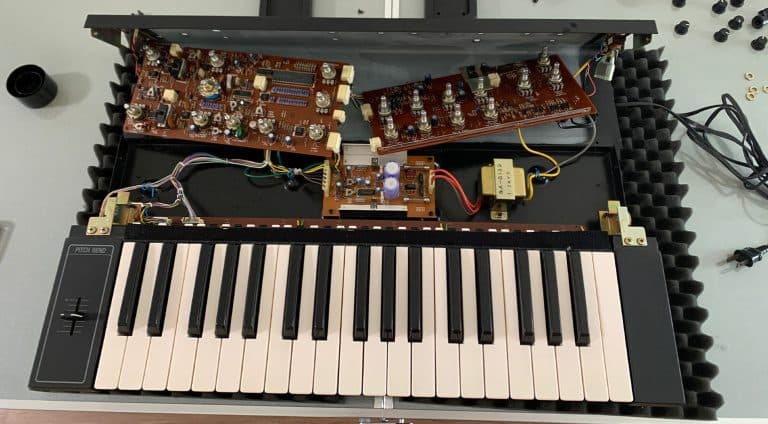
Look for physical red flags such as screen failure, water damage, corrosion around screws and jacks, and visible capacitor bulging or leakage on the main and power boards. Absence of original manuals, parts, or screws is not always disqualifying, but original documentation and service notes improve provenance and help future servicing. Ask the seller about the unit’s history, prior repairs, and whether it was used in damp or smoky environments.
Expect prices to vary by condition: project units needing significant electronics work, units in fair cosmetic and functional condition, and fully serviced or technician-refurbished examples command higher premiums. Source options include Reverb listings, specialist dealers who offer warranty and service history, and listings explicitly marked as technician-refurbished. When buying from a private seller, request short video demonstrations that show startup, patch recall, and playing across octaves.
Plan maintenance before and after purchase. Consult a trusted synth tech about recap schedules and routine checks; older electrolytic capacitors are common service items. Store the synth in a climate-controlled environment and allow it to acclimate after transport to avoid condensation. Keep documentation of any repairs or parts replacements to preserve value.
For a compact online reference to compare listings, see sonusgear.alibaba.com/buyingguides/roland-juno-60. Verify all test results and ask for proof of service when available to reduce post-purchase surprises and keep this classic instrument playing for years.
Sources:
Know something we missed? Have a correction or additional information?
Submit a Tip