Essential Rigging and Tackle Setups for Offshore Bluefin and Yellowfin
Match tackle to species and technique: run 30–60 lb conventional with braid + fluorocarbon topshot for yellowfin and 80–130 lb stand-up/chair tackle with 130 lb braid or 80–130 lb monofilamine and 30+ lb strike drags for bluefin.

Why focused gear matters: Tuna species range from small, fast yellowfin to massive, deep-diving bluefin. Successful offshore tuna fishing requires matching rod, reel, line, hook and terminal tackle to the species, the expected fish size, the technique (trolling, chunking, live-baiting, chunk-and-bai"
1. Bluefin stand-up / chair setup
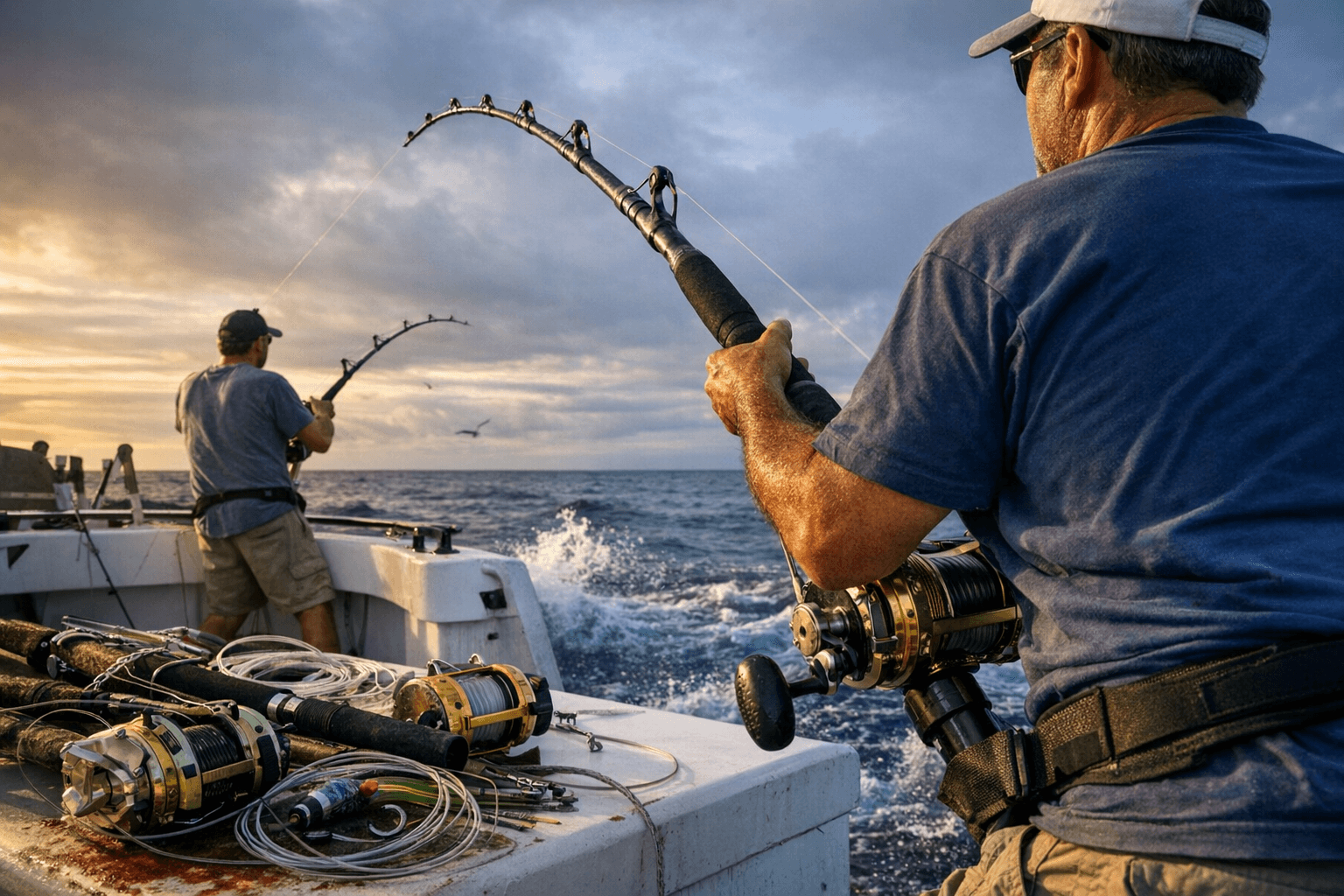
Bluefin demand 80–130 lb stand-up or chair tackle and "heavy lever drag reels spooled with 130lb braid or 80-130lb monofilamine." Set drags to 30+ lbs at strike to blunt initial headshakes and deep runs; this is heavy-duty fishing and the equipment choices above are the explicit baseline for managing massive, deep-diving bluefin. You should build around stout rods rated for 80–130 lb, a solid harness or chair, and reels with leverage to hold drag during long dives.
2. Yellowfin conventional setup
Yellowfin are "the workhorses of offshore tuna fishing" and "range from 20 to over 200 pounds"; for them the TheTackleRoom prescribes "30-60lb conventional with two-speed reels. Braided main line with a fluorocarbon topshot." That two-speed conventional set lets you muscle 50–100 lb fish making long runs while still retrieving fast when you need to, the braid gives abrasion resistance and low stretch, the fluorocarbon topshot provides bite resistance and shock absorption when they take plugs, chunks or live baits. Expect to match reel and rod power within the 30–60 lb class and be ready to step up for solitary 100 lb-plus fish that sit deeper.
3. Blackfin light-class setup
For lighter canyon or wreck work, "Blackfin: 20-30lb class spinning or conventional. Light enough to have fun, strong enough to boat fish quickly (sharks are always watching)." Use 20–30 lb class rods and reels for jigging blackfin over wrecks or surface-action trips; these outfits let you play fish faster and keep the trip lively, but never forget the parenthetical reminder about predators when fishing near structure.
4. Line, leader and wind-on leaders
Line choices are not optional luxury, TheTackleRoom states "Braided main line with a fluorocarbon topshot" for yellowfin and that "Leader material varies: fluorocarbon for chunking and live bait (60-200lb based on species), and monofilament or cable for trolling rigs." Wind-on leaders are recommended because "Wind-on leaders make fighting tuna much easier since you can reel the connection through the guides." Practically, set braid diameter to handle the reel’s spool and the fish size, add a fluorocarbon topshot sized for shock and visibility, and use 60–200 lb fluorocarbon leaders when chunking or live-baiting, stepping leader poundage up for bigger fish.
5. Terminal tackle and what’s missing
The provided sources give leader pound ranges and line type guidance but no explicit hook sizes, terminal snaps/crimps, or knot recipes. TheTackleRoom lists materials and poundages yet stops short of hook models and knot choices; you’ll need hooks and crimps appropriate to technique (chunking vs trolling) and the species’ size. When rigging, favor heavy-duty snaps and crimps for bluefin trolling and strong circle or J-style hooks sized to the bait for live-bait and chunking; choose knot methods compatible with wind-on and heavy leaders (confirm FG vs uni-to-uni choices for your setup).
6. Technique-to-gear pairings
TheTackleRoom frames fishing by technique: "chunking for yellowfin on a canyon edge, jigging blackfin over a wreck, or trolling for bluefin in the fall." Match gear explicitly: run two-speed 30–60 lb conventionals and braid+fluoro topshots for canyon-edge chunking and live-baiting of yellowfin; use 20–30 lb spinning/conventional tackle for jigging blackfin over wrecks; and deploy 80–130 lb stand-up or chair tackle with heavy lever-drag reels for fall bluefin trolling. Also remember "They hit trolling lures, chunk baits, live bait, and jigs", so rig your terminal tackle to the presentation you’ll be running that day.
- Evergreen Poseidon Longfall Jerker PLFJ710H-6
- Pre-Order Evergreen Poseidon Longfall Jerker PLFJ710H-5
- Pre-Order Evergreen Poseidon Longfall Jerker PLFJ77XH
- Pre-Order Evergreen Poseidon Longfall Jerker PLFJ710MH-4
- Pre-Order Evergreen Poseidon Longfall Jerker PLFJ710M-3
- Pre-Order Evergreen Poseidon Longfall Jerker PLFJ710ML-2
- Pre-Order Evergreen Poseidon Longfall Jerker PLFJ710L-1.5
- Pre-Order Evergreen 2018 Poseidon Slow Jerker PSLJ603-6 ... PSLJ603-1.5
- Pre-Order Evergreen Poseidon Spinning Model Spin Jerker PSPJ-602
7. Evergreen rod examples and retailer notes
For rod examples the product listings preserved in the notes show the Evergreen Poseidon and Slow Jerker family; exact model text pulled from the retailer reads:
These appear on a JDM Tackle Heaven listing marked "[Jdmtackleheaven]: Authentic JDM Fishing Gear, Fast, Reliable, Worldwide." and the shop header shows "Gunma, Japan 🇯🇵 No Fishing, No Life 🎣". Use the Evergreen model codes above as direct product examples when specifying rod styles; confirm each model’s power, length and line/lure ratings before pairing to the pound-class recommendations.
8. Shopping and ecommerce cues from the retailer copy
The JDM listing includes UI and promotional copy that affects ordering decisions: "Pre-Order" flags several models, the cart strings read "Item added to your cart" and "Your cart is empty" with "Subtotal:¥0 JPY" visible in snippets, and site promos include "⛟ Free Shipping +$69 | Up To 50% OFF SALE | SHOP NOW 🏷️💲". The store also advertises "International Shipping Reliable and fast carriers: DHL, FedEx, UPS, etc" and customer review copy states "⭐⭐⭐⭐⭐'Detailed tackle supplies needed to catch fish.' -RJ". Treat those as operational details when sourcing gear: pre-order lead times, overseas shipping, and promotional minimums can affect when you have the right rod in hand.
9. Practical rigging tips and on-the-water settings
Repeatable, quoted guidance: "Wind-on leaders make fighting tuna much easier since you can reel the connection through the guides." For bluefin, the single most actionable numeric setting is "Set drags to 30+ lbs at strike." For yellowfin expect to size reels and drag curves to manage 50–100 lb fish making long runs. Build rigs with swappable leaders and a mix of fluorocarbon leader lengths so you can shift between chunking and trolling without retying entire setups.
10. Caveats, known gaps and final cautions
The source material contains a truncated sentence ("chunk-and-bai") and an apparent misspelling, TheTackleRoom uses "monofilamine" when listing bluefin spool options, which should be checked before you buy or specify products. The notes also provide no hook sizes, knot recommendations, terminal snap/crimp specs, or exact rod-action/length specs; those are essential details to finalize rigs. Use the numbers and product codes here as the technical backbone, but verify hook models, knots and exact Evergreen rod specs before committing rigs to a long offshore trip.
Conclusion Gear choices are the difference between a landed giant and a spool of slack line: follow the explicit pound classes and material pairings shown here, 20–30 lb for blackfin, 30–60 lb conventional with braid + fluorocarbon topshot for yellowfin, and 80–130 lb stand-up/chair tackle with heavy lever-drag reels and 130 lb braid or 80–130 lb monofilamine for bluefin, and you’ll be aligned with the techniques that pull tuna out of canyons, over wrecks and off the deep edges.
Know something we missed? Have a correction or additional information?
Submit a Tip