Essential SlamBall court and gear specs every organizer needs
A consolidated reference of SlamBall court dimensions, springbed layouts, equipment and safety rules clarifies what facilities, coaches, and buyers must plan for. These specs matter for safe, regulation play and budgeting.
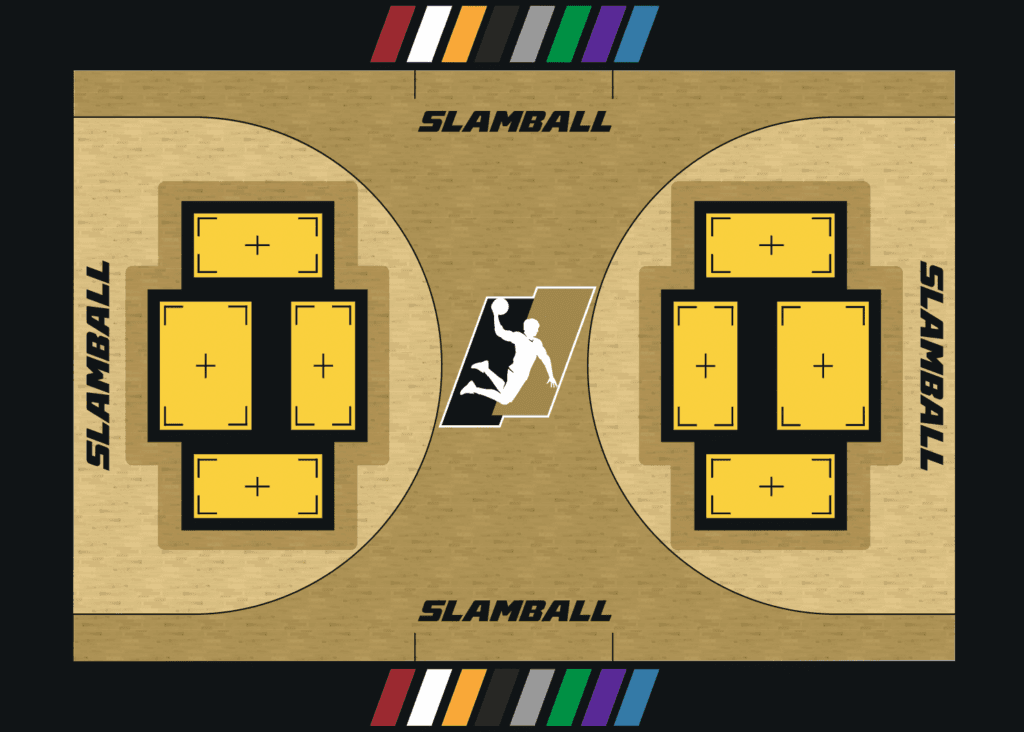
If you are planning a SlamBall court, running a team or buying equipment, the baseline technical specs are now clear and compact enough to guide decisions from layout to helmets. Official play uses a 96 foot by 64 foot footprint and builds the high-energy Slam Zone into each end with four integrated springbeds and precise defensive markings.
Each end contains three standard springbeds sized 7 by 14 feet plus one larger coring bed at 10 by 14 feet. Those beds form the Slam Zone where players use spring energy to launch toward the baskets. Behind the lower springbed sits an 8 foot colored Stopper Box that defines a defensive buffer; complementary defensive lines and open-court spacing mark trampoline and safety zones so trainers and builders can precisely locate trampolines and pad placement.
Scoring zones have changed in recent rule updates. The league uses a three- and four-point arc system with specific radii applied in the modern rule set; facilities should consult the current rules PDF for the exact arc measurements when laying out a regulation court.
Player safety and equipment requirements drive both on-court rules and purchasing lists. Players must wear scrum-cap-style helmets or similar protective headgear in trampoline zones, and common additional padding includes knee and elbow protection and athletic cups. Facilities should stock a range of helmet sizes and enforce proper fit before play. Goals are mounted to reinforced substructures and must be heavily padded; permanent courts should use professionally engineered hoop and backboard assemblies with proven anchoring and padding specifications to limit impact risk.
Court construction involves energy-absorbing systems beyond the springbeds. Perimeter panels and independently articulated floor panels blunt landing forces, and league play courts are bounded by roughly 8 foot clear plexiglass walls to contain action. Budget planners need impact-rated plexiglass and full peripheral padding in their cost estimates.

Operationally, organized play uses four players per side with rolling substitutions. Coaches must train athletes on safe entry and exit of springbeds and on respecting the Stopper Box and defensive stoppage zones to reduce collision risk. Games run fast: four 5-minute quarters with a 20-second shot clock, so facility schedules should allow rapid turnovers and warm-up windows to keep play safe and courts ready.
For vendors, the path to a compliant install is straightforward: engage specialized suppliers for springbeds, inflatable or aircourt systems, and reinforced goal assemblies, and request engineered drawings before awarding contracts. The league publishes a rules-and-regulations page with exact dimension tables and equipment requirements; use those specs as your checklist during procurement and build.
What this means for readers is practical: use these dimensions and gear rules to scope budgets, train rosters on Slam Zone safety, and verify vendor drawings before construction. Follow the detailed specs now and you’ll build a court that delivers the bounce, the pace, and the protection Slamball demands.
Sources:
Know something we missed? Have a correction or additional information?
Submit a Tip