Europe Races to Build Independent Defense as Trump Rattles NATO Commitment
Trump's reported plan to strip Article 5 rights from NATO allies spending under 5% of GDP is reshaping European defense procurement and accelerating a break from U.S. systems.
Reports emerging in late March 2026 that the Trump administration was actively exploring a "pay-to-play" model for NATO, under which allies failing to spend 5 percent of GDP on defense could be frozen out of Article 5 collective defense guarantees, landed in European capitals not as a hypothetical but as a planning assumption. Each new threat has moved the needle: not just in rhetoric, but in contracts signed, budgets passed, and procurement lists quietly rewritten to reduce dependence on American hardware.
The numbers behind that shift are now substantial. EU member states spent €343 billion on defense in 2024, a 19 percent jump from the prior year, and were projected to reach €381 billion in 2025. European Commission President Ursula von der Leyen followed with an €800 billion rearmament framework, branded ReArm Europe and Readiness 2030, anchored by €150 billion in direct loans from Brussels and backed by loosened EU deficit-spending rules for military expenditures. The plan targets nine critical capability gaps including air and missile defense, strategic enablers, drones, and maritime systems, and calls for an EU-wide military mobility corridor to be operational by 2027.
The most consequential shift may be happening inside Germany's defense procurement office. Berlin's 2025-2026 plan allocates only 8 percent of an $83 billion annual budget to U.S. systems, directing the overwhelming remainder toward domestic and European programs: the F127 frigate, the Eurofighter Tranche 5, and the IRIS-T SLM air-defense system. Germany's posture reflects a deliberate strategic choice to insulate procurement from American political volatility, a calculation that would have been almost unthinkable in NATO planning circles a decade ago.
The credibility question driving all of this centers on Article 5. During his first term, Trump openly suggested he might not rush to invoke the mutual defense clause for allies he deemed financial freeloaders. In his second term, that ambiguity has hardened into something more specific: administration officials actively promoted the "pay-to-play" model in several meetings, according to reports from late March 2026, though the concept was not formally tabled at NATO headquarters in Brussels. The distinction matters less to European planners than the direction of travel.
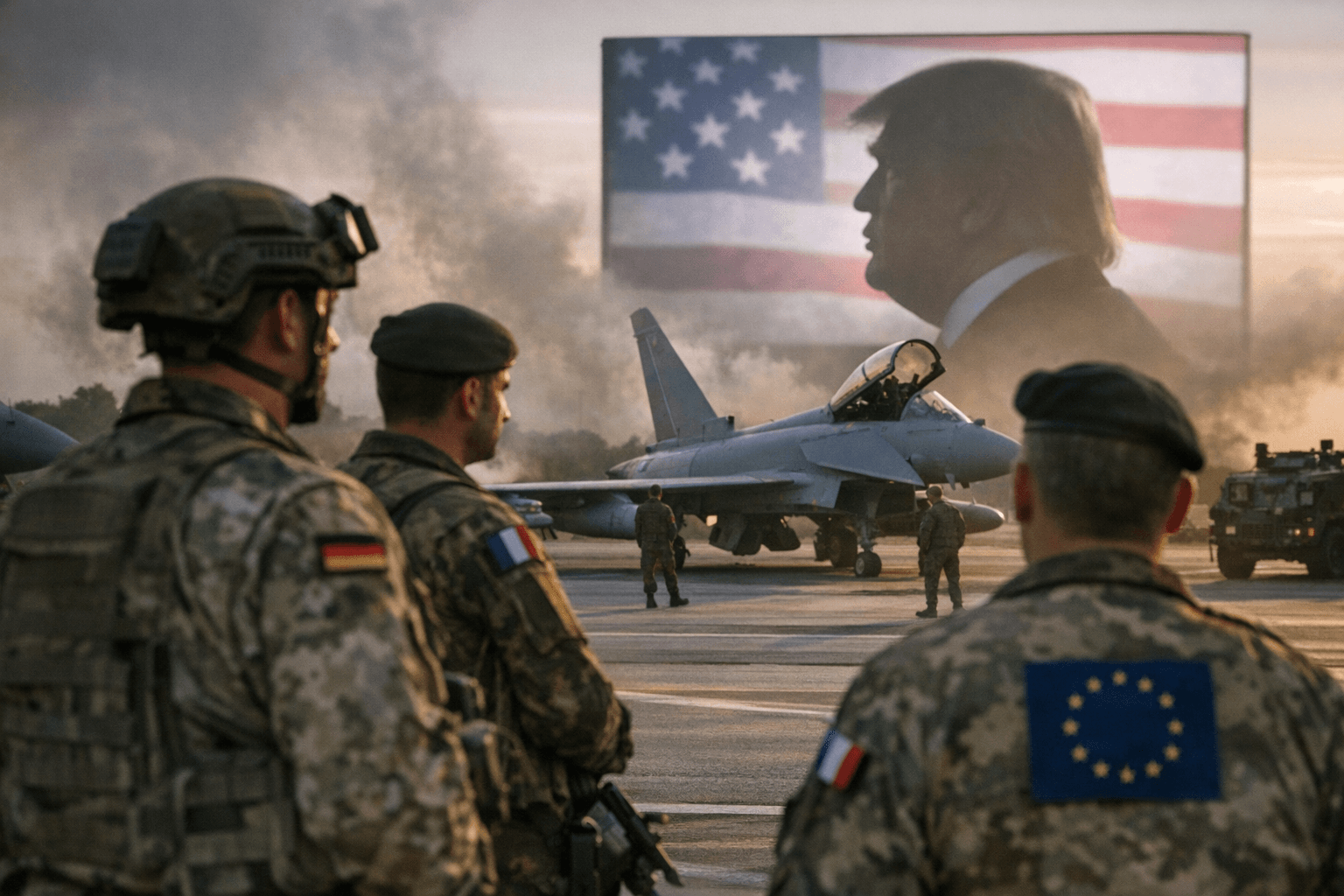
At the Hague summit in June 2025, NATO allies, Spain excluded, pledged to hit 3.5 percent of GDP in core defense spending with an additional 1.5 percent directed toward security-adjacent expenditures including cyber infrastructure and military-grade road networks. The new benchmark effectively ratified Trump's pressure campaign, but it also crystallized a parallel ambition: Europe spending at those levels no longer needs to defer to Washington on capability development. Estonia has committed more than €10 billion to defense between 2026 and 2029. Lithuania is expanding conscription and building a full NATO-integrated division. Both countries remain among the most pro-American in Europe, precisely because they face Russia directly, but even they are diversifying procurement away from systems that could be rendered inoperable by a U.S. decision to withhold software updates or logistics support, a scenario that became credible after Trump froze military aid to Ukraine.
The cost to Washington of a hollowed-out alliance is not abstract. American military influence in Europe runs through approximately 80,000 forward-deployed troops and a network of bases that function as the primary platform for global power projection from Ramstein to Rota. Burden-sharing leverage, the ability to extract concessions on trade, energy policy, and geopolitical alignment in exchange for the security umbrella, dissolves if Europe concludes the umbrella is conditional. Europe collectively fields roughly 1.4 million active-duty personnel; the interoperability deficits that have long made those forces dependent on U.S. command-and-control infrastructure are exactly what the Readiness 2030 framework is designed to close. The further that process advances, the less Washington has to offer in any renegotiation of the transatlantic relationship.
French President Emmanuel Macron and UK Prime Minister Keir Starmer have pushed the concept of a "coalition of the willing," a European reassurance force for Ukraine that would operate outside the formal NATO command structure. Whether that force materializes depends partly on whether the U.S. provides intelligence and logistical backing; but the fact that European leaders are designing military operations around the possibility of American non-participation represents a structural break from seven decades of alliance thinking. That break was not driven by any single statement from Trump. It was driven by the accumulation of them.
This article was produced by Prism’s automated news system from verified source data, official records, and press releases, then run through automated quality and moderation checks before publishing. The system is built and supervised by the people who set the standards it runs under. Read our full AI policy.
Did this article answer your question?


