European Authorities Investigate Wave of Attacks Targeting Jewish Sites
A previously unknown group claimed four attacks on Jewish sites across Belgium, the Netherlands, Greece, and London in 15 days; German prosecutors separately charged three men with Hamas membership and weapons stockpiling targeting Jewish institutions.
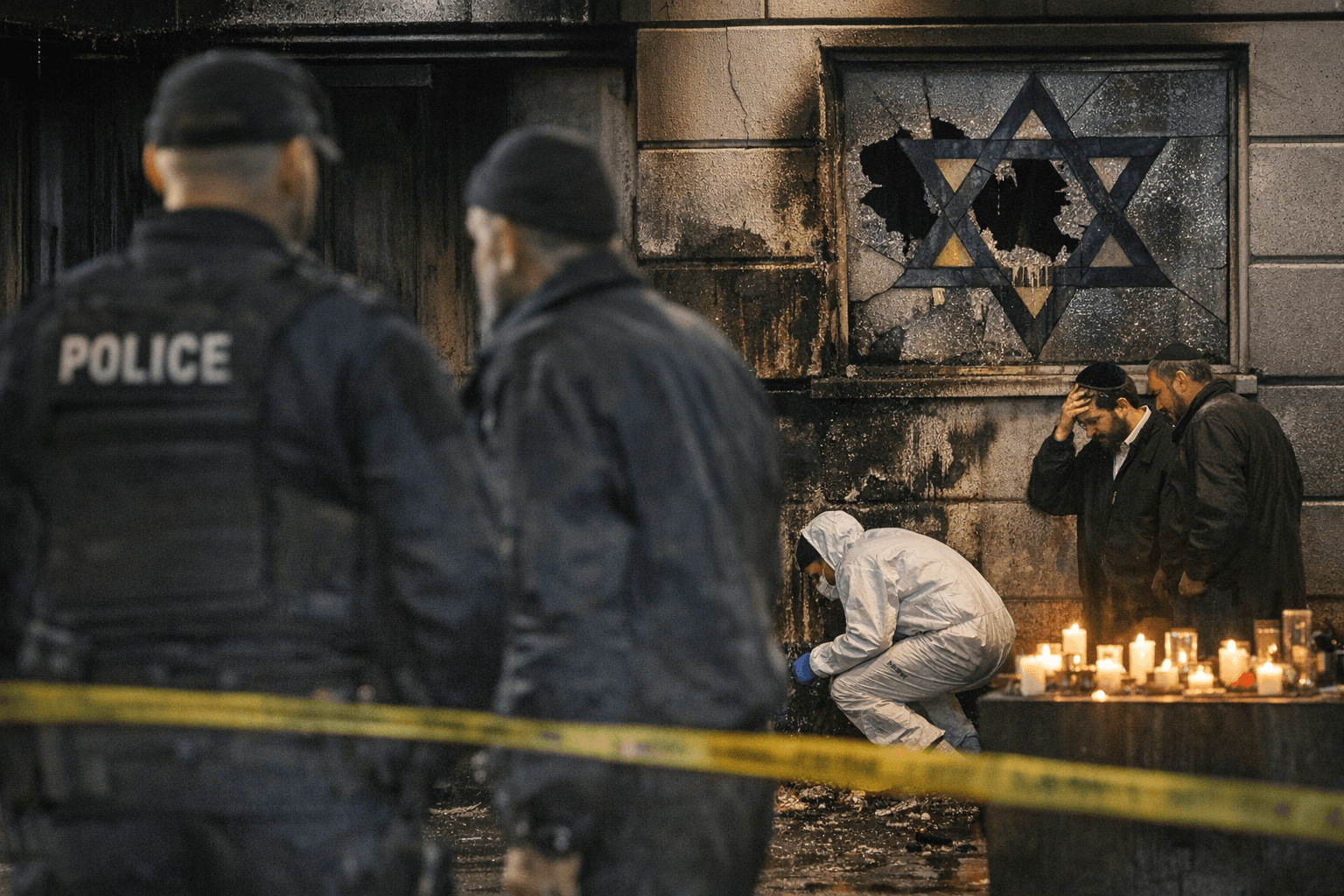
At 4 a.m. on March 9, a pre-dawn explosion blew out the windows of a synagogue on rue Léon Frédéricq in Liège, Belgium, setting off a cascade of similar strikes across Europe that security services are still racing to untangle. A terror group called Harakat Ashab al-Yamin al-Islamiyya claimed responsibility for four attacks on Jewish institutions across Europe in seven days, while a separate set of German prosecutions revealed a Hamas-linked weapons network that had already stockpiled an AK-47, multiple pistols, and hundreds of rounds of ammunition earmarked for strikes on Jewish and Israeli targets on the continent.
The group claimed responsibility for a series of explosions and arson attacks targeting Jewish sites in Belgium, Amsterdam, and Rotterdam between March 9 and March 14. Those incidents included an attack against a synagogue in Rotterdam on March 13, a Jewish school on March 14 in Amsterdam's Buitenveldert district, and an attack against a Jewish site in Greece, although it is not clear what that referred to. Most recently, four ambulances belonging to a Jewish charity were set on fire early Monday in London, with the same group claiming responsibility. Detectives are working to determine whether the claim is authentic; though the London incident has not been classified as a terrorist incident, counterterror officers have been put in charge of the investigation.
The organization is believed to be linked with Iranian terror networks. Israel's Foreign Ministry stated on March 15 that "a jihadi group tied to an Iranian proxy" was behind the attacks, adding that "the IRGC continues to sponsor and export terror across the globe." At this stage, it remains unclear who exactly the group is, but experts believe the fact that most of its social media activity is directed through channels linked to Iraqi Shiite militia groups aligned to Iran and the IRGC would suggest Iranian fingerprints. Joe Truzman, senior research analyst at the Foundation for Defense of Democracies and editor of its Long War Journal, said the war in Iran has likely "compelled the group, for whoever is behind this, to start launching these attacks," and added that he suspects "this organization is being directed" with "an entity behind it."
The attacks in Belgium and the Netherlands drew immediate official condemnation. Belgian Interior Minister Bernard Quintin called the Liège blast "a despicable antisemitic act" that directly targeted the country's Jewish community. Belgian Prime Minister Bart De Wever posted on X: "Antisemitism is an attack on our values and our society, and we must combat it unequivocally. We stand in solidarity with the Jewish community in Liège and throughout the country." The Belgian government announced it would deploy military and federal police forces at sites with links to the Jewish community, including synagogues and schools.
In Amsterdam, a blast struck a Jewish school on March 14; investigators reviewed CCTV footage showing a person placing an explosive device near the building. Amsterdam mayor Femke Halsema condemned what she called "a cowardly act of aggression towards the Jewish community," stressing the city "must be a place where Jews can live safely." Dutch Prime Minister Rob Jetten called the Rotterdam synagogue arson "horrible" and stressed the country must remain safe for the Jewish community. The organization's ability to coordinate attacks in multiple countries in a short period of time indicates that the risk of further attacks remains significant, according to Israel's Diaspora Affairs Ministry.
Running parallel to the claimed attacks, German prosecutors revealed a separate and more operationally advanced threat. Authorities arrested Abed A. G., Wael F. M., and Ahmad I. in October 2025, charging all three with membership in Hamas and preparing a serious act of violence that could endanger the state. Investigators said the suspects had worked since the previous summer to obtain weapons for Hamas operatives in Germany; the October raids turned up an AK-47 assault rifle, multiple pistols, and large quantities of ammunition. Prosecutors believe the weapons were intended for attacks against Jewish and Israeli institutions.
Germany's Federal Prosecutor's Office subsequently announced the arrest of a Lebanese-born man identified as Kamel M. at Larnaca Airport in Cyprus after he traveled there from Lebanon. Prosecutors said Kamel M. transported 300 rounds of live ammunition intended for Hamas operatives, describing the stockpile as part of preparations for "Hamas assassination attacks on Israeli or Jewish institutions in Germany and Europe." Authorities plan to extradite Kamel M. to Germany, where he will appear before a judge as the investigation continues.
French anti-terror prosecutors added another strand to the picture, opening an investigation into two brothers, Moroccan-Italian nationals aged 20 and 22, detained in northern France. Officers found a loaded semi-automatic weapon, a bottle of hydrochloric acid, and an Islamic State flag in their vehicle. Prosecutors described their suspected plot as "lethal and antisemitic."
Security analysts warn the attacks carried out so far "have been mostly unsophisticated, but things may change," with fears that attackers may start targeting people during the day when sites are occupied. With investigations active across at least six countries and extradition proceedings underway, European security services face the challenge of determining whether the claimed attacks and the uncovered weapons networks represent coordinated parts of the same campaign, or converging but distinct threats against the continent's Jewish communities.
This article was produced by Prism’s automated news system from verified source data, official records, and press releases, then run through automated quality and moderation checks before publishing. The system is built and supervised by the people who set the standards it runs under. Read our full AI policy.
Did this article answer your question?


