European Officials Warn Russia Is Secretly Aiding Iran Against U.S. Forces
EU's top diplomat says Russia is helping Iran "to kill Americans," a claim European allies say Washington has been slow to admit.
Kaja Kallas, the European Union's top diplomat, did not soften her words at Vaux-de-Cernay Abbey. Russia, she told G7 foreign ministers on Thursday, was providing Iran with intelligence "to target Americans, to kill Americans," and was supplying drones to help Iran strike U.S. military bases across the region.
The remarks, delivered at a 13th-century monastery outside Paris, crystallized a message European governments have been pressing on American diplomats publicly and privately: Russia's material support for Iran's war effort goes further than the United States has been willing to acknowledge.
Multiple sources, including a senior U.S. official with direct knowledge, said earlier in March that Russia was providing Iran with intelligence regarding U.S. positions in the Middle East. But European officials at the G7 meeting on March 26 argued the cooperation extends well beyond intelligence sharing. Two Western security sources and a regional official close to Tehran told Reuters that Russia has been providing satellite imagery to Iran and has helped Iran upgrade its drones to emulate the versions Moscow deployed against Ukraine.
The drone dimension of the relationship is particularly tangled. The United Kingdom assessed that Iran had transferred Shahed drones to Moscow for battlefield use in Ukraine and passed production know-how to Russia, which in turn helped Iran refine its own drone warfare capabilities. A U.K. official described the exchange as substantial, though that official could not confirm a recent physical transfer of hardware from Russia to Iran. Officials separately alleged that Russia is sending upgraded drones used in the Ukraine war back to Iran, a claim the U.K. could not corroborate on the record.
French Foreign Minister Jean-Noël Barrot described the relationship as unmistakably reciprocal. "It is a proven fact that cooperation has existed and continues to exist between Russia and Iran in both directions, and we are fully aware of this," he said at a news conference. He added there was "reason to believe that today Russia is supporting Iran's efforts, both military and otherwise, which appear to be directed, in particular, against American targets."
German Foreign Minister Johann Wadephul put Moscow's motive more bluntly. "Putin cynically hopes that the escalation in the Middle East will divert our attention from his crimes in Ukraine," he told reporters. "We see very clearly how closely the two conflicts are intertwined. Russia is evidently supporting Iran with information about potential targets."
U.K. Secretary of Defense John Healey told BBC News he saw the "hidden hand of Putin" behind Iran's war effort. British Foreign Minister Yvette Cooper said she was "deeply concerned about the links between Russia and Iran that have been longstanding in terms of shared capabilities, including drones."
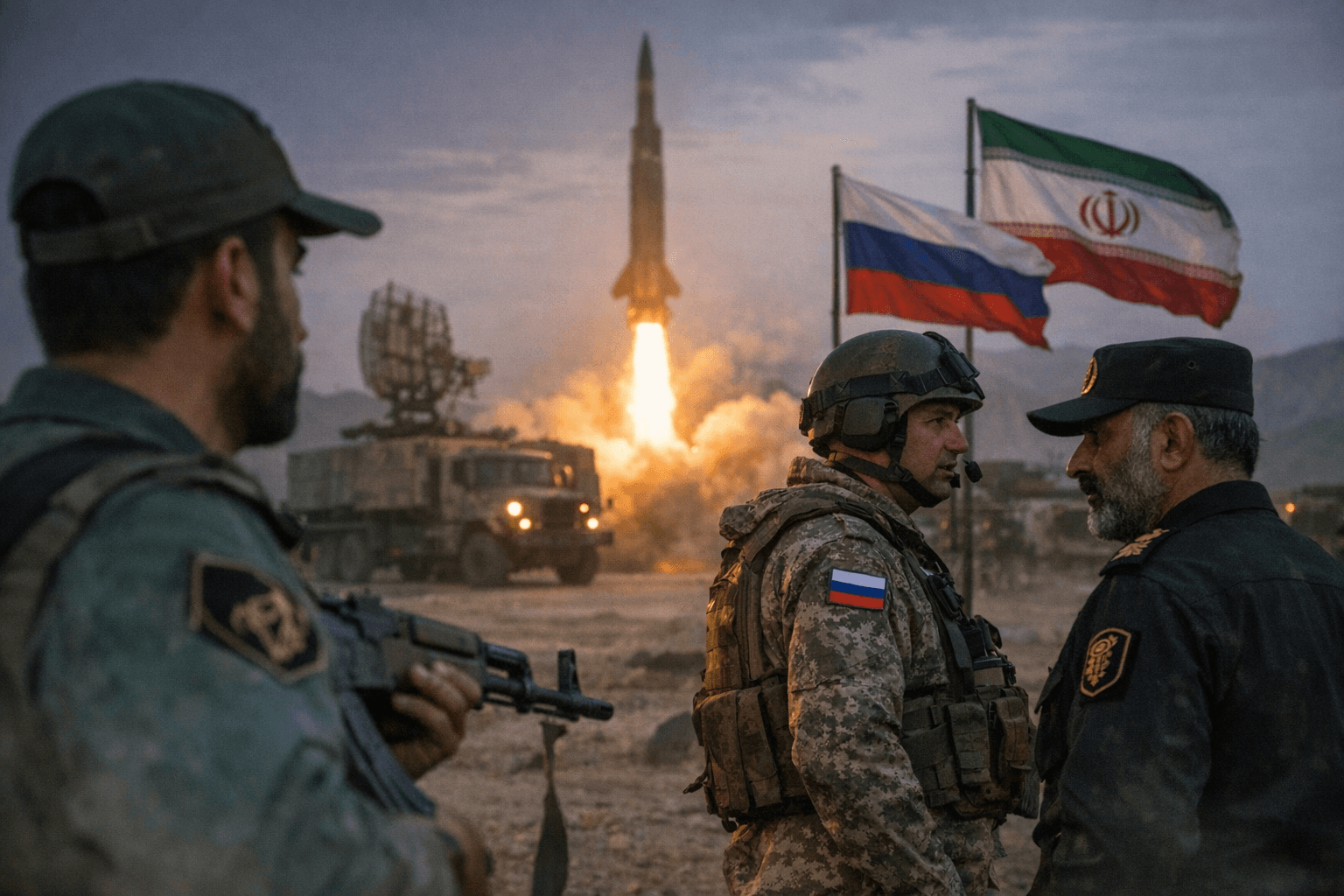
Adding urgency to the European push, Iranian and Russian officials reportedly began secretly discussing drone deliveries days after Israel and the United States attacked Tehran in late February, according to officials briefed on the intelligence.
Moscow pushed back. Kremlin spokesperson Dmitry Peskov said: "There are a lot of fakes going around right now. One thing is true: we are continuing our dialogue with the Iranian leadership."
But European ministers pressed the question of consequences, framing the intelligence gap not as a diplomatic abstraction but as a direct risk to American lives. Kallas argued the two wars cannot be managed in isolation. "These wars are very much interlinked," she said. "So if America wants the war in the Middle East to stop, and Iran to stop attacking them, they should also put pressure on Russia so that they are not able to help them in this."
Secretary of State Marco Rubio joined the second day of the G7 gathering, where European allies raised the Russia-Iran cooperation issue directly with him. Russia and Iran signed a strategic partnership agreement last year, and Reuters reported that Moscow has since sent more than 13 tonnes of medicine to Iran through Azerbaijan, a material flow that illustrates how embedded the bilateral relationship has become even outside the military domain.
Whether the United States will publicly revise its assessment of Russia's role, or begin treating the two conflicts as a single strategic problem, is now the question American allies say Washington can no longer defer.
This article was produced by Prism’s automated news system from verified source data, official records, and press releases, then run through automated quality and moderation checks before publishing. The system is built and supervised by the people who set the standards it runs under. Read our full AI policy.
Did this article answer your question?


