Eurovision opens in Vienna amid Israel boycott protests and security crackdown
Eurovision opened in Vienna under heavy security as boycott protests over Gaza cut the field to 35 countries, the smallest since 2003. Israel advanced to the final despite demonstrators outside Wiener Stadthalle.

Eurovision opened in Vienna on Tuesday as a music spectacle turned into a stress test for whether a global entertainment brand can still claim political neutrality during a major war. The first semi-final went ahead at Wiener Stadthalle with Israel on stage, even as five public broadcasters had withdrawn over the Gaza conflict and the field shrank to 35 countries, the smallest since 2003.
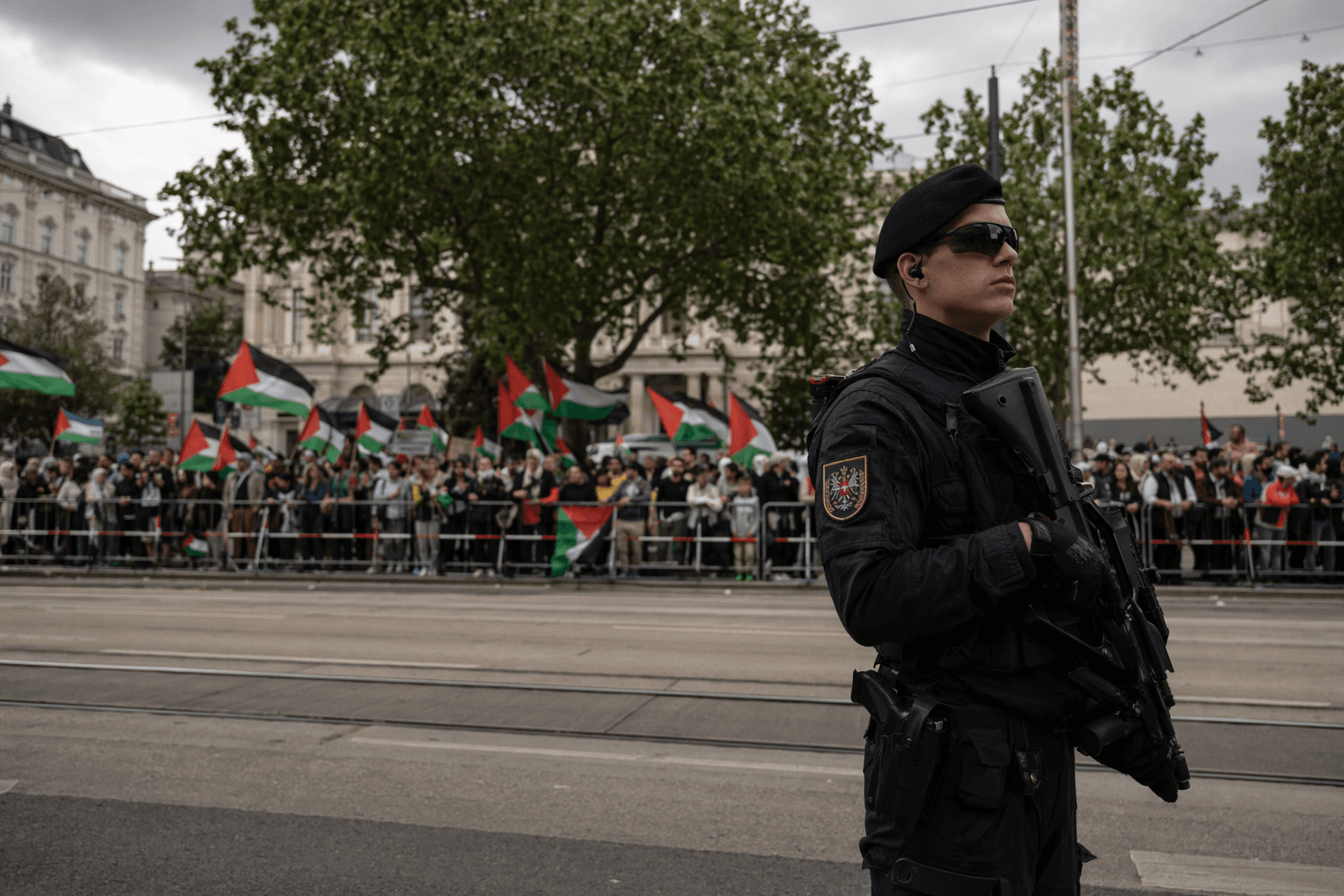
The scale of the backlash was visible outside the arena and built into the contest itself. Protesters gathered in Vienna, with attendance at this week’s demonstrations estimated at up to 3,000, while crowd-control measures and flag restrictions were enforced inside. Vienna police had already described Eurovision as one of the biggest security events they had faced, and ORF responded with a strict no-bag policy for live shows and limits on flags and banners. The broadcaster also created a cybersecurity coordination group with Austria’s interior ministry and the European Broadcasting Union.
The opening night underscored how quickly Gaza has changed Eurovision’s public meaning. Public broadcasters in Spain, the Netherlands, Ireland, Iceland and Slovenia pulled out, saying Israel’s participation was incompatible with their values and responsibilities in light of the humanitarian crisis. Israel still competed in the semi-final and qualified for the grand final, keeping the dispute at the center of the week’s coverage.
Austria’s leadership has pushed back hard against the criticism. Vienna Mayor Michael Ludwig reacted sharply to a protest interruption at a separate event, saying, “We won't let ourselves be terrorised into silence.” Amnesty International Austria co-head Shoura Hashemi later condemned those remarks as “unbearable, false, divisive,” widening the clash between officials and pro-Palestinian demonstrators.
The politics around this year’s contest are especially visible because Vienna is hosting during Eurovision’s 70th anniversary year, after JJ won the 2025 contest with “Wasted Love.” That combination of symbolism and security has made Austria’s capital a flashpoint for a debate that extends far beyond pop music.
Eurovision’s reach helps explain why the fight matters. The contest drew an estimated 166 million viewers last year, more than the 128 million who watched the U.S. Super Bowl, making it a rare entertainment event with genuine geopolitical weight. For organizers, the immediate challenge is keeping the show intact. The deeper one is whether a brand built on unity can survive a war that has turned participation itself into a political statement.
This article was produced by Prism’s automated news system from verified source data, official records, and press releases, then run through automated quality and moderation checks before publishing. The system is built and supervised by the people who set the standards it runs under. Read our full AI policy.
Did this article answer your question?