Export-Import Bank lends $10 billion to Project Vault critical minerals reserve
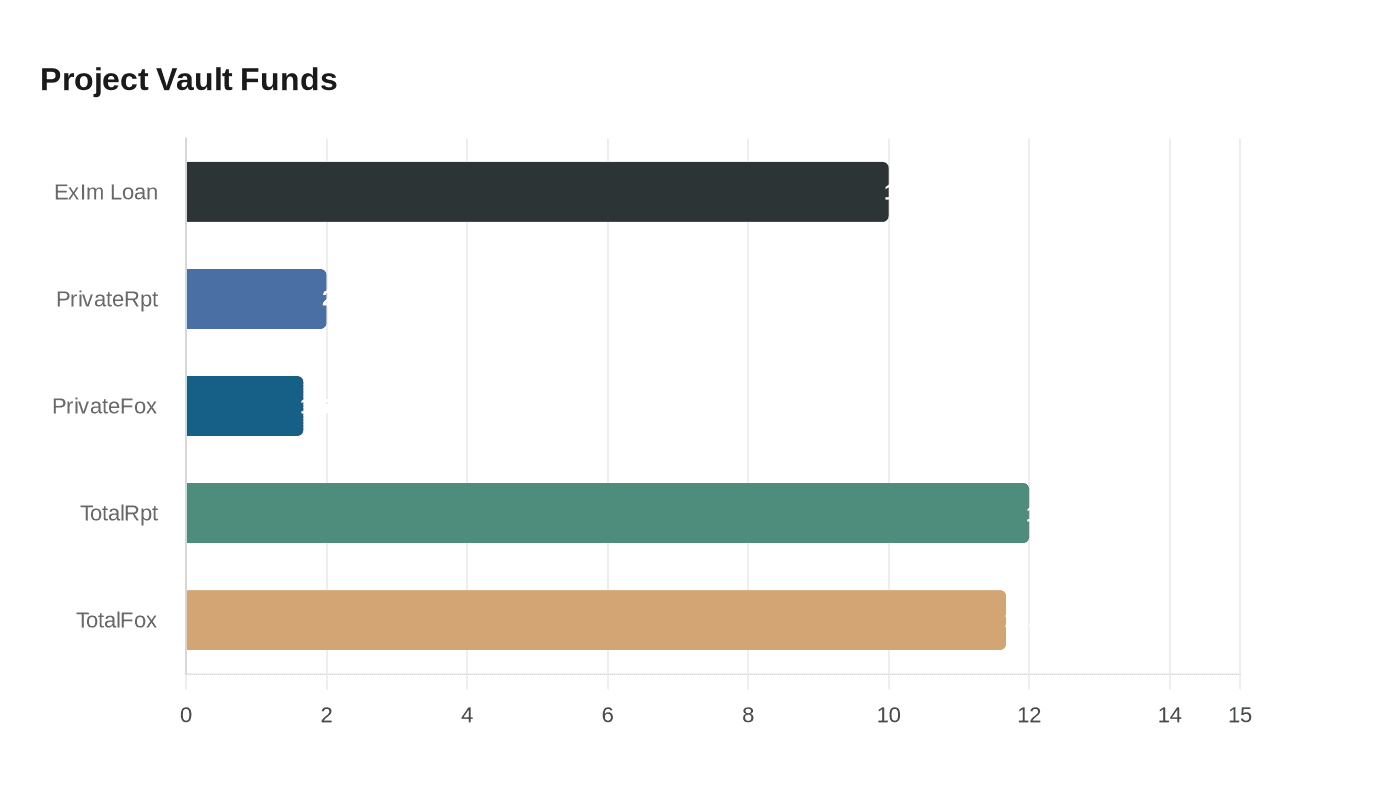
The Export-Import Bank will lend $10 billion to Project Vault, paired with roughly $1.6‑2 billion in private capital, to build a civilian stockpile of rare-earth and critical minerals.
The U.S. Export-Import Bank is underwriting a $10 billion loan to Project Vault, the administration’s new U.S. strategic critical minerals reserve, with private investors reported to contribute roughly $2 billion or, by one account, $1.67 billion. The White House framed the effort as a commercial buffer for automakers, chipmakers and other manufacturers that depend on minerals such as cobalt, graphite, silicon, copper, nickel, titanium and lithium.
“Today we're announcing the creation of the U.S. strategic critical minerals reserve, the first-ever stockpile of the critical minerals that you've been hearing so much about,” President Donald Trump said at the Oval Office announcement, CBS News reported. The administration added that the reserve will be “for civilian use in times of emergency.” CNBC quoted the President saying, “For years, American businesses have risked running out of critical minerals during market disruptions. Today, we're launching what will be known as Project Vault, to ensure that American businesses and workers are never harmed by any shortage.”
Bloomberg first reported the White House plan, and the package has been covered by CBS News, CNBC, Al Jazeera and Fox Business. Most outlets present a headline seed financing of about $12 billion combining the $10 billion Export-Import Bank loan and approximately $2 billion in private capital; Fox Business specifically cited $1.67 billion in private cash in its reporting, producing an $11.67 billion total in that account. The discrepancy over private commitments has not been resolved in public statements.
Officials and analysts framed Project Vault as the industrial equivalent of the Strategic Petroleum Reserve: a government-backed stockpile intended to blunt price spikes and supply interruptions. The White House pointed to a 2024 statistic, cited by CBS News, that the United States was entirely reliant on imports for 12 critical minerals and imported 50 percent or more of 29 others. Policymakers intend Project Vault to reduce reliance on foreign suppliers, particularly China, which Fox Business said “currently controls between 60-70% of rare earth mining.”
Markets reacted unevenly to the announcement. CNBC reported that U.S.-listed rare-earth miners surged after the news, with Critical Metals up more than 10 percent, USA Rare Earth rising nearly 11 percent, and MP Materials gaining about 4 percent. By contrast, Al Jazeera captured a mixed snapshot in which MP Materials was up 0.6 percent while companies including Lithium Americas and Trilogy Metals were down, and Korean Zinc plunged 12.6 percent. Those divergent snapshots reflect different trading windows and market interpretations of how quickly the program will translate into new contracts or domestic production.
Project Vault targets minerals used in electric vehicle batteries, semiconductors and smartphones, and Fox Business highlighted the broader strategic stakes by naming defense and high‑tech applications. The announcement involved business executives in the Oval Office; Fox Business reported President Trump was scheduled to meet with GM Chief Executive Mary Barra and mining executive Robert Friedland.
Key operational details remain opaque: the loan’s approval conditions and terms, the identities and legal commitments of private investors, the procurement timetable, storage and withdrawal rules, and whether purchases will prioritize domestic production. Those questions will determine whether Project Vault reshapes supply chains or simply reallocates geopolitical leverage. The program tests a growing U.S. policy trend of using public finance to force a faster reconfiguration of critical mineral supply lines away from dominant foreign suppliers and toward a more resilient industrial base.
Know something we missed? Have a correction or additional information?
Submit a Tip

