FBI still seeks Monica Witt, accused of spying for Iran
The FBI kept Monica Witt on its wanted list more than five years after she allegedly defected to Iran, tying her case to a wider cyber campaign against U.S. intelligence.
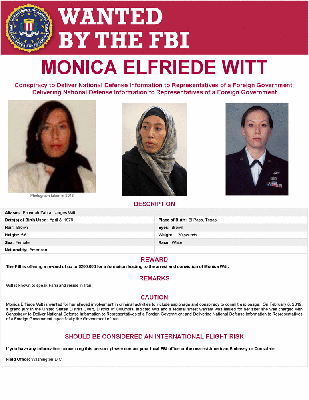
The FBI is still publicly hunting Monica Witt, the former U.S. service member and counterintelligence agent accused of defecting to Iran in 2013 and passing highly classified information to Iranian officials. More than five years after her federal indictment, the case remains open, a reminder that espionage investigations can keep damaging U.S. national security long after the initial breach.
Witt was indicted on Feb. 8, 2019, in Washington, D.C., on charges of conspiracy to deliver and delivering national defense information to representatives of a foreign government. The Justice Department said she allegedly disclosed the code name and classified mission of a U.S. Department of Defense Special Access Program and identified a U.S. intelligence officer. Prosecutors said Witt, also known as Fatemah Zahra and Narges Witt, defected to Iran and is known to speak Farsi and reside there.
The FBI’s wanted notice says Witt was born in El Paso, Texas, on April 8, 1979, is 5-foot-6 and about 120 pounds, with brown hair and brown eyes. The bureau says she should be considered an international flight risk. The public notice is part of an effort to generate information leading to her arrest, even as the years pass and the case becomes more entrenched as a symbol of unresolved insider betrayal.
Witt’s indictment was also folded into a broader counterintelligence and cyber case against four Iranian nationals: Mojtaba Masoumpour, Behzad Mesri, Hossein Parvar and Mohamad Paryar. Prosecutors said those men carried out a cyber campaign in 2014 and 2015 aimed at Witt’s former colleagues in the U.S. intelligence community, using fictional and imposter social media accounts and attempting to deploy malware to gain covert access to their computers and networks.
That linkage is part of what keeps the case alive in public view. It is not just about one alleged defector. It is about the way a human source, foreign intelligence services and cyber operations can converge on the same target set, exposing people, programs and institutional trust at once. For U.S. officials, leaving the case unresolved also serves a strategic purpose: it keeps pressure on Iran’s intelligence apparatus, reinforces the warning to potential insiders and signals that long-tail espionage cases do not fade simply because years have passed.
This article was produced by Prism’s automated news system from verified source data, official records, and press releases, then run through automated quality and moderation checks before publishing. The system is built and supervised by the people who set the standards it runs under. Read our full AI policy.
Did this article answer your question?

