FCC Moves to Bar Device Testing in Countries Lacking U.S. Reciprocal Agreements
The FCC will vote April 30 on rules that could bar labs handling roughly 75% of global electronics testing from certifying devices for the U.S. market, citing foreign interference risks.
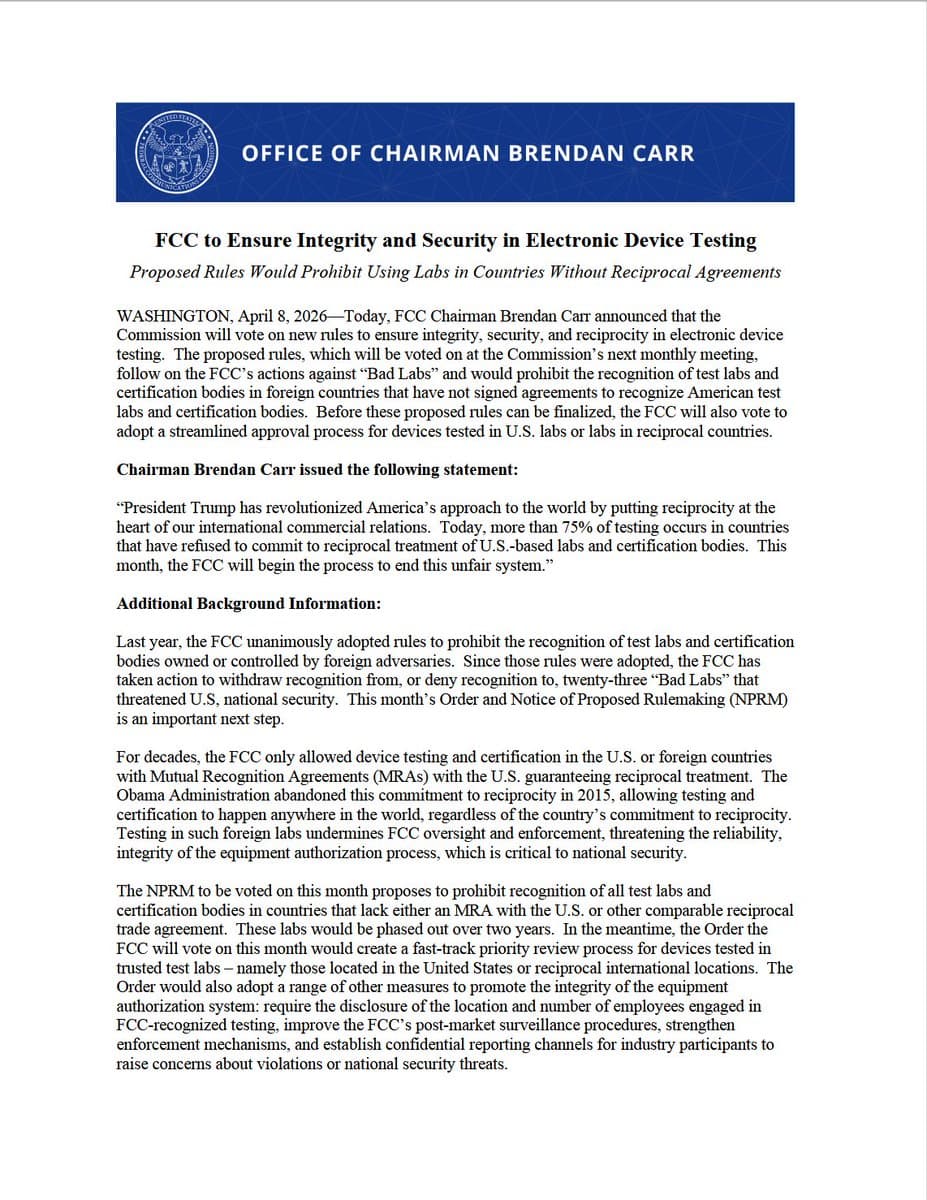
A sweeping Federal Communications Commission proposal set for a vote on April 30 could disqualify labs responsible for testing roughly three-quarters of the world's electronics from certifying devices for the American market, forcing manufacturers to reroute compliance work on a scale not seen in the modern supply chain era.
FCC Chairman Brendan Carr announced the vote on April 8, framing the proposed rules as a restoration of a reciprocity standard the agency enforced for decades before the Obama administration abandoned it in 2015. Under that earlier framework, only labs in the United States or in countries holding Mutual Recognition Agreements with the U.S. could certify devices for American sale. The 2015 policy shift opened the door to testing in any country, regardless of whether that country's labs were subject to equivalent oversight or inspection by U.S. officials. The new proposal would close that gap.
Devices tested in labs located in countries without reciprocal agreements would no longer qualify for streamlined FCC certification, a designation that is effectively a prerequisite for selling phones, routers, and IoT equipment in the United States. The agency also proposed a separate fast-track approval path for devices tested in what it is calling "Trusted Test Labs," a category reserved for facilities in the U.S. or in jurisdictions the FCC deems secure through MRA or trade-agreement status. That two-tier system is designed to accelerate market entry for compliant manufacturers while creating friction for those routing work through unsanctioned labs.
The practical stakes are enormous. China accounts for roughly 75 percent of global electronics testing, according to FCC estimates, meaning that the vast majority of consumer and commercial devices currently moving through Chinese certification labs would face a disrupted pathway to U.S. shelves. Manufacturers would need to qualify alternate labs in MRA-partner countries, invest in domestic testing capacity, or absorb delays as they reroute compliance work through a narrower pool of recognized facilities. Any of those options adds cost; none is immediate.
The April 8 proposal is deliberately broader than the FCC's 2025 action, which withdrew recognition from 23 Chinese government-controlled labs branded "Bad Labs." That earlier move targeted ownership and control by foreign adversaries. The new proposal operates on geography and reciprocity, meaning labs not directly controlled by Beijing but operating in China would also lose eligibility if no reciprocal agreement exists between the two countries.
FCC officials framed the national security rationale around the risk that foreign adversaries could manipulate testing results before devices enter U.S. commerce, compromising not just emissions and safety data but the foundational integrity of the equipment authorization process. Enforcement would fall primarily at the point of certification rather than at ports, but devices that reached the market under subsequently disqualified lab certifications could face FCC scrutiny.
Tech companies and global manufacturers are expected to engage heavily in the public-comment process the April 30 vote would open. Industry observers note the proposal also intersects directly with broader U.S. trade and export-control policy, and could accelerate investment in domestic lab capacity as manufacturers weigh the cost of compliance rerouting against the longer-term risk of a certification bottleneck.
This article was produced by Prism’s automated news system from verified source data, official records, and press releases, then run through automated quality and moderation checks before publishing. The system is built and supervised by the people who set the standards it runs under. Read our full AI policy.
Did this article answer your question?