FDA backs uniQure Huntington's gene therapy filing, shares surge
FDA's shift could let uniQure seek accelerated approval for AMT-130, sending shares up more than 70% as Huntington's families watched closely.
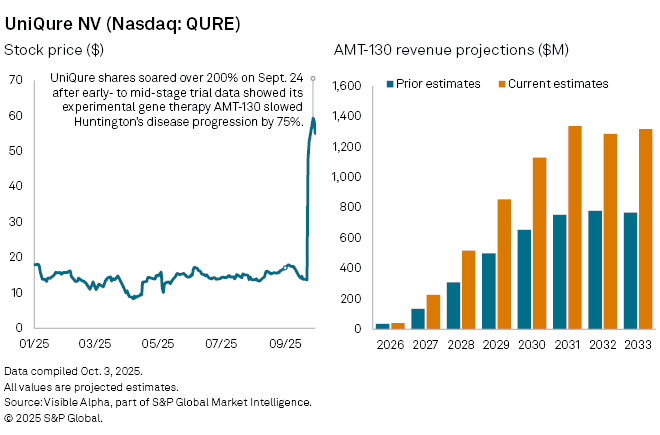
The FDA’s decision to let uniQure pursue an accelerated-approval filing for AMT-130 marked a sharp turn in one of the most closely watched Huntington’s disease programs in the world. The move matters far beyond Wall Street: for families facing a fatal inherited disorder with no approved disease-modifying therapy, it keeps alive the possibility of the first treatment aimed at changing the course of the illness.
uniQure said the agency now accepts that a three-year analysis from its Phase I/II program may serve as the primary basis for a biologics license application. In the company’s latest readout, high-dose AMT-130 showed a 75% slowing of disease progression at 36 months on the composite Unified Huntington’s Disease Rating Scale compared with a propensity score-matched external control, while also meeting a key secondary endpoint on Total Functional Capacity. The study also found mean cerebrospinal fluid neurofilament light chain levels below baseline at 36 months, data that support the signal but do not erase the remaining uncertainty around long-term safety and whether the effect will hold in broader use.

That uncertainty is central to the accelerated-approval path. The FDA had previously said in March 2026 that it could not agree the Phase I/II data against an external control were enough for approval and strongly recommended a prospective, randomized, double-blind, sham surgery-controlled study. That followed a November 2025 pre-BLA meeting in which uniQure said it was surprised and disappointed by what it described as a sudden reversal from an earlier, more favorable view of the pathway. The latest shift suggests the agency is again willing to consider the company’s existing evidence, while still expecting a confirmatory study to be designed and run.
The reaction was immediate. uniQure’s U.S.-listed shares jumped more than 70% in premarket trading, underscoring how much regulatory clarity can move both investor sentiment and patient expectations in rare disease medicine. Huntington’s affects about 75,000 people in the U.S., Europe and the U.K., and the company says AMT-130 is a one-time AAV5 gene therapy that uses an artificial microRNA to silence the huntingtin gene and reduce production of mutant huntingtin protein.
The patient community pushed hard for that opening. In January 2026, a coalition of five Huntington’s disease nonprofits urged the FDA not to delay review, after one petition collected about 40,000 signatures. HDSA later said its coalition petition topped 47,000 signatures and that advocates sent more than 11,000 messages to Congress. On June 17, 2026, HDSA called the agency’s stance an “encouraging and meaningful step forward,” while stressing that accelerated filing is not approval. uniQure said it plans to submit the filing in the third quarter of 2026, and the real test will be whether the signal in early data can survive the scrutiny of a confirmatory trial.
This article was produced by Prism’s automated news system from verified source data, official records, and press releases, then run through automated quality and moderation checks before publishing. The system is built and supervised by the people who set the standards it runs under. Read our full AI policy.
Know something we missed? Have a correction or additional information?
Submit a Tip