Fed Governor Urges 'Jumbo' 100+ Basis-Point Cuts in 2026
Federal Reserve Governor Stephen Miran publicly pressed for "well over 100 basis points" of interest-rate cuts in 2026, sharpening a rare and politically charged split at the central bank. The declaration heightens market and policy uncertainty as officials weigh a faster easing path against caution on inflation that remains near, but not at, the Fed's 2 percent target.
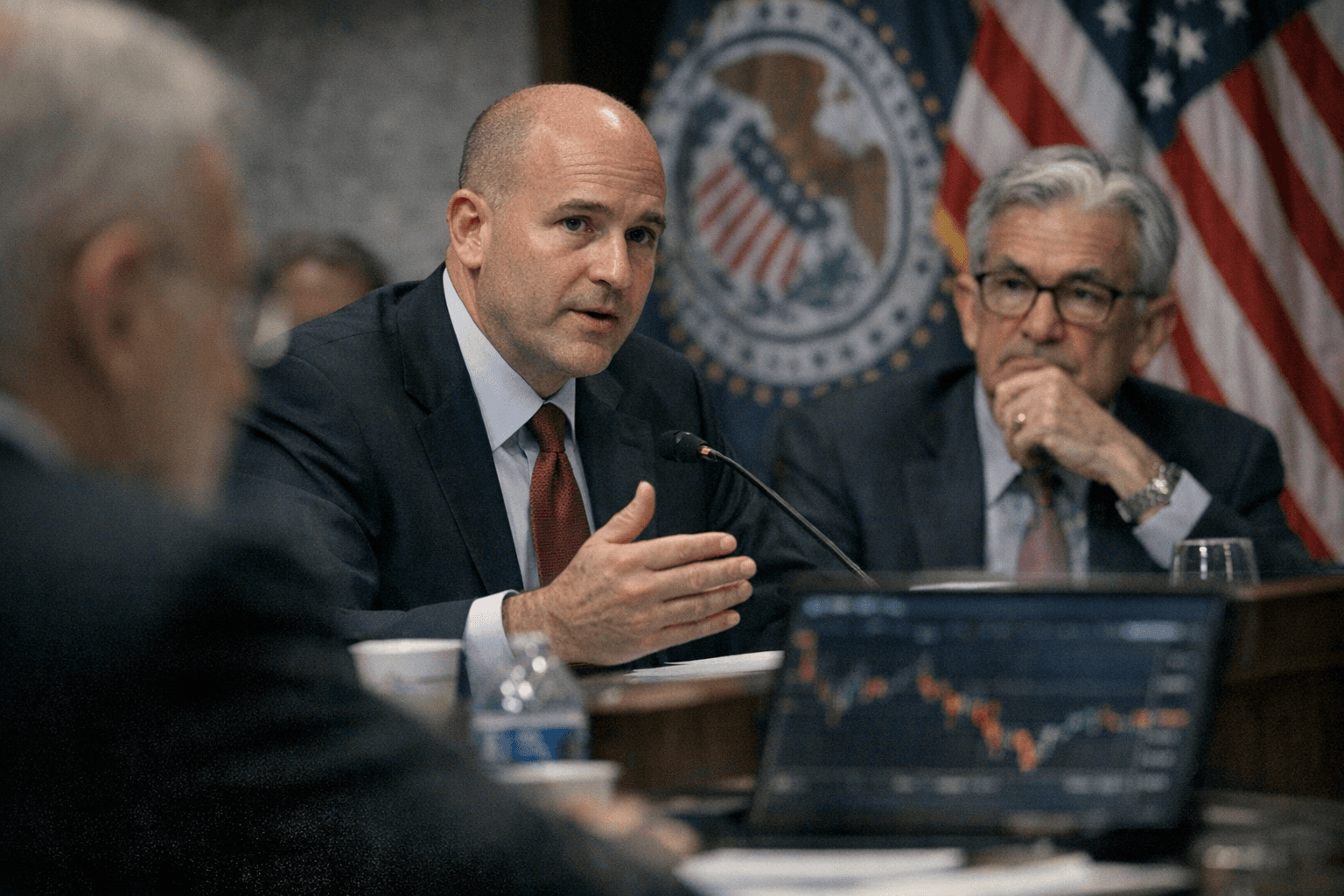
Federal Reserve Governor Stephen Miran told Fox Business on Jan. 6 that policymakers will need to ease policy "well over 100 basis points" in 2026, intensifying a public division inside the central bank over the pace and scale of rate cuts. Miran said the current stance is "clearly restrictive and holding the economy back," and repeated a view he has offered since last fall that the committee should move quickly to lower borrowing costs.
The comments come three weeks after the Federal Open Market Committee trimmed its policy rate by 25 basis points at the December 2025 meeting to a 3.50 percent to 3.75 percent range. At that meeting Miran reportedly favored a 50 basis-point reduction; two presidents, Jeffrey Schmid and Austan Goolsbee, voted to leave rates unchanged, with Schmid recording his second consecutive dissent. Those votes underscored a committee split that has widened as officials consider how to respond to slowing growth and cooling labor-market momentum.
Miran, who took leave in September from his role as chair of the White House Council of Economic Advisers to accept a temporary Fed seat, has been a persistent voice for larger easing. His appointment to the Board of Governors was controversial, drawing concern among global central bank watchers about the institution's independence. His temporary term expires Jan. 31, 2026; Miran has said he will remain at the Fed until the president names a permanent replacement.
The governor's call for "jumbo" cuts aligns politically with pressures from the White House. President Donald Trump has publicly urged lower rates as growth slowed in 2025, and Miran's stance reflects those pressures even as other Fed officials emphasize a data-driven, measured approach. Officials advocating gradual easing point to inflation that remains near the Fed's 2 percent objective and to labor-market indicators that, while softer than in prior years, have not deteriorated decisively.
Markets and investors are watching closely. A policy path that trims more than a percentage point of rates within a single year would alter expectations for Treasury yields, corporate borrowing costs and the dollar, and could shift financial conditions markedly relative to a slow, incremental easing trajectory. The public split also raises governance questions, since clear disagreement among governors and presidents can amplify volatility in markets that prize Fed unity.
Speculation about succession and longer-term leadership at the Fed has entered the conversation alongside the policy debate. Names floated as possible successors or nominees include Kevin Hassett and former governor Kevin Warsh, with market wagers and commentary indicating uncertainty over the administration's choices. Decisions about personnel could affect the balance of views on the policy committee and how aggressively it pursues rate cuts.
For now, the Fed faces a choice between a rapid reduction in rates to support an economy that has lost momentum and a cautious, data-dependent strategy designed to secure a return of inflation to target without reigniting price pressures. Miran's public push for "well over 100 basis points" of easing has made that choice more visible and intensified scrutiny from investors, global central banks and political actors as 2026 gets under way.
This article was produced by Prism’s automated news system from verified source data, official records, and press releases, then run through automated quality and moderation checks before publishing. The system is built and supervised by the people who set the standards it runs under. Read our full AI policy.
Did this article answer your question?

%3Amax_bytes(150000)%3Astrip_icc()%2FCertificate-of-deposit-2301f2164ceb4e91b100cb92aa6f868a.jpg&w=1920&q=75)
