Fiji Mabe Pearl Farmers Boost Profits After Two-Day Financial Literacy Workshop
Two-day Savusavu workshop on 24–25 February 2026 taught Fiji’s mabe pearl farmers practical financial management to strengthen livelihoods and improve profitability.

The Ministry of Fisheries Research, in partnership with the Australian Centre for International Agricultural Research (ACIAR), concluded a two-day financial literacy workshop in Savusavu from 24–25 February 2026 aimed at enhancing the livelihoods of individuals involved in Fiji’s mabe pearl sector. The training targeted local mabe pearl farming communities and offered hands-on modules intended to help farmers track income, control costs and plan for enterprise growth.
Organisers designed the Savusavu sessions to be practical in scope. “The workshop was designed to provide participants with practical skills to better manage income and expenses, improve profitability, and support the long-term sustainability of their pearl farming enterprises,” the materials state. A social media post from the organisers reiterated that “the primary objective of the workshop was to empower local mabe communities by equipping them with essential financial management skills,” and other social posts confirmed the two-day programme concluded as scheduled.
The workshop is part of a broader ACIAR-supported effort across the Western Pacific to translate technical pearl culture into viable livelihoods. ACIAR documents note that financial literacy training already enabled the Raviravi Women’s Group in Fiji to become an independent business. “Financial literacy training provided to the members of Raviravi Women’s Group has enabled them to establish the group as an independent business. The members are now well trained to manage their finances and can pay themselves for working on their spat and mabé pearl farms,” ACIAR reports.
Regional project activity cited by ACIAR demonstrates training reach and market links beyond Fiji. In Papua New Guinea, 59 artisans from Neitab, Tunnung, Kung, Meterankasing and Tabut communities, as well as artisans at Raviravi and Ravita in Vanua Levu, Fiji, received similar training. ACIAR also records that Tonga’s mabé pearl farmers and artisans secured an online sales contract to Hawaii after a 2020 marketing workshop, and that a quarterly five-year mabé pearl product sales contract was signed in February 2021 with Jewels of Polynesia for regular export of value-added mabé pearl pieces.
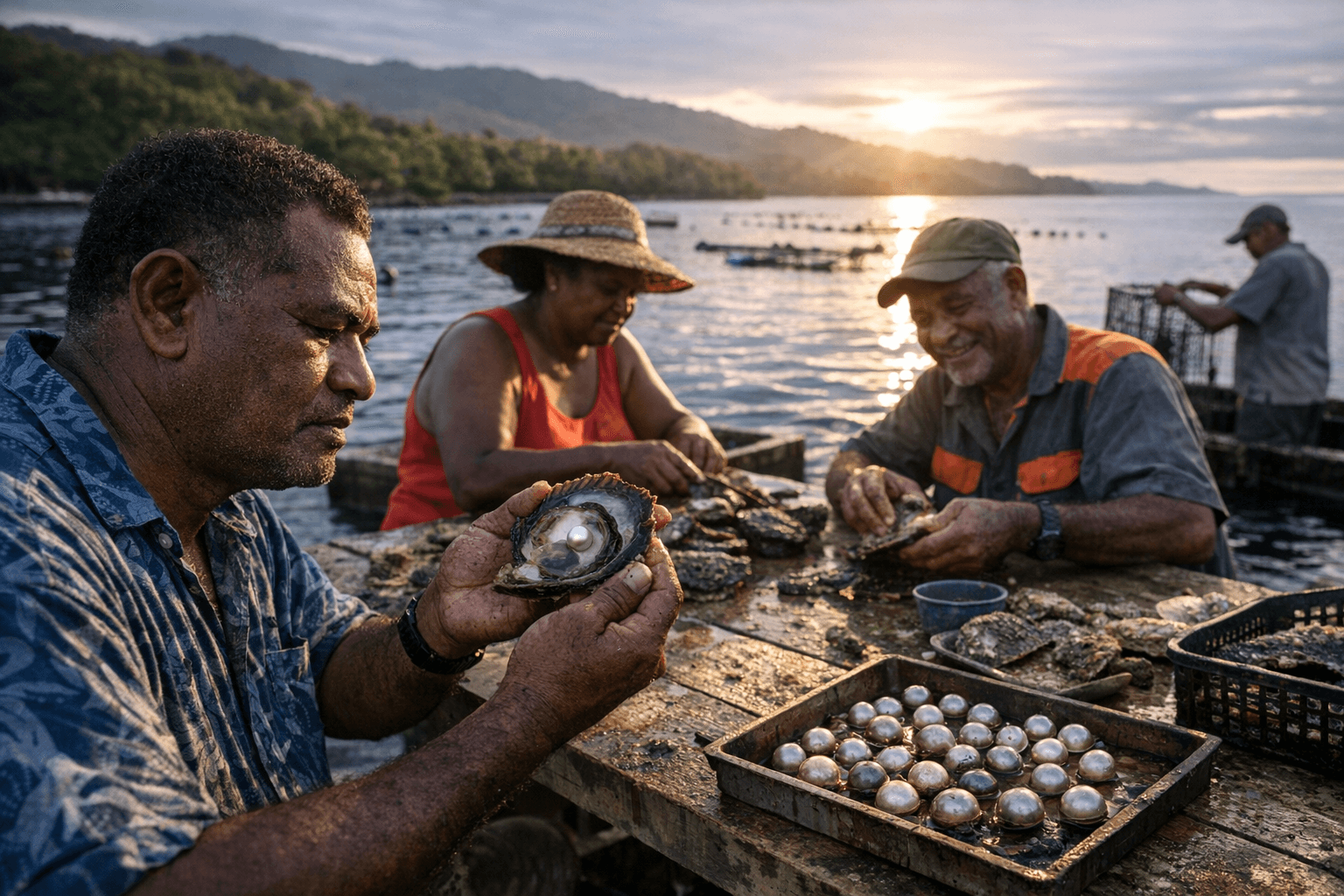
Economic modelling in ACIAR project material frames why financial skills matter at scale. “At steady state, median annual profitability was determined to be $156,362, but inclusion of price and production risk factors reduced annual profitability to $29,463. The model farm achieved an internal rate of return of 36% with a benefit–cost ratio of 1.8 and payback period of 5 y. Farms holding 100,000 oysters and producing more than 8,000 pearls are deemed of viable scale,” the report states, and it notes that “given the average rural household income in Fiji is $5,800, round pearl culture offers significant economic opportunity” for upstream and downstream participants.
Organisers stress that training is a foundational step toward financial control and stable returns. “Organisers say strengthening financial literacy is a key step toward empowering communities to take greater control of their operations and secure more stable economic outcomes.”
Know something we missed? Have a correction or additional information?
Submit a Tip