Flamingos become symbol of Albanian revolt against Kushner resort plan
Pink flamingo cut-outs turned a luxury resort fight into a revolt over who can profit from Albania’s protected coast and island.

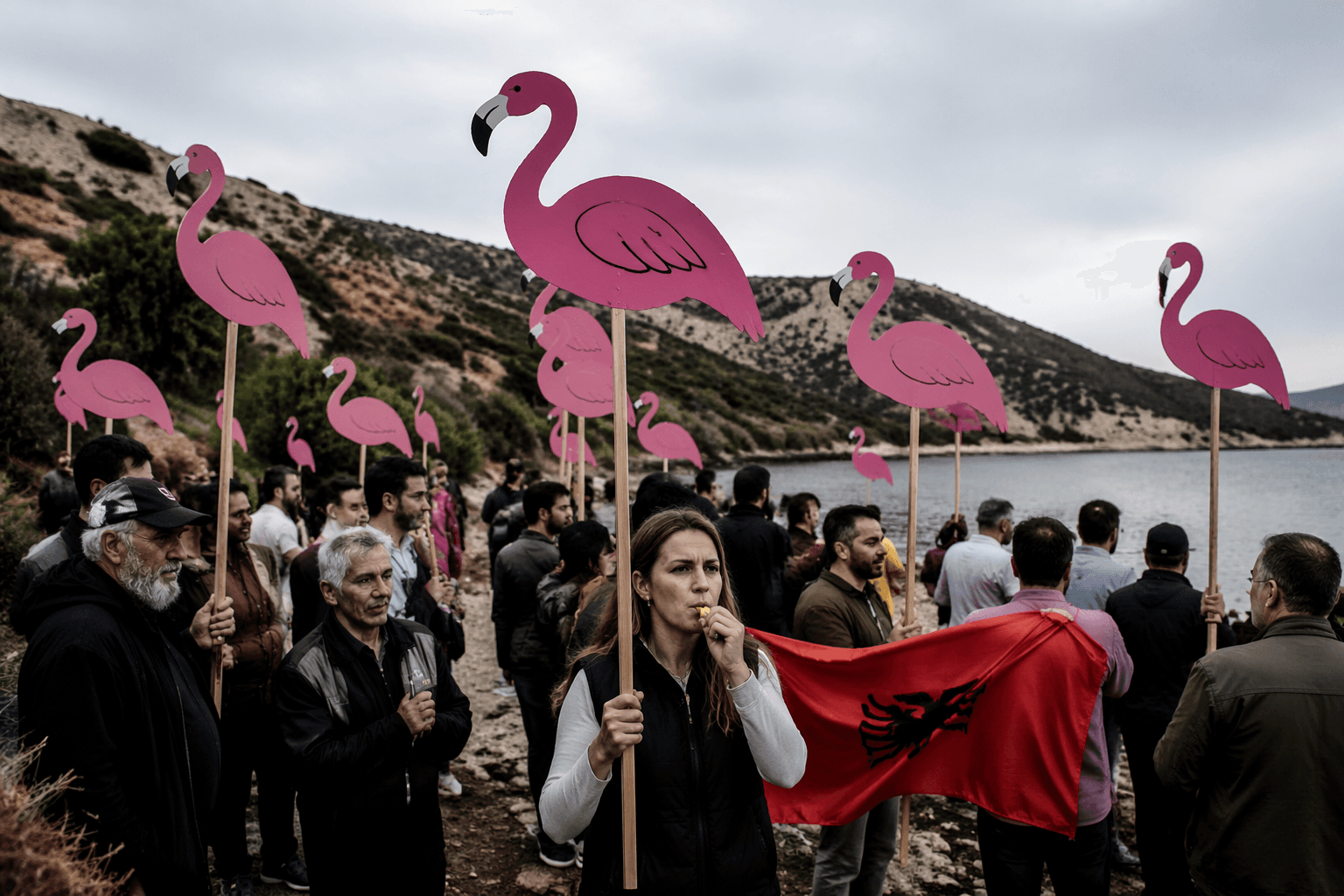
Pink flamingos have become the unlikely face of a widening revolt in Albania, where thousands of people marched in Tirana over a Trump-linked resort plan they say would chew into some of the country’s most sensitive coastal habitat. The birds, carried as cardboard cut-outs through several days of protests in late May and early June, gave a vivid symbol to anger over land, power and the future of Albania’s shoreline.
The project tied to Jared Kushner and Ivanka Trump has two parts: a coastal development in the Vjosa-Narta, also known as Narta Lagoon, protected area and a smaller resort on Sazan Island, a former communist-era military base off the southern coast. Protesters say the site holds flamingo habitat, migratory-bird stopovers, Mediterranean monk seals and sea turtle nesting grounds, making it one of the Adriatic coast’s most fragile ecosystems. The slogan “Albania is not for sale” has driven the demonstrations, which have now hardened into what activists call a flamingo revolution.
Kushner announced plans in 2024, through Affinity Partners, to develop a luxury resort in Albania. The proposal has since been linked to a development that could include up to 10,000 hotel rooms, apartments, villas and a marina. Albanian authorities granted special investor status to a Kushner-linked firm, while the government has framed the scheme as a chance to push Albania into the high-end tourism market and support its bid for European Union membership.
That pitch has collided with deep suspicion about who gets access to prime land and who benefits from political ties. Albania has about 450 kilometers, or 280 miles, of coastline that remained largely underdeveloped during communist rule, and critics say that history has left the country especially vulnerable to opaque deals. In 2024, Albania amended its protected-areas law, opening the door to some tourism development in sensitive zones, and opponents argue that change was tailored to make projects like this possible.
The backlash intensified after footage showed a protester being dragged by a private security guard and after developers began fencing off land and beach access with barbed wire while bringing excavators into the area. Environmental groups in Albania and across Europe have condemned the work, and one local group said long-protected habitats were being irreversibly destroyed.
Prime Minister Edi Rama has defended the plan, saying no final project exists yet and that an environmental assessment is still under way. He has also described the resort as an elite tourism opportunity, a line that has only sharpened criticism from activists, who accuse his government of favoring oligarchic interests and lacking transparency. Albania’s Special Prosecution Office Against Corruption and Organized Crime, known as SPAK, has also opened an inquiry into decisions made in 2024 that changed the legal status of land along the southern coast, including parts of the Vjosa-Narta lagoon and Sazan. As the protests spread, the flamingo has become more than a bird: it has become a warning about sovereignty, corruption fears and the price of selling off the coast.
This article was produced by Prism’s automated news system from verified source data, official records, and press releases, then run through automated quality and moderation checks before publishing. The system is built and supervised by the people who set the standards it runs under. Read our full AI policy.
Did this article answer your question?