Florida Locals Cheer as Artemis II Prepares for Historic Crewed Moon Mission
The first crewed lunar mission in 53 years lifts off today from Kennedy Space Center, carrying a heat-shield fix that will determine whether NASA can put boots on the Moon by 2028.

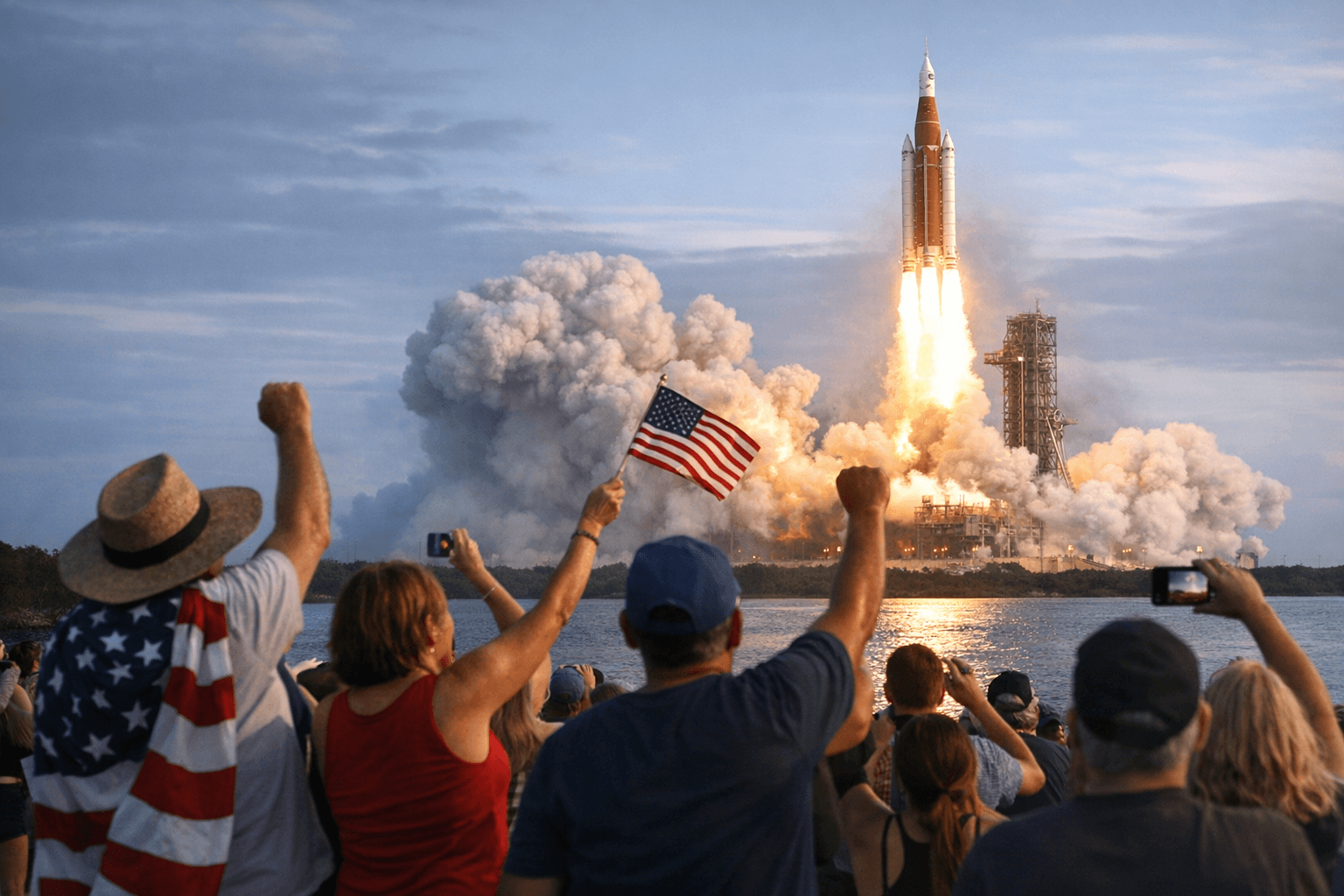
Hundreds of thousands of people lined Florida's Space Coast on Wednesday, waiting for a moment that hasn't come in more than half a century: four astronauts pointed toward the Moon. NASA's Artemis II, scheduled to launch at 6:24 p.m. ET from Kennedy Space Center in Florida, will begin a 10-day journey looping around Earth and the Moon. The Artemis program is years behind schedule and billions of dollars over budget, and tonight's flight is the first real accounting.
"The world is definitely coming to the Space Coast," said Peter Cranis, Executive Director of the Space Coast Office of Tourism. Louise Bergeron traveled from Quebec, Canada, to witness the launch firsthand. "We never see that," she said. "We were very excited. I know there's a lot of people here."
But beneath the celebration lies a mission weighted with technical consequence. Commander Reid Wiseman, Pilot Victor Glover, Mission Specialist Christina Koch, and Mission Specialist Jeremy Hansen of the Canadian Space Agency will travel a 685,000-mile free-return trajectory around the Moon, venturing farther from Earth than any human has ever been. Every system aboard the Orion spacecraft must perform.
The most consequential test may be the one least visible from the bleachers. Following Artemis I, NASA identified unexpected erosion of the Orion heat shield after atmospheric reentry, with portions of the AVCOAT ablative material eroding more extensively than predicted by preflight models. Rather than replacing the heat shield for Artemis II, NASA elected to modify the reentry trajectory by increasing the descent angle, reducing the time the spacecraft would spend in the thermal environment associated with the damage. The updated mission timeline also reflects time to address the Orion environmental control and life support systems, pushing the launch from a September 2025 target to its current April 2026 date.
The SLS rocket, built by Boeing, and the Orion crew capsule, made by Lockheed Martin, which together are taller than the Statue of Liberty, have reportedly required around $44 billion. What that investment buys is not a landing, not yet. Artemis III, now targeting mid-2027, will launch to low Earth orbit for technology tests and demonstrations rather than a surface touchdown. Artemis IV, scheduled for 2028, is now set to mark the first time U.S. astronauts set foot on the Moon since 1972. All of that hinges on Artemis II proving that Orion, with its redesigned reentry profile, can safely carry a crew home from deep space.
The crew itself marks three historic firsts simultaneously. Victor Glover will become the first Black person to travel to the Moon. Christina Koch will become the first woman. Jeremy Hansen will become the first Canadian to fly beyond low Earth orbit. The mission also carries AVATAR, a scientific payload capable of mimicking individual astronaut organs, in its first deep-space test.
The SLS rocket rolled out to Launch Complex 39B on March 19, the same pad complex that launched Apollo missions including Apollo 10. The crew posed at the pad on March 30. Meteorologists tracked a favorable 80% "Go" weather forecast for the April 1 launch date at Kennedy Space Center. Backup windows are available on April 7, 8, 10, and 11 if conditions force a scrub.
No American astronaut has ventured toward the Moon since Apollo 17 in December 1972. When Wiseman, Glover, Koch, and Hansen lift off tonight, they will do so aboard a spacecraft whose heat shield, life support, and reentry guidance were rebuilt after an anomaly that the agency had to disclose, diagnose, and fix before anyone could fly. That chain of accountability, completed over more than three years of delays, is what stands between tonight and the Moon's surface.
This article was produced by Prism’s automated news system from verified source data, official records, and press releases, then run through automated quality and moderation checks before publishing. The system is built and supervised by the people who set the standards it runs under. Read our full AI policy.
Did this article answer your question?

