Florida Measles Outbreak Grows as Health Officials Report Additional Cases
Seven new measles cases pushed Florida's statewide total to 140, with six of those newest infections in Collier County teenagers linked to the Ave Maria University cluster.

Florida's measles count climbed to 140 as of March 14, with seven additional cases disclosed to the Florida Department of Health in the last reporting week, including one case in Broward County. Six of the new cases are in Collier County, in people between the ages of 15 and 19. The seventh involves a Broward County child under age four.
The numbers tell a story of rapid acceleration. Confirmed diagnoses stood at 92 on Feb. 14, then jumped to 114 on Feb. 21, a near 25% rise in a single week, according to the Florida Department of Health's Reportable Diseases Frequency Report. The state has now recorded more measles infections in roughly three months than it did across all of 2024, when 12 cases were confirmed statewide.
More than 100 measles cases have been reported in Collier County alone, with the outbreak concentrated in the 15-to-24 age group, consistent with the cluster at Ave Maria University, though not all cases have been among college students. The outbreak at Ave Maria University, located in southwest Florida's Collier County, infected at least 57 students. Fox News described it as "the largest outbreak on an American college campus in recent history." By Feb. 10, the university posted that "48 nurse-assessed students have progressed beyond the contagious period and now have natural immunity."
The age breakdown is striking. The 140 infections span from birth through the 60-to-64 demographic, but the 15-to-19 age group saw the most reported infections with 59 cases, followed by 20-to-24-year-olds with 45 cases. Of the 114 confirmed infections counted in February, 76 were acquired within Florida rather than linked to travel outside the state, underscoring that the virus is circulating domestically and not simply arriving with travelers.
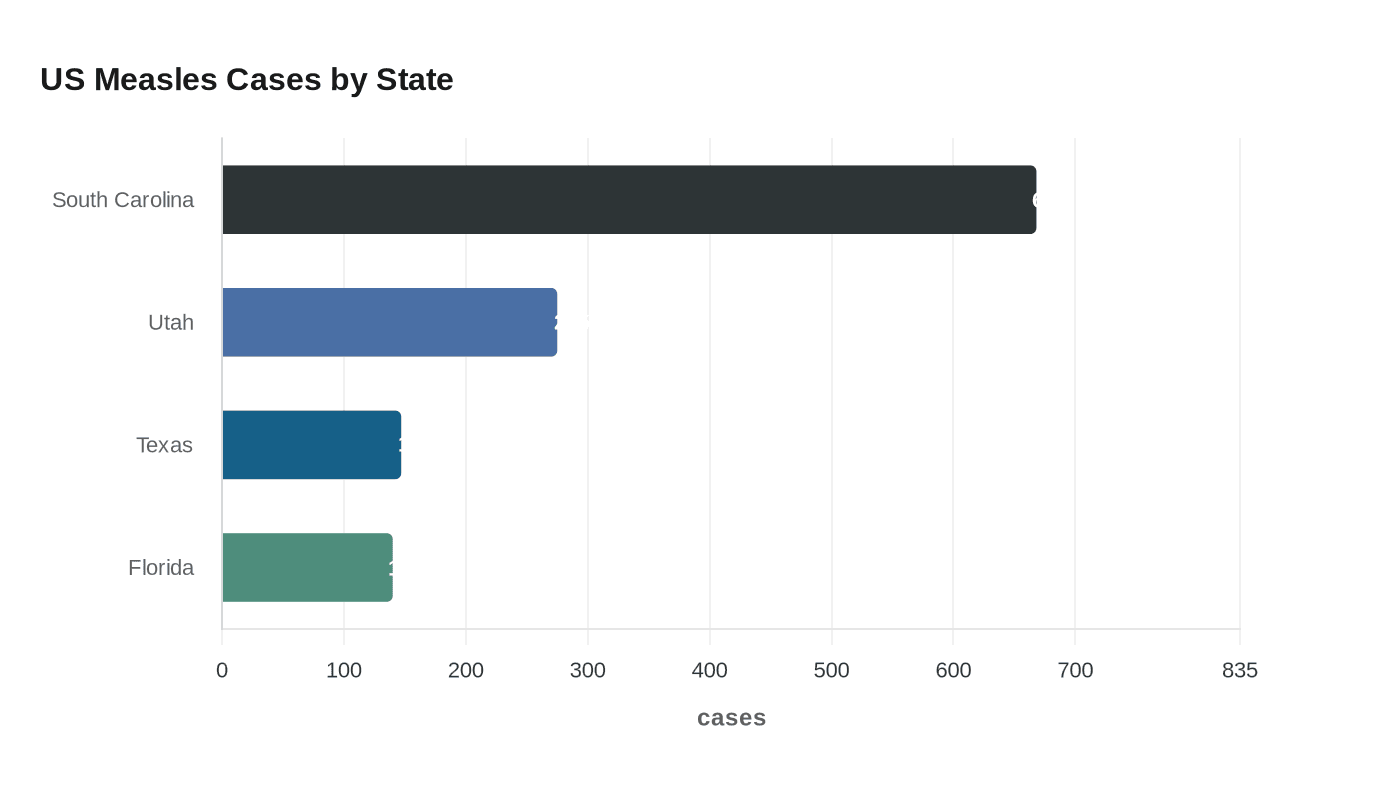
Nationwide, the CDC reported 1,487 measles cases as of March 20, with 74 requiring hospitalization. The majority, 92%, occurred in unvaccinated people, with another 4% in people who were not fully vaccinated. CDC data show Florida ranks fourth in the nation in the number of infections; South Carolina leads with 668 cases, followed by Utah with 275 and Texas with 147.
The surge is arriving alongside a political fight over vaccine policy. The administration of Gov. Ron DeSantis has sought to make it easier for parents to opt out of mandatory school vaccines. While the Legislature declined to endorse DeSantis' proposal in the 2026 session, the governor has said he remains committed to seeing the policy become law before he is term-limited out of office in January.
Clinicians are alarmed. Dr. Mark Toney, a licensed pediatrician and vice president of medical affairs at Wolfson Children's Hospital in Jacksonville, put it plainly: "It is unusual to have cases of measles, period. For us to have little pockets like this is even more unusual." He added that "the most effective way of stopping the spread of measles is to have a high vaccination rate in the community and the population." When vaccination rates fall below roughly 95% of a population, the protective barrier of herd immunity begins to weaken, and Florida's kindergarten measles vaccination rate currently sits at 88.8%, according to the CDC.
The Florida Department of Health in Collier County has stationed staff on Ave Maria University's campus and is offering pre- and post-exposure options for all ages Monday through Friday at its Naples and Immokalee locations. The state's public reporting system does not disclose the vaccination status of individuals who contracted measles, and it remains unclear how many cases outside Collier County are linked to the university cluster versus separate chains of transmission.
South Carolina, Utah, and many other states with far fewer cases than Florida have stood up measles dashboards providing details about case demographics and exposure locations; Florida provides a case count by county with an option to filter by age group, but no additional context, updated once a week. That data gap is itself a public health concern, as the outbreak in the Everglades-adjacent community of Ave Maria continues to test the limits of what Florida residents can actually know about the virus spreading in their neighborhoods.
Know something we missed? Have a correction or additional information?
Submit a Tip