Ford expects $1.3 billion tariff refund, raises full-year guidance
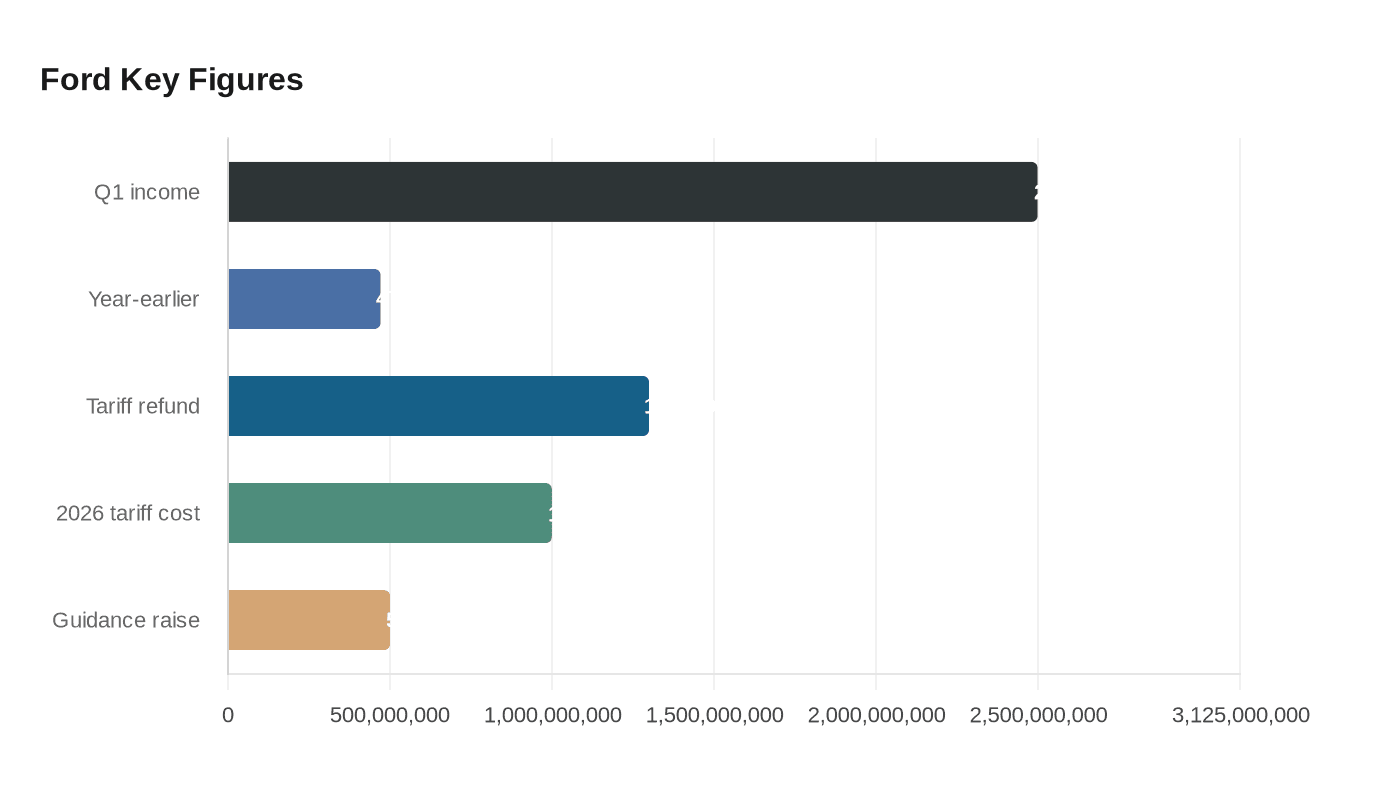
Ford’s profit jumped to $2.5 billion, but $1.3 billion of that lift came from a tariff refund after the Supreme Court struck down some Trump-era duties.
The Dearborn, Michigan automaker’s quarter was boosted as much by a legal reversal as by selling trucks and SUVs. Ford said it expected a $1.3 billion federal refund for tariffs it had paid, and that helped push first-quarter net income to about $2.5 billion from $471 million a year earlier on revenue of roughly $43.3 billion. The company also raised full-year guidance by $500 million.
The tariff money matters because it is not recurring operating strength. Ford said the refund was a one-time benefit and not the only reason results improved. Sherry House said the stronger quarter reflected more than the refund alone, pointing to underlying business performance as Ford leaned on its high-margin large SUVs and F-Series trucks to support retail share. Ford’s April 2 U.S. sales release had already signaled that mix, with big SUVs and F-Series models helping offset broader industry shifts.
Even with the refund, Ford said it still expects about $1 billion in net tariff costs for 2026. That leaves a large policy burden on one of America’s biggest manufacturers, and it shows how trade rules can distort corporate earnings. A profit figure lifted by a court-ordered refund can make the underlying business look stronger than it really is, especially when the same company still faces higher costs for the materials that keep its most profitable vehicles rolling off the line.
Those costs are especially acute in aluminum, a key input for the F-150 pickup, Ford’s most important earnings engine. The automaker said it remains under pressure as it works to source aluminum, even as tariffs that had inflated costs were partially unwound by the Supreme Court’s February ruling striking down some of President Donald Trump’s tariffs. The result is a mixed picture for industrial policy advocates: Ford got relief from one policy shock, but not enough to eliminate the margin squeeze created by the original tariffs.
Ford and Ford Motor Credit Company were scheduled to discuss the quarter at 5 p.m. ET. The numbers suggest the company is still navigating two economies at once, one driven by vehicle demand and another shaped by courtroom-driven tariff reversals.
This article was produced by Prism’s automated news system from verified source data, official records, and press releases, then run through automated quality and moderation checks before publishing. The system is built and supervised by the people who set the standards it runs under. Read our full AI policy.
Did this article answer your question?
%3Amax_bytes(150000)%3Astrip_icc()%2FCertificate-of-deposit-2301f2164ceb4e91b100cb92aa6f868a.jpg&w=1920&q=75)