Foreign Nations Recruit Top U.S. Scientists Amid White House Research Cuts
Canada, France, and the EU have launched billion-dollar programs to recruit U.S. scientists as federal grant terminations wiped out $9.5 billion in NIH research funding.
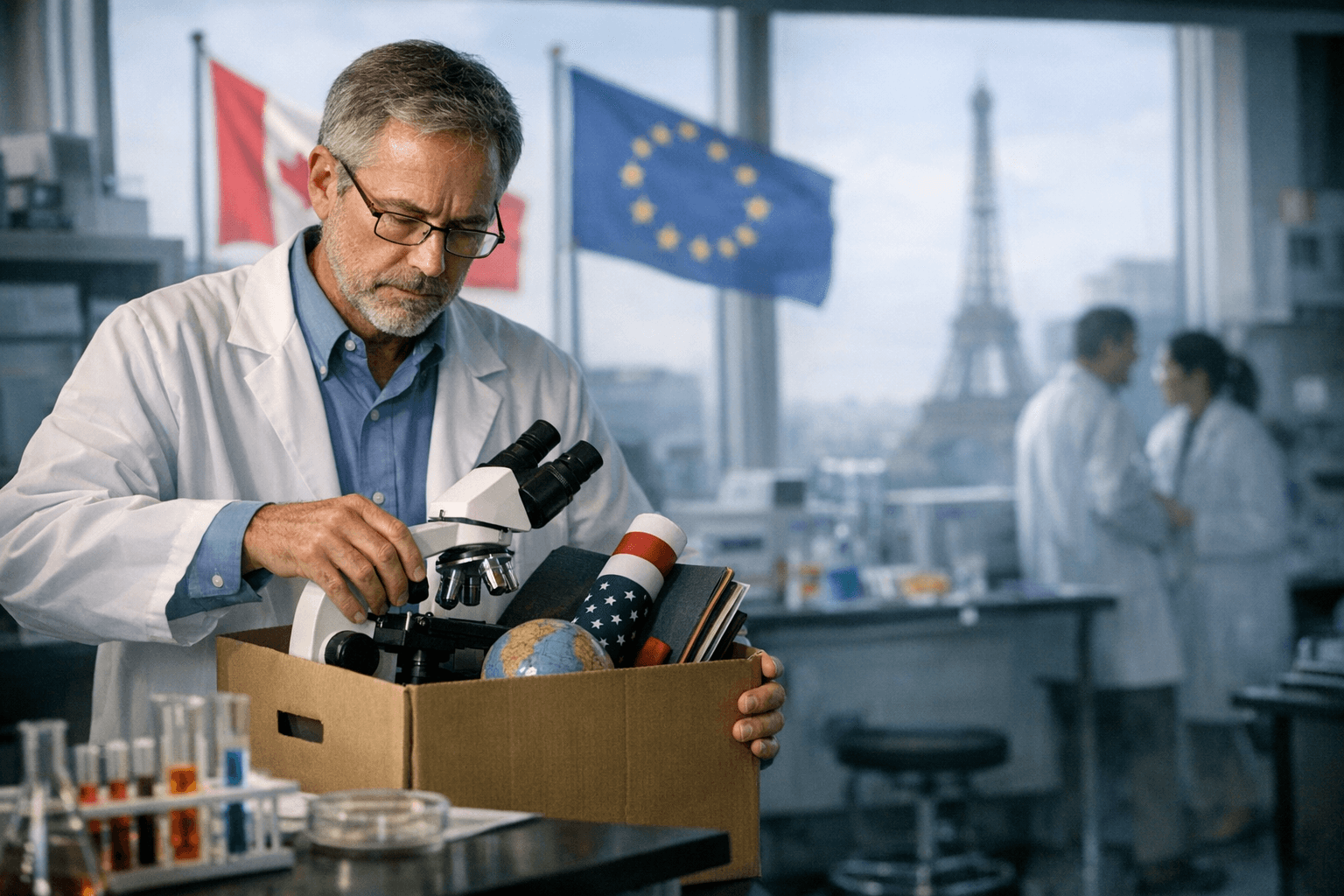
Applications from American scientists to the European Research Council nearly tripled in two years, rising from 60 for the 2024 grant cycle to 169 for 2026, a trajectory that captures, in stark numeric terms, how thoroughly the Trump administration's assault on federal research funding has reshuffled the global competition for scientific talent.
The defections are no accident of circumstance. Foreign governments have moved with deliberate speed to convert Washington's dysfunction into their own competitive advantage. France launched its "Choose France for Science" platform in April 2025, pairing universities with international researchers in health, climate, digital technology, and space. Aix Marseille University separately committed €15 million over three years to its "Safe Place for Science" scheme, which was flooded with applicants almost immediately after its March 2025 announcement. "We are witnessing a new brain drain," said Éric Berton, the university's president. "We will do everything in our power to help as many scientists as possible continue their research. However, we cannot meet all demands on our own."
The European Union matched that ambition at scale. In May 2025, European Commission President Ursula von der Leyen, appearing alongside French President Emmanuel Macron at the Sorbonne, announced a $565 million program explicitly designed to make "Europe a magnet for researchers." The Netherlands simultaneously opened its own fund for displaced American scientists, while South Korea and Ireland rolled out targeted recruitment for early-career researchers, the cohort that represents the longest-term loss to U.S. competitiveness.
Canada mounted perhaps the most systematic offensive. Its 2025 budget allocated CA$1.7 billion, roughly $1.2 billion in U.S. dollars, for the Canada Global Impact+ Research Talent Initiative, a 12-year plan to bring 1,000 leading researchers north. The centrepiece, the Canada Impact+ Research Chairs program, earmarked $1 billion for 100 new university research chairs. A companion program, the Canada Impact+ Research Training Awards, added $133.6 million to pull in doctoral students and postdoctoral researchers before they even reach the stage of running their own labs. China, Australia, and Germany have been aggressively recruiting as well, offering funded laboratories, relocation packages, and streamlined visas.
The supply of talent available for that recruitment is enormous. A Nature survey of more than 1,600 U.S.-based scientists found that 75 percent were considering leaving the country. The magazine's own job board showed that American scientists submitted 32 percent more applications for positions abroad between January and March 2025 than in the same period a year earlier. International student enrollment on U.S. campuses fell 17 percent in fall 2025, thinning the pipeline that replenishes research labs a generation into the future.
What drove them to that point was a systematic dismantling of federal science funding. Across 2025, the Trump administration cancelled or suspended more than 7,800 grants from the National Institutes of Health and the National Science Foundation, with NIH alone terminating roughly 2,100 grants worth approximately $9.5 billion by June of that year. The cuts disproportionately eliminated research on infectious disease, vaccine hesitancy, and studies involving populations defined by race or gender. A STAT survey of nearly 1,000 NIH-funded researchers found that more than a quarter had already laid off laboratory staff, more than two in five had cancelled planned experiments, and two-thirds had advised their students to consider careers outside academia altogether.
Kristin Weinstein, a PhD candidate at the University of Washington studying cancer and autoimmunity, told CBS News she and her family were weighing a move to Europe or Canada. Her situation is representative of researchers at every career stage. The fields most exposed, biomedical science, climate research, and infectious disease, are precisely the ones where American leadership has historically translated into patents, therapies, and public health infrastructure. Every senior researcher who accepts a chair in Toronto or Marseille takes with them graduate students, institutional knowledge, and grant-writing capacity that may take a decade to rebuild domestically. The countries now spending billions to recruit them are betting that the United States will not reckon with that cost until the ledger is already settled abroad.
This article was produced by Prism’s automated news system from verified source data, official records, and press releases, then run through automated quality and moderation checks before publishing. The system is built and supervised by the people who set the standards it runs under. Read our full AI policy.
Did this article answer your question?

