Former Marine Warns U.S. Military Must Adapt to Rapidly Advancing Drone Warfare
Former Marine colonel Mark Cancian warns the U.S. military isn't built for the rapid-cycle drone adaptation reshaping wars from Ukraine to the Middle East.

Drone designs in Ukraine change every few weeks. The U.S. military changes them over years. That gap, retired Marine colonel Mark Cancian argues, is the central problem American defense planners have yet to solve.
"There's a broader issue for all of these small drones particularly, which is adaptation," said Cancian, a senior adviser with the Center for Strategic and International Studies Defense and Security Department. "Ukrainians say that they change the design every couple of weeks as the Russians implement countermeasures. That is something the U.S. military is not used to."
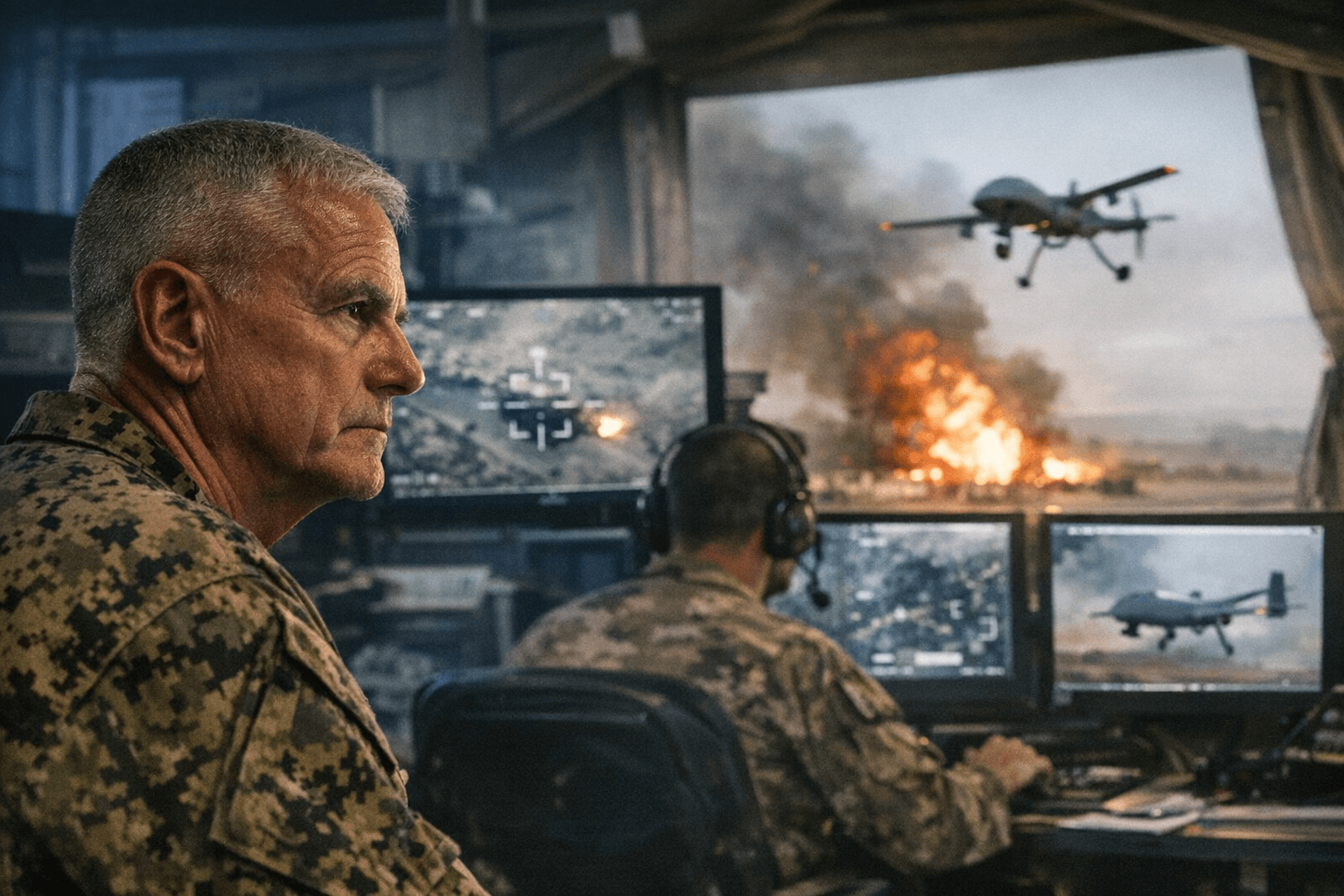
The warning carries particular urgency given the current operational environment. Iran is launching deadly drone strikes on U.S. forces and allies in the Middle East, and the same weapons have been used for years in Ukraine, where drones have transformed warfare. What began as a battlefield novelty has become the defining technology of peer and near-peer conflict, and adversaries are not waiting for Washington to catch up.
Chinese tech companies have developed and deployed a wide range of maritime drones, including surface vessels, autonomous submarines, and research drones, extending the threat beyond land battlefields into contested waterways. On the U.S. side, General Atomics is developing a new line of drones designed to fly into combat alongside traditional fighter aircraft, a concept known as collaborative combat that would pair autonomous systems with crewed jets like the F-22 and F-35 to expand firepower on a single sortie.
But hardware development alone will not close the gap Cancian identifies. The problem is structural. During wartime, he noted, the connection between developer, manufacturer, and the front lines needs to be extremely close, a model the U.S. military's acquisition system was not designed to sustain. The Pentagon must embrace technological change and incorporate it into recruitment, training, and strategies, a shift that cuts across how the military selects people, teaches them, and plans for conflict.
The policy remedies extend beyond the Defense Department. Congress needs to expand funding for research and development into technologies with military applications. The administration should end what critics describe as a self-defeating posture toward universities and return to long-term, open-ended investment through grants for research and development. Private industry's bets on nascent technologies, including autonomous drones, should be expanded.
Export controls represent another pressure point. Advanced artificial intelligence chips must be kept from reaching adversarial nations, yet a decision announced Dec. 8 to allow the sale of some of the world's most powerful chips to China drew sharp criticism from defense analysts and security observers who called it a strategic mistake that undercuts the very export discipline the U.S. needs to maintain technological leverage.
The stakes of inaction extend beyond any single theater. Deterrence alone is often not enough to prevent the catastrophic use of new weapons, as 20th-century conflicts repeatedly demonstrated. Keeping pace in these 21st-century arms races will require political will and national coordination between the public and private sectors and research institutions, and eventually, negotiated treaties to limit how and where these weapons are used. The world, Cancian and others warn, is already behind.
Know something we missed? Have a correction or additional information?
Submit a Tip